

Jie Lu: five cells, two back each pair
Content version · · Sources & references
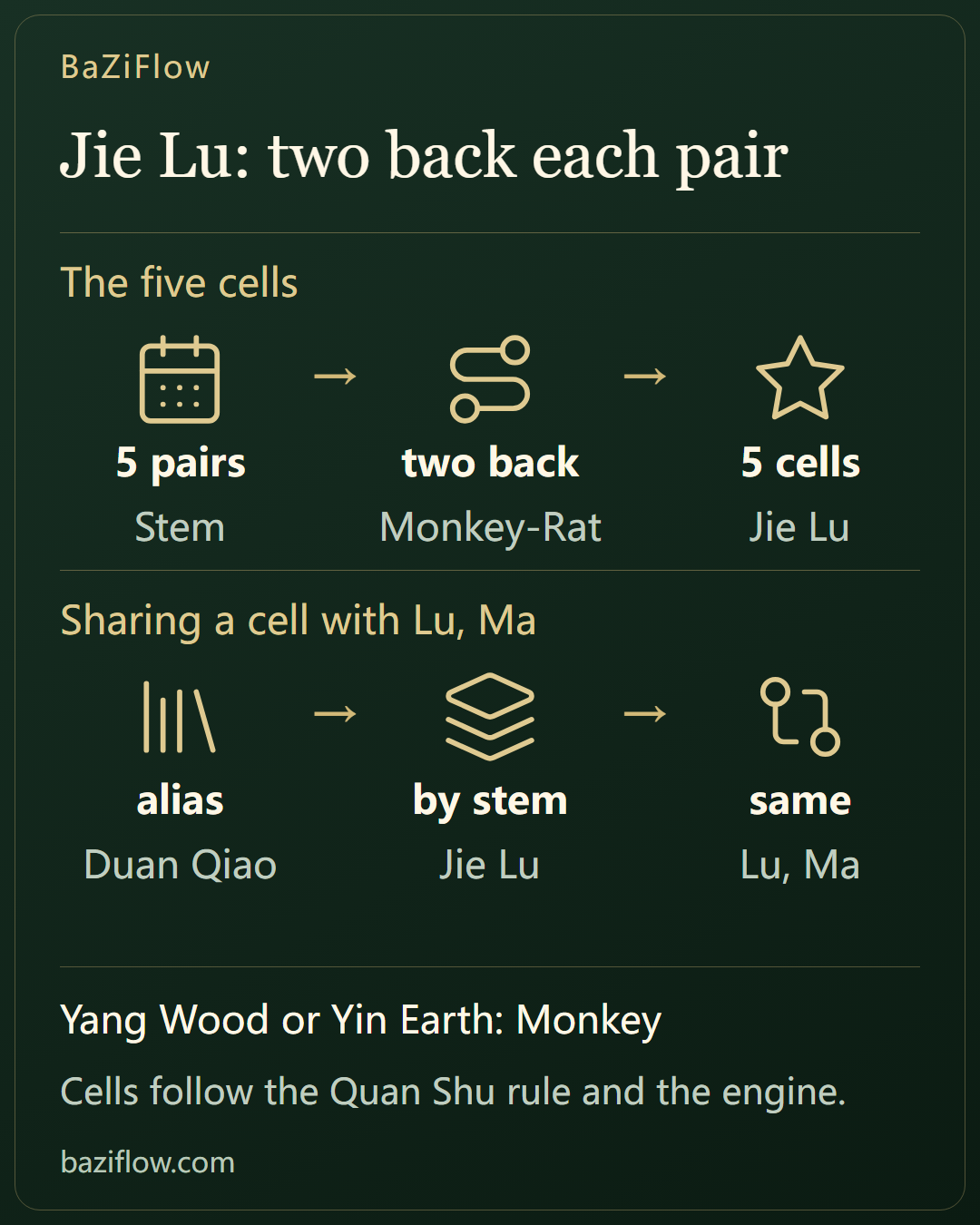
Jie Lu is placed by the birth-year stem and lands only on Rat, Tiger, Dragon, Horse or Monkey. A stem-and-year table, two book lines pairing it with Lu Cun and Tian Ma, and a same-cell count keep it apart from Duan Qiao.
The short version6 min read
Jie Lu is a minor star placed by the birth-year stem: the ten stems form five pairs and the star has only five landing cells, Rat, Tiger, Dragon, Horse and Monkey, stepping two cells back with each pair from the Monkey cell of Yang Wood and Yin Earth.
- Jie Lu reads the year stem, never the year branch; across the sixty pillars each of its five cells (Monkey, Horse, Dragon, Tiger, Rat) is taken twelve times, one cell per stem pair.
- In the book, "broken bridge" (断桥) is an alias given within the Tian Kong entry, and that Tian Kong is placed by hour; Jie Lu is the first cell of the rule named "Jie Lu Kong Wang", and the two names merely sit side by side in one ode.
- Of the sixty year pillars, Jie Lu shares a cell with Lu Cun in 6 (all Yin Water years) and with Tian Ma in 6 (three Yang Wood and three Yang Water pillars); this is a same-cell count, not the book's "meeting".
Read first
What do Zi Wei's supporting, malefic and minor stars actually do? ↗
The broken bridge first, then Jie Lu
The four characters "broken bridge, Jie Lu" appear side by side in an ode in juan 1 of the Quan Shu (紫微斗数全书). They are two names, though: "broken bridge" (断桥, Duan Qiao) is an alias the book gives to Tian Kong, while Jie Lu (截路) is a minor star the site places by the year stem, with only five places to land.
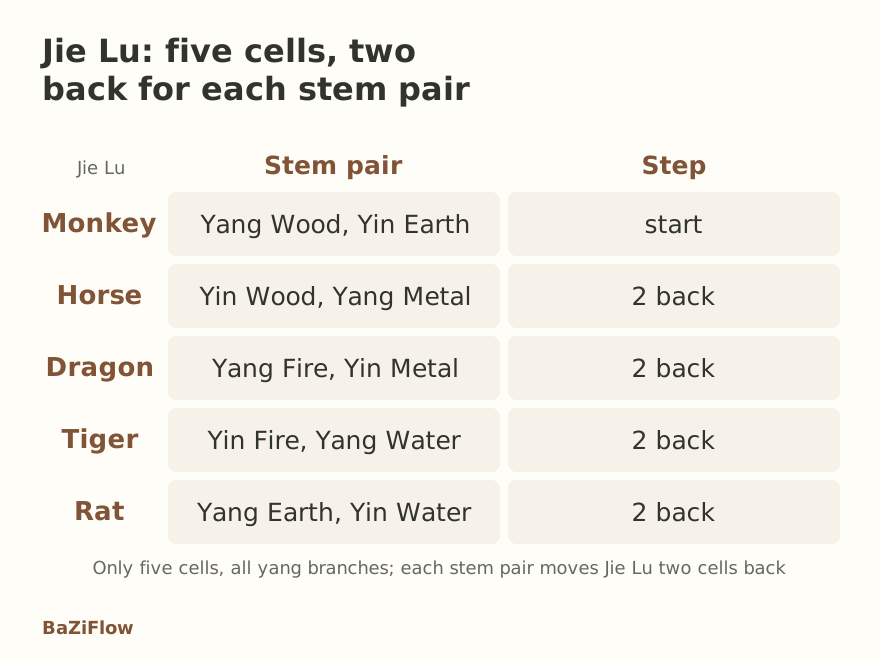
The ring lists the twelve branches; the green cells are the five where Jie Lu lands, each with its stem pair. Cells follow the juan 2 rule and were checked pillar by pillar.
The five green cells in the picture are every place Jie Lu can be. Monkey goes with Yang Wood and Yin Earth years, Horse with Yin Wood and Yang Metal, Dragon with Yang Fire and Yin Metal, Tiger with Yin Fire and Yang Water, and Rat with Yang Earth and Yin Water; the arcs run from Monkey to Rat and each stem pair moves two cells back.
Enlarge diagram · scroll sideways to read
Where the Tian Kong in question comes from is explained in the Tian Kong article.
Five cells, two back with each stem pair
Take the stem number modulo five and you have its pair: Yang Wood and Yin Earth leave the same remainder, and so do Yin Wood and Yang Metal. Both stems of a pair land on the same cell, and with each step of the pair number the cell moves two back. The table also lists the first three years from 1984 on in which each stem appears:
Enlarge diagram · scroll sideways to read
Each stem comes round six times in sixty years, and whichever branch it pairs with, Jie Lu stays in the same cell. Among the sixty pillars each of the five cells holds twelve, with no cell richer or poorer than the others.
Where the book sets it beside Lu and Horse
The Tian Ma entry in juan 3 has a line that lists Jie Lu among the things Lu and Ma should avoid:
Lu and Horse most enjoy galloping together; they should avoid meeting Sha (杀), Yang (羊) and Huo (火), or Jie Lu and Kong Wang.
The Tian Ma entry in juan 2 has a line in the same direction, "best when meeting Lu Cun, most to be avoided: Jie Lu and Kong Wang". The book writes Jie Lu in one breath with Lu Cun (禄存) and Tian Ma (天马), and the engine can count in which year pillars they share a cell:
Enlarge diagram · scroll sideways to read
Same pillar, a new palace name with each Life palace
Same stem, same cell; what the table varies is the Life palace. Three year pillars are each cast twice, once with Life at Tiger and once with Life at Horse:
Enlarge diagram · scroll sideways to read
The first row for Ding Mao deserves a second look: Jie Lu lands on the Life palace only because the Life branch happens to be Tiger; the position did not step aside for the Life palace and did not move because of it.
Three checks before writing down a Jie Lu
Find the pair of the year stem
Each stem pair owns one cell: Monkey (Yang Wood, Yin Earth), Horse (Yin Wood, Yang Metal), Dragon (Yang Fire, Yin Metal), Tiger (Yin Fire, Yang Water), Rat (Yang Earth, Yin Water); the year branch is never consulted.
Keep it apart from the broken bridge
The book's broken bridge means Tian Kong, placed by hour; the site's Jie Lu is placed by year stem, and a note records them separately.
A shared cell is only a count
Year pillars in which it shares a cell with Lu Cun or Tian Ma can be listed, but should not be written up as "Lu cut off" or "the Horse stopped".
Two small sums
Born in a Yi Wei (乙未) year: which branch holds Jie Lu?
Yin Wood pairs with Yang Metal and the cell is Horse, so Jie Lu sits at Horse.
Born in a Ren Zi (壬子) year: does Jie Lu share a cell with Tian Ma?
In a Yang Water year Jie Lu is at Tiger, and in a Rat year Tian Ma is also at Tiger, so they share a cell.
The cell right after Jie Lu in the same rule is Kong Wang, the void counted by decade is Xun Kong, and the minor stars as a family begin at supporting, malefic and minor stars.
Questions readers ask next
Are the four characters "Duan Qiao Jie Lu" about one star?
No. "Broken bridge" is an alias the book gives to Tian Kong, while Jie Lu is another star; the two names merely stand side by side in a line of verse. The book's Tian Kong is placed by hour and the engine's Jie Lu by year stem, so the inputs differ.
I was born in a Yang Wood year. Why is Jie Lu at Monkey, and why is the year branch ignored?
In the engine Jie Lu uses only the stem: Yang Wood and Yin Earth form a pair that lands at Monkey, Yin Wood and Yang Metal a pair that lands at Horse. The branch does not change the position, so all six pillars of one stem put Jie Lu in one cell.
What does it mean when Jie Lu falls on the Life palace?
Only a coincidence of position: some branch happens to be this chart's Life palace and Jie Lu lands on it, so the palace name reads Life. A 1987 Ding Mao chart with Life at Tiger is like that, and the same Tiger cell is called Wealth on a chart with Life at Horse.
Was this article helpful?
Sources & references
Continue reading
Kong Wang (空亡): The Second Cell of a Stem Pair, and the Word the Book Uses as a Catch-All ↗
Xun Kong (旬空): Two Voids per Decade, the Engine Takes One by Yin and Yang ↗
Tian Kong (天空): One Cell After the Birth Year, and Not the Book's Hour-Based "Tian Kong" ↗