

Career readings: compare claims with the work
Content version · · Sources & references
Use a documentation sample to separate preferences, demonstrated work and role requirements while retaining the distinct objects of three interpretive systems.
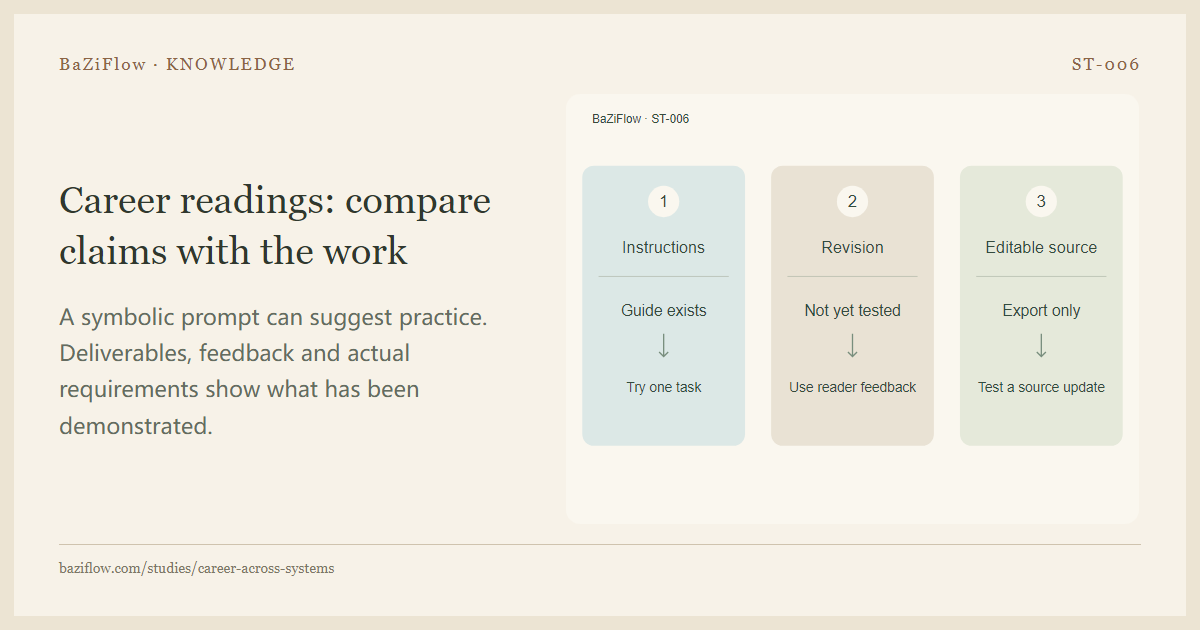
A symbolic prompt can suggest practice. Deliverables, feedback and actual requirements show what has been demonstrated.
Read first
Begin with the deliverable, not the career adjective
A person considering a documentation role has a polished two-page guide. In a fictional vacancy brief, the role also requires revising instructions after user feedback and maintaining the source file. The guide looks clear, but no one has yet tried following it, and the editable source is missing. “Good with communication” cannot settle either gap.
This is a useful starting point for comparing career-themed readings. Ask what the work requires, what has actually been demonstrated and which part of the situation remains unknown. A symbolic description may suggest a question worth exploring, but it is not a work sample, an employer's requirement or a response from a reader.
This exercise compares Zi Wei, Western astrology and tarot as different interpretive entry points. No chart is calculated for the applicant, and no placement is assigned to the proposed occupation. The exercise is about preserving the type of evidence behind a statement, not building a combined job-matching score.
The two-page guide is a concrete object that can be examined. Its attractive presentation does not establish that its instructions work, and a successful first use would not establish that future revisions will be easy. Break the sample into the requirements that the fictional brief actually named.
| Requirement | Material currently available | A bounded next check |
|---|---|---|
| Clear instructions | A finished two-page guide | Ask an appropriate reader to follow one task |
| Revision after feedback | No revision record yet | Make one documented change after the trial |
| Maintainable source | Only an exported copy | Rebuild or locate the editable file and test an update |
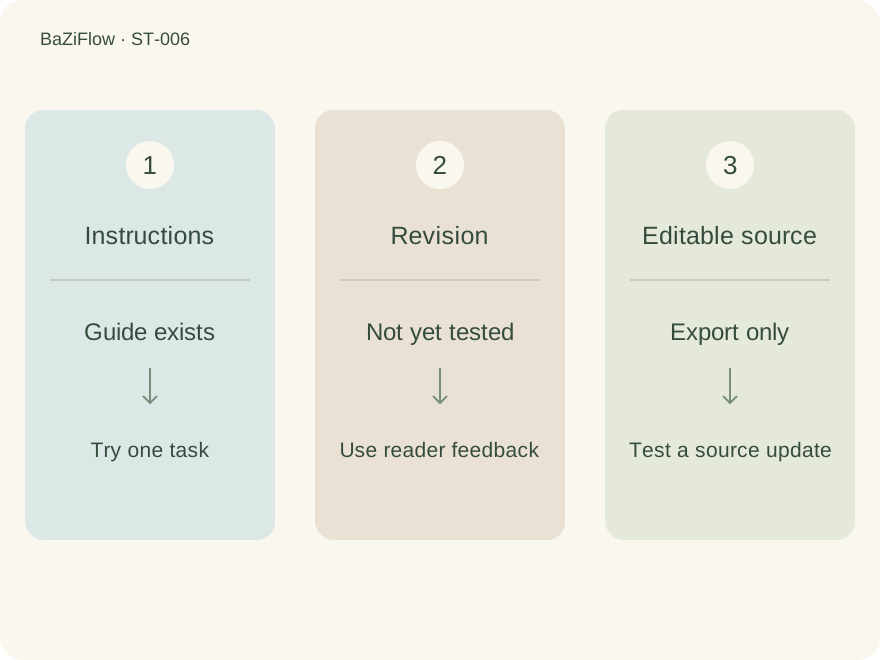
Original fictional task checks, not a complete occupational standard or a suitability score.
If the reader becomes stuck at step three, that observation concerns the guide and the task being attempted. It does not establish a permanent communication weakness. If the revision resolves the difficulty, record the specific change rather than converting it into proof of a favourable chart description. The applicant may still need practice with other documents, tools or audiences.
This keeps both strengths and limits visible. A finished guide is a real achievement even when the source file is missing. A missing source file is a real limitation even when the prose is excellent. Neither fact needs to be cancelled by a broad judgement about occupational suitability.
Add occupational information without importing a verdict
The US Bureau of Labor Statistics structures its Occupational Outlook Handbook around matters such as duties, work environment and preparation for entry. That is a useful example of the categories a person can investigate. Its scope is the United States, and a general occupational profile is not the same document as a particular employer's vacancy brief. No current pay or growth figure is being used here.
For the documentation example, the named deliverables in the actual brief would determine what sample to prepare. Requirements that are unclear should be checked with the relevant organisation. Local training or credential conditions also need their own appropriate sources; a symbolic interpretation cannot fill an unanswered eligibility question.
Preferences belong in the record as well. The applicant may enjoy explanatory writing but dislike frequent meetings, or enjoy revising a text while finding the software unfamiliar. Those observations can coexist. Collapsing them into “suited” or “unsuited” removes the distinctions that would help compare real roles.
A single trial also has a limited time scope. It gives information about this document, task and reader. It does not establish an entire career trajectory, and a long-term symbolic reading does not excuse skipping a present requirement. Compare like questions before treating two reports as agreeing or disagreeing.
Finish with a small, reviewable experiment
For this applicant, the next experiment could be one reader trial, one revision and one test of updating the editable source. Save the original, the feedback and the revised version. The result may show progress, a remaining difficulty or an additional question. None of those outcomes needs to be presented as a test of destiny or a guarantee of employment.
If several readings merely recommend practice, combine them into one reminder. If they suggest genuinely different questions, give each question its own evidence requirement. Continue with turning tarot career questions into action for reflective prompts, or complementary and repetitive readings for checking whether a second report adds anything. The useful output is a better-defined task and a more honest account of what is known, not a profession assigned by accumulating labels.
Keep the symbolic structures in their own languages
The second volume of the Zi Wei Dou Shu Quan Shu discusses stars in palaces and their relations. A reading drawing on that tradition should preserve its actual palace and star references and the method used; the palace-by-palace view is in which palaces bear on career. The fact that an interpretation concerns work does not make every statement about work a palace observation.
In Lilly's seventeenth-century discussion of houses, the tenth includes office, honour and a person's profession or trade. This is a historical topic assignment. It is not a conversion between a Western house and a Zi Wei palace, nor a claim that either directly measures the applicant's writing skill. A shared English heading such as “career” can conceal different underlying objects.
Waite's description of the Eight of Pentacles concerns work and craft, including preparation. In a reflective reading it might prompt a question about practice. The card does not certify that the person has acquired the skill depicted. A prompt to revise the guide can be useful while the quality of that revision remains something to inspect separately.
These sources are used for their particular interpretive objects, not to validate an occupational forecast. If a report omits the configuration, card or question on which it rests, retain that omission in the comparison. Do not invent an astrological explanation for the guide's missing source file after discovering the problem.