

Six Harmony, Three Harmony and Directional Assemblies
Content version · · Sources & references
Rabbit–Dog, Pig–Rabbit–Goat and Tiger–Rabbit–Dragon share a branch but belong to different structures. Compare their membership rules before asking whether a combination forms or transforms.
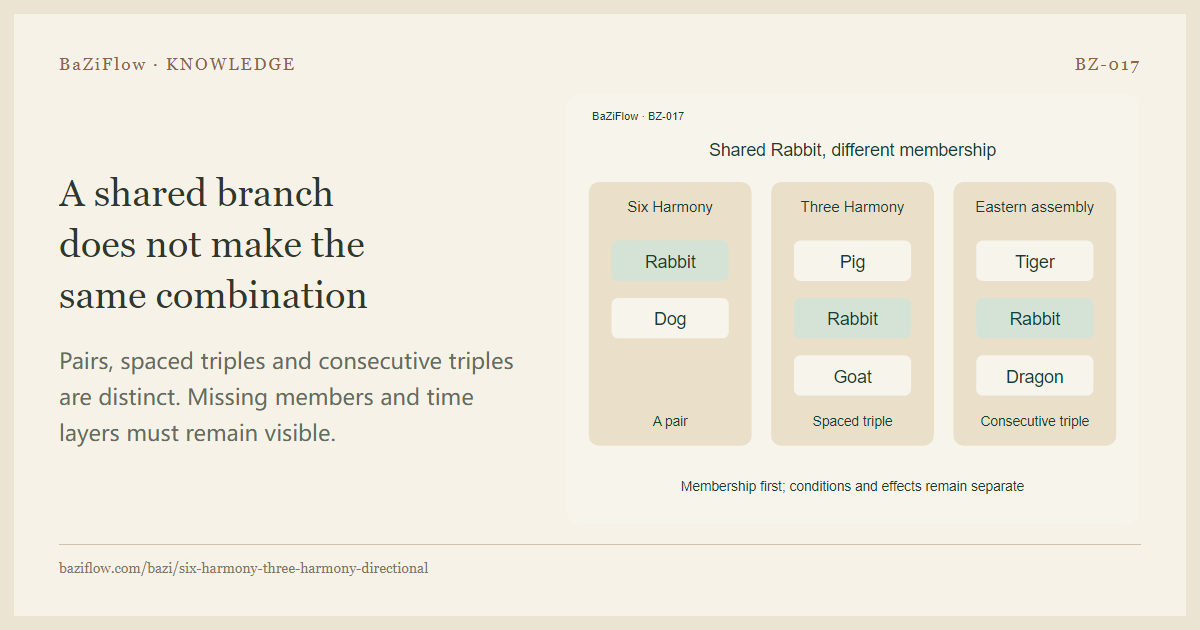
Pairs, spaced triples and consecutive triples are distinct. Missing members and time layers must remain visible.
Read first
What the ten stems and twelve branches each do ↗
Five Elements cycles: learn the relationships, not just the order ↗
Find the missing member before judging a group
A record contains Pig and Rabbit. Someone calls it a complete Wood Three Harmony group. The first question is simple: where is Goat? It has not been supplied. A term such as half-combination, where a method uses one, does not make an absent branch present in the original record.
Now add Goat in an annual field. The comparison contains all three names across two time layers, but the natal record has not acquired another branch. Add Goat from another person's chart instead and ownership changes as well. Before interpreting a group, decide which chart and time layers the claim refers to. Otherwise a correct list can be attached to an incorrect record.
San Ming Tong Hui, volume 2, explicitly distinguishes a full triple from one lacking a member when discussing Three Harmony transformation. Full membership is therefore a question worth answering accurately. It is still not, by itself, proof that a transformation is effective or beneficial in a particular chart.
Three names describe three ways of grouping branches
Six Harmony uses six pairs: Rat–Ox, Tiger–Pig, Rabbit–Dog, Dragon–Rooster, Snake–Monkey and Horse–Goat. “Six” counts the pairs; it does not require six branches to establish one pair. Every branch appears once in that pairing list.
Three Harmony uses spaced triples. Directional assemblies, often called Three Meetings in modern teaching, use consecutive triples. Their complete memberships are:
| Structure | Members | Usual phase or direction |
|---|---|---|
| Three Harmony | Monkey, Rat, Dragon | Water |
| Three Harmony | Pig, Rabbit, Goat | Wood |
| Three Harmony | Tiger, Horse, Dog | Fire |
| Three Harmony | Snake, Rooster, Ox | Metal |
| Directional assembly | Tiger, Rabbit, Dragon | East / Wood |
| Directional assembly | Snake, Horse, Goat | South / Fire |
| Directional assembly | Monkey, Rooster, Dog | West / Metal |
| Directional assembly | Pig, Rat, Ox | North / Water |
The spacing can be checked on the twelve-branch cycle. Move from Monkey through Rooster, Dog and Pig to Rat: four steps. Rat to Dragon takes another four, and Dragon back to Monkey another four. The traditional explanation associates the triple with generation, culmination and storage. A directional assembly instead takes three adjacent branches associated with one seasonal direction.
Each family of four triples accounts for twelve entries, but the grouping procedure differs. The arithmetic checks membership only. It gives no numerical strength, priority or event prediction.
Use Rabbit to see why overlap matters
Rabbit belongs to the Rabbit–Dog pair, the Pig–Rabbit–Goat triple and the Tiger–Rabbit–Dragon directional assembly. The diagram puts those three structures next to each other so that their different requirements remain visible.
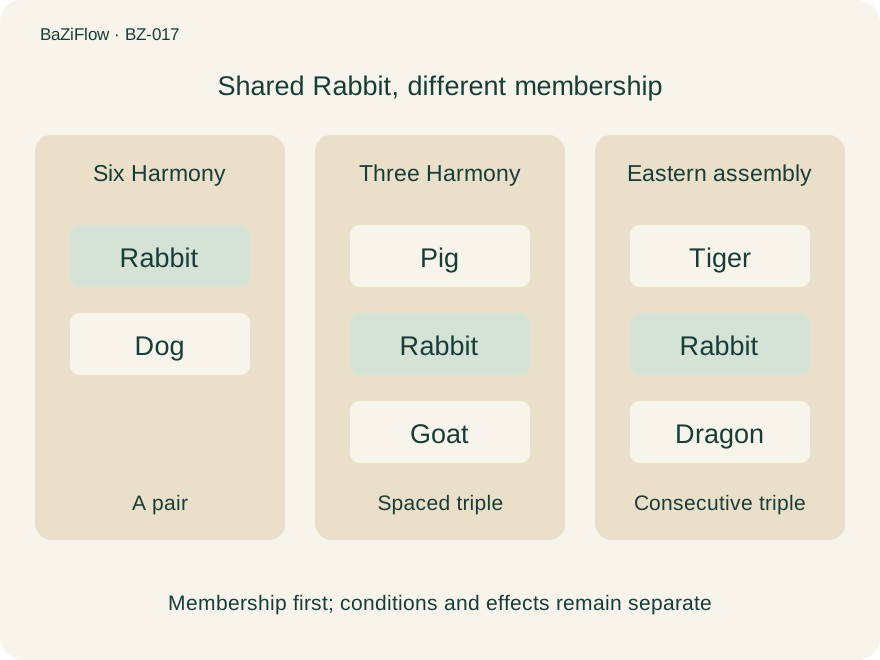
Original BaZiFlow membership comparison; recognising a group does not automatically establish transformation or an outcome.
A note saying only “Rabbit combines” cannot tell the reader which structure was identified. List the other members. If several candidate groups share the same Rabbit, also mark that shared input. Three connecting lines do not create three independent copies of a branch's contribution.
This is why stacking a favourable paragraph for each detected group is not a deeper interpretation. The analysis must explain how its method handles the overlap. A blanket ranking that always places directional assemblies above Three Harmony and Six Harmony omits the seasonal, positional and other conditions that may matter.
Read the source's distinction before modernising its name
Volume 2 of San Ming Tong Hui discusses Six Harmony and Three Harmony separately. The directional-pattern passage in Di Tian Sui distinguishes the Tiger–Rabbit–Dragon eastern grouping from the Pig–Rabbit–Goat Wood grouping, then considers mixtures of the two. Its accompanying commentary shows that more same-phase membership is not automatically treated as better.
Modern teaching commonly labels the directional grouping Three Meetings. That does not mean every historical occurrence of “meeting” names this exact structure. Preserve the passage's context when matching older terminology to an introductory table.
The four Earth branches require a similar caution. The cited Three Harmony discussion separately mentions all four Earth branches as an Earth grouping. Four members do not become a fifth three-member triple merely because both descriptions use the word “group.” Nor does the membership table here settle different assignments of transformation phases to Six Harmony pairs. Those require their own specified rules.
Write a record that another reader can check
For the opening Pig–Rabbit example, record the two natal members and the missing Goat. If an annual Goat is later considered, add its time label instead of rewriting the natal record. If a particular method then discusses a partial combination or a completed group across layers, retain that method and its conditions beside the membership facts.
Use explicit branch fields, not matching characters inside ordinary prose. Keep positions, ownership and unresolved entries visible. This separates an error in reading the data from a disagreement about interpreting correctly identified data.
The next comparison, stem combinations and transformation, concerns a different family of pairs. Clash, punishment, harm and destruction applies the same distinction between identifying a relationship and judging its role, without treating a name as an outcome.