

Ten of Pentacles: a family under the arch
Content version · · Sources & references
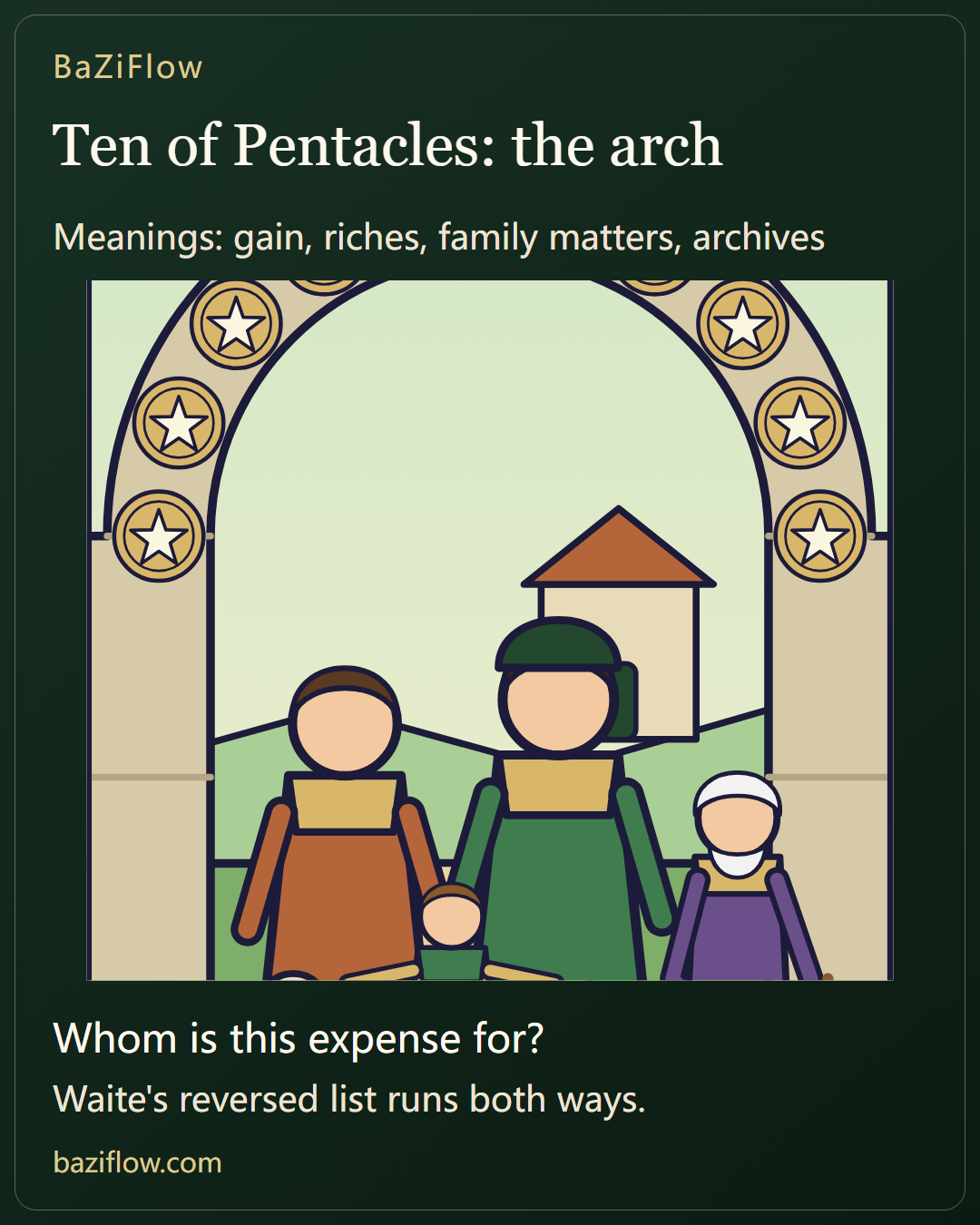
The Ten of Pentacles shows a family beneath an arch, with an old man and two dogs in front. Read the picture, the word list and the extras apart, then sort a household budget by person and keep a monthly copy.
The short version6 min read
The Ten of Pentacles has an arch with a family beneath it and an elder seated in front. Waite's list circles the household: gain, yes, but also family matters, archives and extraction.
- In the picture a man and woman stand under an arch that gives entrance to a house and domain, while a child looks curiously at two dogs near an ancient personage, a hand resting on one of them.
- The upright list pairs gain and riches with family matters, archives and extraction; the reversed list begins with chance and loss and ends on "sometimes gift, dowry, pension".
- The extras say it stands for a dwelling whose value comes from other cards; reversed, an occasion which may be fortunate or otherwise.
Read first
Start with the picture: a family under an arch, an elder and two dogs in front
Waite's description runs as follows. A man and woman stand beneath an archway which gives entrance to a house and domain. They are accompanied by a child, who looks curiously at two dogs accosting an ancient personage seated in the foreground, and the child's hand is on one of them.
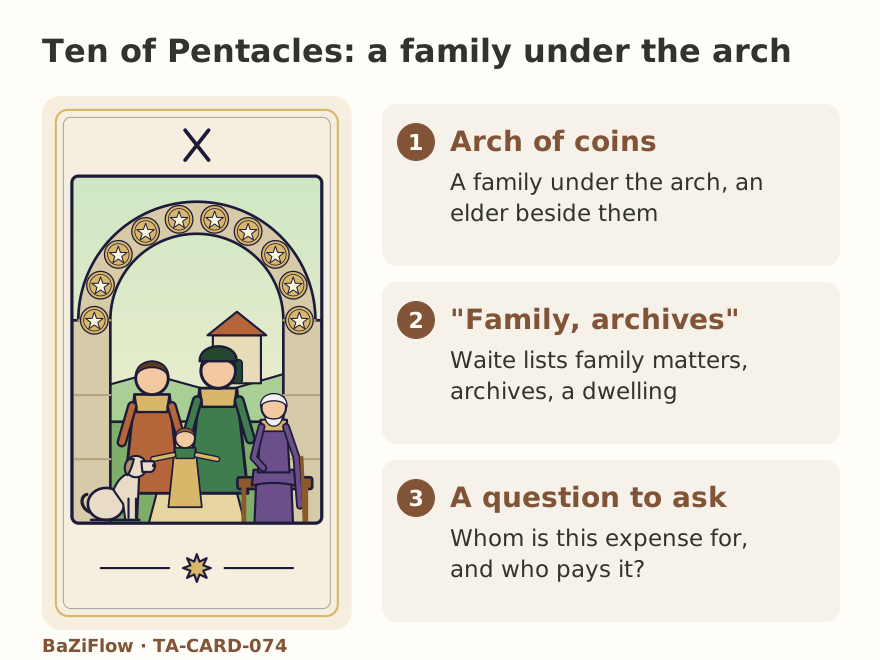
BaZiFlow original Ten of Pentacles: a family under the arch
In the RWS original the arch is gray stone with the vault pressing down from above; through it a tower and a red-roofed house show. The man wears a blue-gray cloak and faces away from us, the woman is in red, and the child stands at the right edge. At the front left a white-haired elder sits in a richly patterned robe with two white dogs low at the right, pressing toward him, the child's hand on one, and ten pentacles are spread over the whole picture. The BaZiFlow drawing sets the ten pentacles as the arch itself: a man, a woman and a child stand below, a white-haired elder at the right and a small dog at the left.
Enlarge diagram · scroll sideways to read
What Waite lists: gain, family matters, archives, and "extraction"
The divinatory meanings run: gain, riches; family matters, archives, extraction, the abode of a family. The reversed list goes two ways. Half of it is chance, fatality, loss, robbery, games of hazard; then it turns to "sometimes gift, dowry, pension".
Gain, riches; family matters, archives, extraction, the abode of a family. Reversed: Chance, fatality, loss, robbery, games of hazard; sometimes gift, dowry, pension.
Enlarge diagram · scroll sideways to read
The extras say the Ten stands for a house or dwelling and derives its value from other cards, with the reversed card an occasion which may be fortunate or otherwise. Like the extras of the Nine of Pentacles, this reads the card between its neighbors. And because "loss" and "gift" stand side by side in the reversed list, the card writes both losing and receiving by somebody else's arrangement.
Arch, elder and dogs: what Waite wrote, what the picture shows
Three things in the Ten of Pentacles are worth separating: the arch, the elder and the dogs in front, and the ten coins. Waite describes where the first two are and gives no meaning.
Arch, elder, ten coins: sources compared
- The arch
- Waite writes that it "gives entrance to a house and domain". An arch is a threshold between outside and inside, which is common knowledge; what it stands for on the card the text does not say.
- Elder and two dogs
- Waite writes that the child watches the dogs close in on the elder, a hand on one of them. This is the most story-like part of the picture, and the text only describes it.
- Ten pentacles
- In this entry Waite does not discuss how they are arranged. In the RWS picture they are scattered across the whole scene, and the BaZiFlow drawing sets them as the arch, as an illustration.
Enlarge diagram · scroll sideways to read
Some teachers call the arch "a shared base", since everyone beneath it comes and goes through one door. The name is handy as long as it is labeled as borrowed.
How to read it: set up the shared arch, then a column for each person
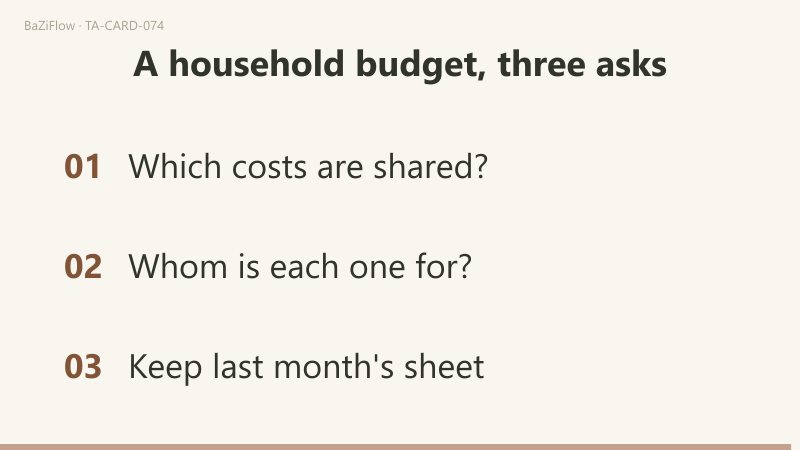
The card has a structure of its own: a common doorway, several people beneath it, and an elder left in the foreground. Moved into daily life, that is sorting a household's monthly budget. Suppose three generations live together: an elder, two adults and a child:
First the arch: what is shared?
Rent, utilities and the internet bill all go in and out through the same door, so they sit in a "shared" column. Once you can see at a glance which items belong to the whole household, the sheet has a frame.
Then the people: whom is each cost for?
Put each expense under the elder, the adults or the child. "Whom it is for" and "who pays" are often not the same person, and two columns make that visible.
Last the archive: keep a page each month
Waite's list includes "archives". Save a separate copy of this month's page and do not overwrite last month's, so next month you can see which lines changed.
Enlarge diagram · scroll sideways to read
One household budget, three positions
Already sorted
- Shared items in one column
- Each cost says whom it is for
Still mixed
- "Household spending" in one lump
- Nobody recorded who pays
Step to add
- Split the lump into lines
- Save a copy each month
Reversed and neighboring cards: chance, loss, and also gift and pension
The first half of the Ten's reversed list reads like a risk sheet: chance, fatality, loss, robbery, games of hazard. The second half turns: sometimes gift, dowry, pension. None of the three is earned in the moment; each comes from somebody else's arrangement or an earlier agreement. That is a teaching summary, and the text does not group them so. The extras are plainer still: an occasion which may be fortunate or otherwise.
Neighboring cards, and where each puts home and money
One figure alone in the garden
In the Nine of Pentacles the domain is "possibly her own", and the subject is one person; the Ten makes the same domain a family's dwelling.
A family under a rainbow
The Ten of Cups lists contentment and repose of the whole heart and also the town inhabited by the Querent; the Ten of Pentacles lists gain, archives and a dwelling.
A man carrying ten staves
The Ten of Wands has one man under the weight of ten staves; the Ten of Pentacles has a door, people and a home, and the weight does not rest on one person.
Enlarge diagram · scroll sideways to read
Questions readers ask next
Is the Ten of Pentacles a card of great wealth?
The list does open with gain and riches, but straight after come family matters, archives, extraction and the abode of a family. The figures in the picture are a household and its doorway, with no number in sight. The extras add that its value derives from other cards, so alone it cannot say how much.
What does the Ten of Pentacles mean reversed?
Half of Waite's reversed list is risk: chance, fatality, loss, robbery, games of hazard. The end of it turns: "sometimes gift, dowry, pension". The extras say only an occasion which may be fortunate or otherwise. Both directions stand side by side and are not ranked.
Does the text say the picture shows three generations?
Waite lists a man, a woman, a child and an "ancient personage" and does not say how they are related. Three generations is the reading the picture invites; label it as a reader's summary and not as Waite's wording.
Was this article helpful?
Sources & references
Continue reading
Nine of Pentacles: alone among the vines, with Waite's "possibly her own" ↗
Page of Pentacles: eyes lifted to one coin, and “insensible of that which is about him” ↗