

Same number, different editions
Content version · · Sources & references
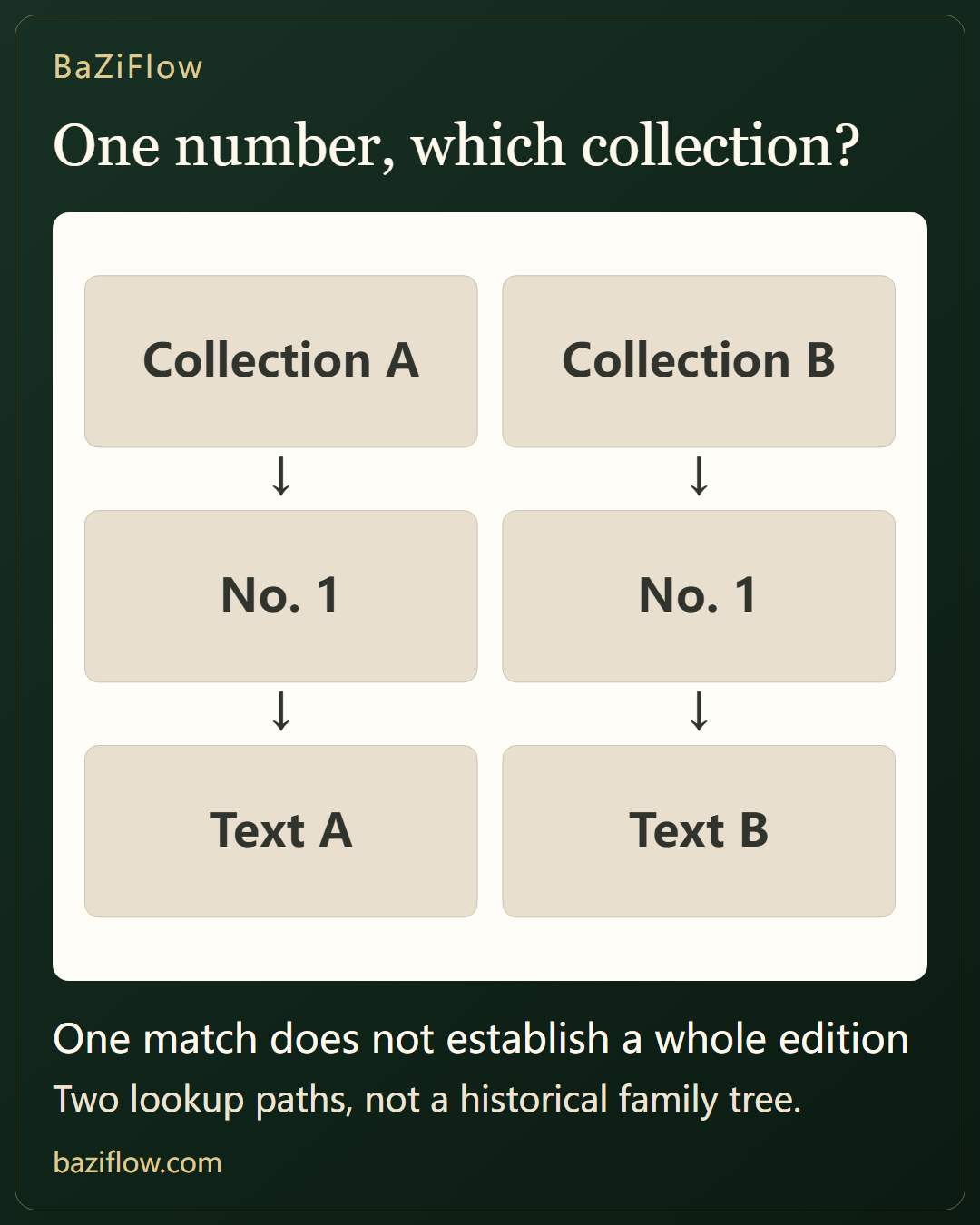
Compare source-bound first-lot headings, distinguish character forms from content changes, and avoid merging several editions into an entry no source contains.
The short version6 min read
Two sources labelled lot one may identify different entries. Keep their provenance separate and compare particular fields before deciding whether a difference concerns display, transcription, text or commentary.
- An identifier needs its collection to locate an entry.
- Character forms, transcription errors, textual variants and revised explanations require different checks.
- Agreement in one field does not establish agreement throughout a collection.
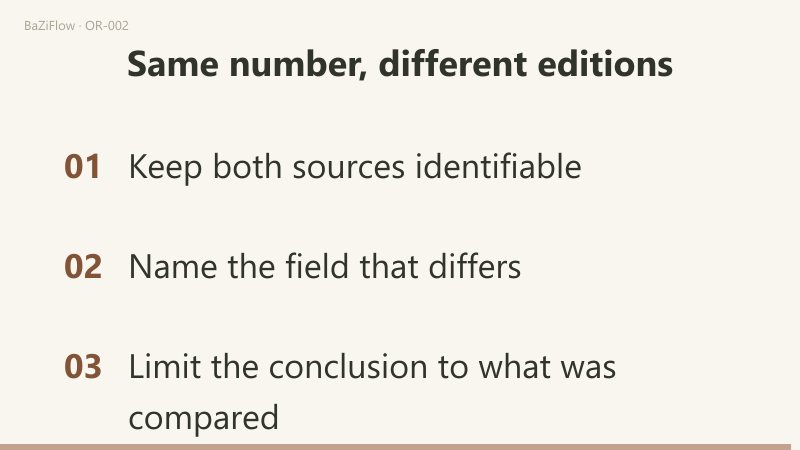
Read first
What are oracle lots? Numbers, poems, and narrative references ↗
Edition matching is not a contest over which answer is nicer
Two slips can carry the same number while referring to different narratives. Before deciding which reading to use, establish which collection each slip belongs to. Selecting the more reassuring grade does not resolve an edition problem; it replaces the object being interpreted.
A number works inside a collection. Across collections it may locate a different item, and within a collection the wording or commentary may have been revised. “Different versions” therefore covers several possible relationships that should not be collapsed into a single explanation.
Compare the fields, not just the identifier
- Textual variant
- Different wording at a specified comparable location, identified with its source.
- Comparison scope
- The field, entry or collection actually inspected; it bounds the conclusion.
Compare what the evidence actually identifies
A January 2019 Lungshan Temple magazine article, issue 43, printed page 33, describes two Guanyin hundred-lot groupings whose opening story headings differ: Song Taizu receiving the yellow robe, and Zhongli attaining the Dao. This is the named author's description of two groupings, not a claim that only two exist worldwide.
The Hong Kong Chinese Temples Committee's actual Guanyin lot-one page lists Zhongli attaining the Dao. Its opening verse begins with heaven and earth opening to a favorable connection. Checking that page establishes those fields in that edition; it does not establish agreement across an entire hundred-entry collection.
| Material checked | Number | Story heading | Scope of evidence |
|---|---|---|---|
| First grouping described in the magazine | 1 | Song Taizu and the yellow robe | A published account of a grouping |
| Second grouping described there | 1 | Zhongli attaining the Dao | A published account of a grouping |
| Committee's individual page | 1 | Zhongli attaining the Dao | The specific page inspected |
The first two headings differ despite the shared number. That is sufficient to show why a number alone cannot settle the edition. The latter two headings agree, but one matching field does not prove that every verse, grade, note, or remaining entry also agrees.
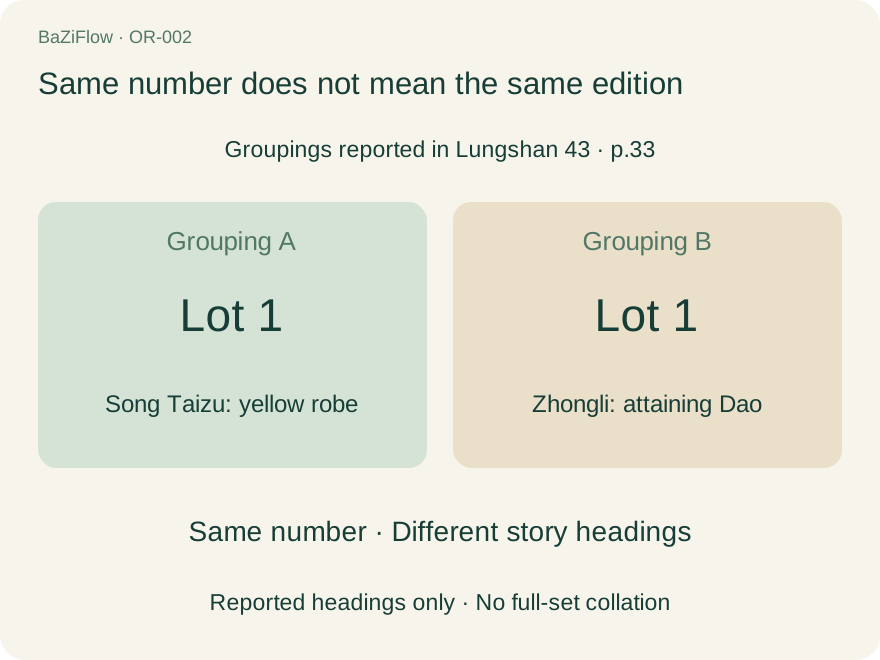
Original BaZiFlow comparison of the magazine's reported headings, not a claim to have collated all one hundred entries.
Same number
- Headings may differ
Same heading
- Other fields remain unchecked
Three kinds of difference need different treatment
A character-form conversion may change how a word is displayed without changing its content. Retain the source form even when a normalized reading is supplied. By contrast, a substituted phrase, a different narrative, or a revised grade is a content difference and needs field-level comparison.
An apparent variant may instead be a transcription error. If an extracted word looks implausible, compare it with the page image before treating it as a stable historical reading. When the image is unavailable, say that the transcription remains unchecked. Text appearing on a website is not proof that optical recognition was error-free.
A new modern explanation attached to an unchanged poem is another layer again. Identify whether the poem changed or only the interpreter's prose. The distinction developed in poem, allusion, and commentary prevents every disagreement from being mislabeled as a different original poem.
Converted character form
- What to inspect
- Source form and display
Suspect transcription
- What to inspect
- The original image
Changed verse wording
- What to inspect
- The exact textual location
New explanation
- What to inspect
- Commentary rather than verse
A formal edition can explicitly decline to standardize others
The Chinese Temples Committee describes its editorial work as a supplementary reference after comparison, rather than an attempt to unify the versions. Its stated purpose matters: the publication cannot be cited as an instruction that every temple must abandon its own text.
A local slip can document what a person received at a particular place, while an edited collection offers a text for comparison. Those uses can coexist. A newer page does not automatically have an older textual pedigree, and an older printing is not automatically free of copying mistakes.
Do not decide the relationship by search ranking or by counting reposts. Several sites may reproduce one source, so their apparent agreement need not be independent evidence. Where the transmission relationship is unknown, preserve that uncertainty rather than constructing a lineage from a similar title.
Received slip
- The material actually obtained
Edited reference
- A second text to compare
Avoid producing an entry that no source contains
Imagine taking the poem from edition A, the story heading from B, the grade from C, and a modern explanation from D. Presented without labels, the result looks like one complete original entry even though the combination may never have existed in any collection.
A teaching comparison can place these materials side by side, but it must keep their provenance visible. An absent field need not be filled merely to make a table look complete. Preserving a difference is more useful than concealing it behind a smooth composite.
For a particular received slip, begin with that slip as the object of study. Other texts are comparisons. If only the number survives, list possible matches as possibilities; do not let a tentative guess become an established fact in later paragraphs. See recording version and source.
Edition A
- Poem
- A poem
- Story
- A story
- Grade
- A grade
Edition B
- Poem
- B poem
- Story
- B story
- Grade
- B grade
Keep the conclusion as narrow as the comparison
If a heading was checked, report the heading match. If one complete entry was compared, do not claim the whole collection matches. Even identical poems can carry different supplementary notes. A web access date records when it was inspected, not when the text was composed; publication and acquisition dates serve different purposes too.
These distinctions do not prevent interpretation. They establish which material an interpretation is using, and where further evidence could change the comparison. The introductory article on oracle-lot numbers and texts supplies the basic relationship. Edition-aware reading keeps a shared number from doing more evidential work than it can support.
One field checked
- Report that field
One entry checked
- Report that entry
Collection unchecked
- Do not extrapolate
Identify both materials
Label the received slip A and the page B, preserving each place or address and date.
Locate the difference
If the number agrees but the story’s person differs, record a heading difference without assuming all the verses differ.
Specify the next check
After comparing a heading, inspect the poem and grade. Unchecked fields remain unchecked rather than becoming matches.
Questions readers ask next
Must one source be wrong when the same number has different text?
Not necessarily. The sources may represent different collections or revisions. Identify their provenance and the specific difference first.
Do converted character forms establish different content?
Not on their own. Keep the source form and inspect meaning; substituted verse wording is a separate question.
Does an official reference replace every local edition?
Its stated editorial purpose matters. A supplementary reference is not automatically an instruction to standardize every local text.
Was this article helpful?
Part of a learning path
Oracle lots: from versions to real-world thinking · Step 2 of 2 available