

How three timing layers overlap
Content version · · Sources & references
Work through one fixed branch position with three palace labels. Learn how natal, ten-year and annual scopes differ, and why a shared location does not by itself establish a life event.
The short version6 min read
A layered chart assigns palace names separately within a shared set of branch positions. The natal layer retains the birth arrangement, a decade layer covers a ten-year period, and an annual layer covers the selected year. One address can therefore carry several correctly scoped names.
- Branch positions stay fixed while each layer supplies its own Life-palace starting point for naming the twelve palaces.
- With natal Life at Tiger, decade Life at Horse and annual Life at Dragon, Tiger is natal Life, decade Wealth and annual Spouse.
- Searching for Spouse reverses the question: the three layers locate it at Rat, Dragon and Tiger rather than at one shared address.
Read first
A fixed chart with separately named layers
A natal chart is based on birth information and chosen charting conventions. Looking at a target year does not mean replacing the birth year with that year and pretending it is new birth data. Time-layer annotations should remain identifiable as overlays on the underlying arrangement.
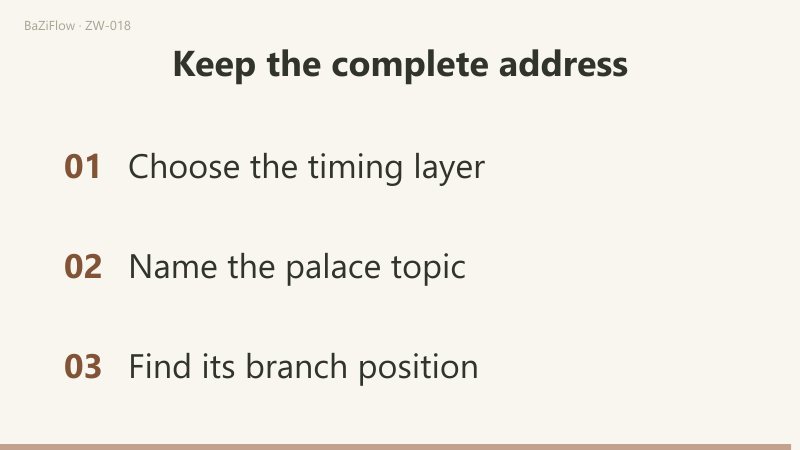
The whole-chart palace guide distinguishes branch positions from palace topics. In a layered reading, add a scope to that distinction. “Annual Spouse at Tiger (寅)” is a more complete address than either “Spouse” or “Tiger” alone.
The iztro timing documentation similarly requests both a palace name and a timing scope when locating a palace or its surrounding relationships. A query for decade Spouse is not interchangeable with one for annual Spouse. The same discipline works in handwritten notes.
Stars and transformations need their own origins retained as well. A mark introduced for a target year is not a permanent change to the birth-year stem. If several layers place marks near one star, do not count all of them as natal marks. The transformation-source comparison explains why that source information matters.
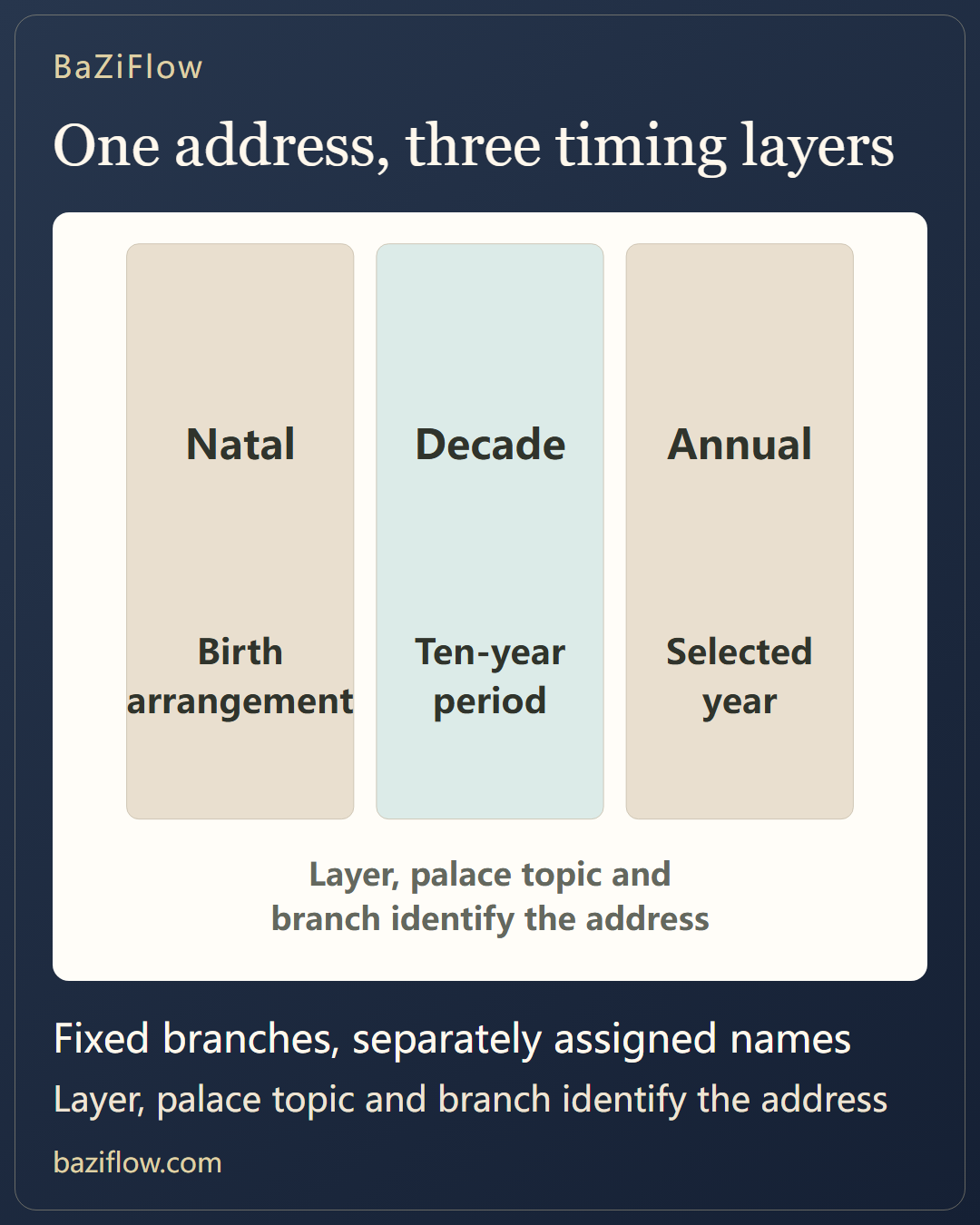
Natal
Birth arrangement
Decade
Ten-year period
Annual
Selected year
Layer, palace topic and branch identify the address
Reconstruct three names at one address
Take a single fixed branch position, Tiger. In our exercise it will carry three labels: natal Life, decade Wealth and annual Spouse. These do not conflict, because each belongs to a different layer.
Here are the deliberately limited starting conditions: natal Life is at Tiger, decade Life is at Horse (午), and annual Life is at Dragon (辰). No birth date, age or target calendar year is supplied. We are checking palace order, not constructing a person's forecast.
| Layer | Its Life-palace starting position | Label reached at Tiger |
|---|---|---|
| Natal | Tiger | Life |
| Decade | Horse | Wealth |
| Annual | Dragon | Spouse |
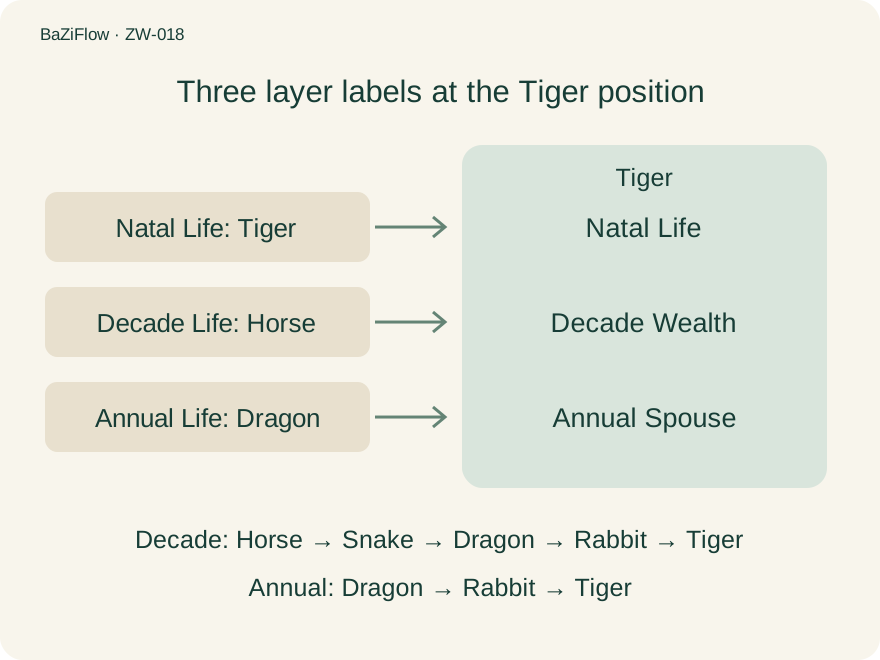
Original BaZiFlow palace-order exercise using three stated Life-palace starting positions; it is not an individual timing forecast.
For the decade row, follow the reverse palace order from Horse: Life at Horse, Siblings at Snake (巳), Spouse at Dragon, Children at Rabbit (卯), Wealth at Tiger. For the annual row, Life at Dragon leads to Siblings at Rabbit and Spouse at Tiger. The branch address remains fixed while the starting point for the layer's names changes.
This small calculation explains why “Wealth is at Tiger” and “Life is at Tiger” may both be correct with different scope labels. It also explains the reverse problem: two mentions of “Spouse palace” need not identify the same branch position. Ask which layer supplies the name.
Now reverse the exercise. Keep the topic Spouse fixed rather than keeping the address Tiger fixed. In the naming order, Life is followed by Siblings and then Spouse, so take two reverse steps from each layer’s Life palace. Natal Tiger leads through Ox (丑) to Rat (子); decade Horse leads through Snake to Dragon; annual Dragon leads through Rabbit to Tiger. The three answers are Rat, Dragon and Tiger.
Compare these answers with the table. Tiger is indeed annual Spouse, but it is not natal Spouse in this exercise. Erasing “annual” and looking at natal Spouse at Rat would change the object being examined. No added stars are needed to demonstrate the mistake: the timing scope is already a necessary part of the address.
Natal
Decade
Annual
Ten years and one year are different scopes
The cited iztro introduction describes a major period, commonly called a decade period, as ten years. Its starting age depends on the five-element bureau, with direction determined by the adopted rules. It does not mean that everyone changes periods whenever a Gregorian year ends in zero.
An annual layer covers a year. In the rule described by this source, the annual Life palace takes the position of that year's branch. The same target year can therefore have different relationships to different people's natal palace names.
The minor period also advances by year, but it is not another name for the annual layer. Its starting arrangement and age-based rules differ. Do not replace an age-related minor-period marker with an annual-palace label simply because both concern one year.
These are descriptions of a traditional timing framework. Their durations and placement rules can be checked without treating the framework as a proven predictor of personal events.
Decade
- Ten-year period
Annual
- Selected year
Make a timing note reproducible
Before discussing an interpretation, record the target date or age, the period being displayed and the conventions for year and age boundaries. A note that merely says “this year” becomes ambiguous when opened later. A screenshot without its selected date may leave the reader unable to recover the intended layer.
For each palace you discuss, retain its layer, topic name and branch position. If a different date changes the annual layer while the decade remains the same, update only the affected records. Keeping the layers separate makes those changes visible.
You can test your understanding by covering the exercise table and recomputing Tiger's three names from the stated starting points. That is a complete, checkable learning task. It does not require inventing a personal outcome to accompany the result.
Finer subdivisions are possible, but a shorter interval is not inherently more accurate. The next article on what monthly charts can say examines what additional context is needed when moving from a year to a month.
Do not turn overlapping labels into an event
Our exercise has no stars, transformations or personal history. The overlap of decade Wealth and annual Spouse at Tiger does not establish marriage, money from a partner or spending caused by a relationship. Those stories are absent from the inputs.
A traditional interpretation may examine overlaps within a fuller method. It should state that method and the additional conditions used. Several labels derived within one charting system are not automatically several independent pieces of evidence for a real-world event.
This distinction is worth learning before adding more detail. Otherwise a colourful layered display can look more certain simply because it contains more annotations. The number of layers does not itself supply a probability.
Decade Wealth
- Tiger
Annual Spouse
- Tiger
Only their shared Tiger address is established
Questions readers ask next
How can one Tiger position have three palace names?
Each layer names palaces from its own Life-palace starting point, following the reverse palace order. The branch position stays fixed. A complete reference includes the layer, the palace topic and the branch address.
Where are the three Spouse palaces in this exercise?
Move two reverse steps from each Life palace: natal Tiger through Ox to Rat; decade Horse through Snake to Dragon; annual Dragon through Rabbit to Tiger. The three Spouse addresses are therefore Rat, Dragon and Tiger respectively.
Does a decade change when the calendar reaches a round year?
No. In the cited method its starting age depends on the five-element bureau, and direction follows separate adopted rules. Ten years describes a period’s length, not a universal Gregorian starting point. Check the chart’s ages and boundaries.
Was this article helpful?
Theme: Time & life stages
Part of a learning path
Zi Wei: from palaces and stars to the Four Transformations · Step 6 of 6 available