

Life stages and time scales
Content version · · Sources & references
Compare long periods, annual layers and dated events without treating them as interchangeable. Learn where BaZi and Ziwei timing methods fit, and what a retrospective record can establish.
The short version6 min read
A statement about several years and one about a particular day answer different questions. Keep those ranges visible before deciding what an event says about a period.
- A phase, a year and an event date can overlap without becoming interchangeable records.
- Annual stems or branches remain in their time layer rather than entering the natal pillars.
- Choose the event date that answers the original question, not whichever date best fits an interpretation.
Two descriptions can differ without contradicting each other
An account of a ten-year period and an account of one difficult month may be talking about different things. Before deciding that one disproves the other, check the subject and the dates attached to each statement. A broad theme does not describe every day inside its range.
The reverse mistake is just as easy: an event happens, and its emotional force seems to confirm an entire period. One move, appointment or interrupted course cannot by itself characterize years of experience. This learning route keeps the length of a claim visible so that the strength of the conclusion does not outrun the record.
One month
- A limited observation
A longer phase
- More than one event
Phases, years and events have different ranges
- Time scale
- The length covered by a statement, such as a phase, a year or one day.
- Observation date
- A date used to align records, not evidence of what caused the event.
Make an observation window before opening a timing chart
Choose the actual question. Are you examining a semester of study, a change during one year, or a longer shift in responsibilities? A practical life stage is a way of organizing experience. A calculated period in a traditional system has a separate method for determining its boundaries. Similar dates do not automatically make those boundaries equivalent.
Record what you knew at the time as well as what happened later. If you are reviewing a move, the moving date and the earlier decision date may answer different questions. Do not silently replace one with the other because it fits an interpretation more neatly.
| Record | Keep visible |
|---|---|
| Observation window | The question and actual date range |
| Traditional period | The method and calculated boundaries |
| Event | Its date, description and evidence |
An unknown date should stay unknown. A rough recollection can still be useful, but it is not a basis for claiming a precise match to a day. Privacy matters too: a learning record can describe the kind of event without making someone else's personal details public.
Decision
- Date
- Assume October 2
- Question answered
- When was the move agreed?
Moving
- Date
- Assume October 18
- Question answered
- When did the move happen?
Learn one hierarchy before combining several
For BaZi, reading natal structure, luck, years and months together is the relevant entrance. A stem or branch from an annual layer does not become a component of the birth chart merely because it appears in the same report. Keep its source and time scope attached.
Zi Ping Zhen Quan's chapter on luck periods relates the period's stems and branches to the natal configuration. This supports a statement about that text's interpretive method. It does not establish that the method accurately predicts a specific modern event, and its examples should not be stripped of their conditions.
For Ziwei, natal, decade and annual layers introduces the corresponding distinctions within that system. The iztro teaching material lists decade periods and annual layers separately and cautions against treating them as substitutes. Its classification is useful here; its traditional interpretations are not being offered as guarantees about your life.
Natal pillars
- Belongs to
- The birth configuration
- Not interchangeable with
- Annual stems and branches
Annual layer
- Belongs to
- The specified year
- Not interchangeable with
- The birth configuration
Read the drawing as alignment, not a chain of causes
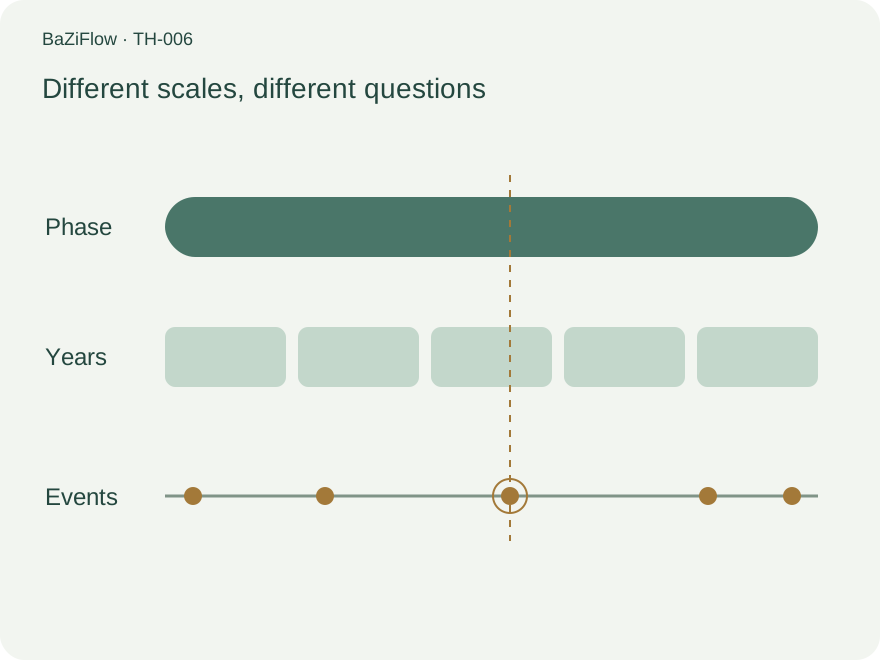
Original BaZiFlow time-scale diagram. Band lengths are illustrative and do not calculate a real starting age.
The long band, annual cells and isolated points deliberately have different shapes. They represent different scales of discussion. The dotted guide lets you locate an observation date across those scales; it does not say that the upper band caused the lower event.
There are no real ages on the diagram. Its widths are not an algorithm for calculating when a period begins. A long phase can contain work, study, care, rest and many experiences that a single theme does not summarize. Keeping those experiences visible is part of an honest review.
If a report emphasizes one theme, ask what conditions support that emphasis and how wide a claim it makes. “A topic to examine during this period” is a different kind of statement from “this event will happen on this date.” More detailed language needs more justification, not merely a smaller box on a timeline.
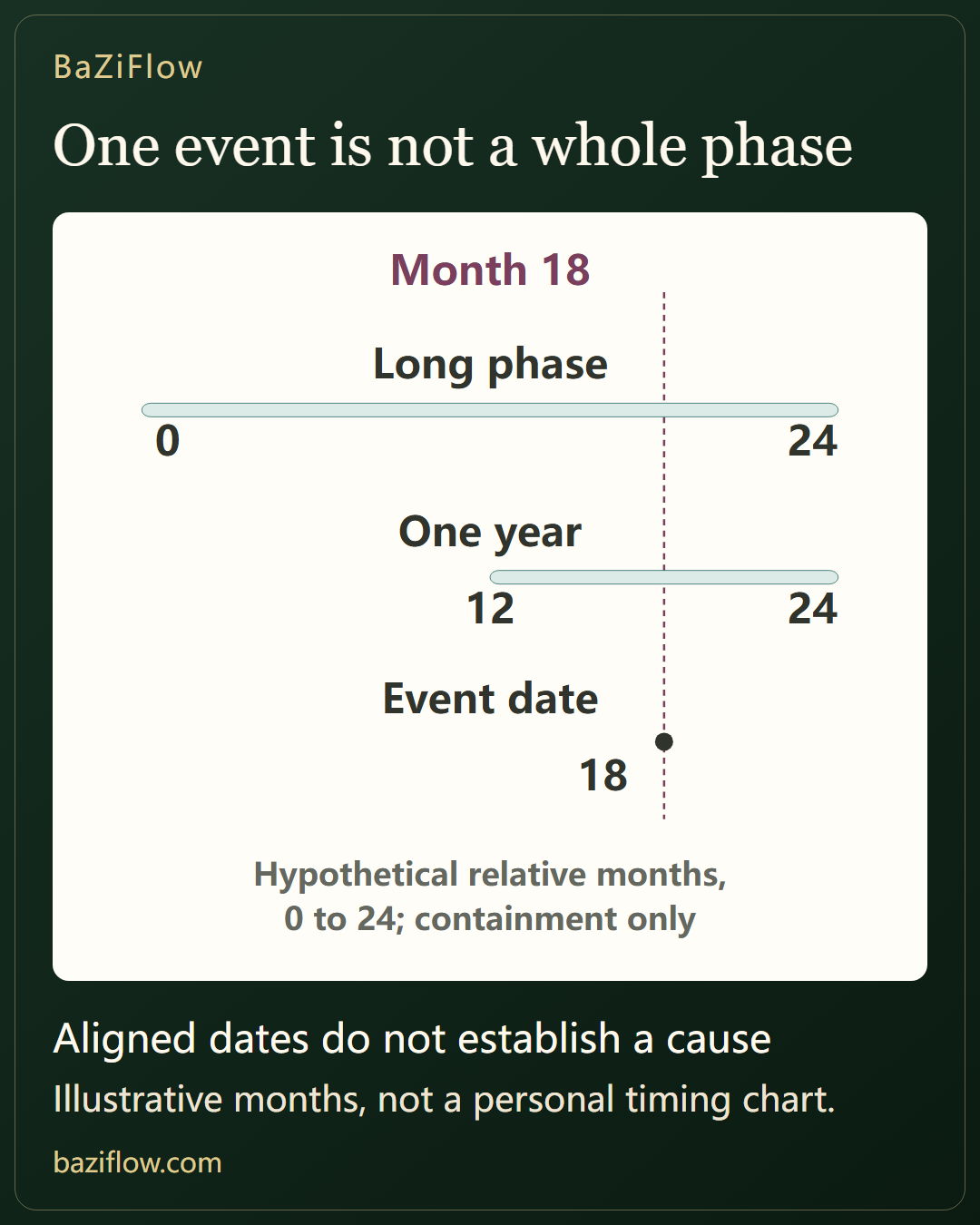
Month 18 · 18
0 ↔ 24
- Long phase · 0–24
- One year · 12–24
- Event date · 18
Relative-month illustration; no starting-age calculation
Compare settings before comparing conclusions
When tools display different periods, check the birth-data version, starting-period method, age convention and boundaries first. An age label is not necessarily a precise Gregorian date. Nominal age and completed age cannot be compared by pretending they are the same measure.
The cross-system route through luck pillars, decade limits and transits helps identify what each method is doing. All of them address time, but they do not become identical because their descriptions sound similar. Agreement between encouraging adjectives is not several independent confirmations of an event.
If birth data is corrected, preserve the earlier version and explain what changed. A new calculation may make an old interpretation inapplicable. Quietly editing the old record would hide that dependency and make the earlier account appear more stable than it was.
A useful review includes what did not happen
Suppose a period was described as emphasizing learning. Record actual study, the plans that did not proceed, the constraints you encountered and other important parts of life. Do not keep only matching fragments or broaden the original statement until every possible result fits.
Institutions, responsibilities, choices and chance all belong in the practical context. A traditional period cannot replace them or justify postponing necessary action. Learning about a stage should leave room to participate in your life rather than turn a label into a script you must wait out.
You can finish with a limited result: the dates are comparable, the methods differ, or the available record is too imprecise for a narrow claim. Each result teaches more than a confident verdict unsupported by the time scale you actually have.
Planned course
- Keep in the review
- What was expected
- Do not replace it with
- Only successful plans
Actual study
- Keep in the review
- Work actually completed
- Do not replace it with
- A claim about the entire year
Constraints
- Keep in the review
- For example, a canceled course
- Do not replace it with
- A revised prediction that fits everything
Identify the event in the question
Use the moving date for the actual move and the decision date for the decision. Do not switch because another date fits better.
Locate that date in each range
Record where it falls within the year and phase. Being contained in a range does not itself establish an influence.
Keep the precision the record allows
A remembered month remains a month. Do not invent a day, and retain plans that did not happen alongside the completed events.
Questions readers ask next
Does an annual stem become part of the birth chart?
No. It belongs to the annual layer. Keep that source separate before interpreting any relationship with the natal configuration.
Does month 18 predict a special event?
No. It is a hypothetical point on a relative axis used to show containment, not a personal calculation.
Can one event establish an entire phase?
No. Review the original scope, other experiences and unrealized expectations rather than selecting one matching event.
Was this article helpful?
Start reading
Natal, Luck, Annual and Monthly Layers: How to Read Them Together ↗ · BaZi
Natal, Decade and Annual Layers: Keep the Labels Separate ↗ · Zi Wei Dou Shu
Luck Pillars, Ziwei Decades and Transits: Three Clocks ↗ · Cross-system studies
Sources & references
Continue reading
Natal, Luck, Annual and Monthly Layers: How to Read Them Together ↗