

Trace a Sukuyō claim to its passage
Content version · · Sources & references
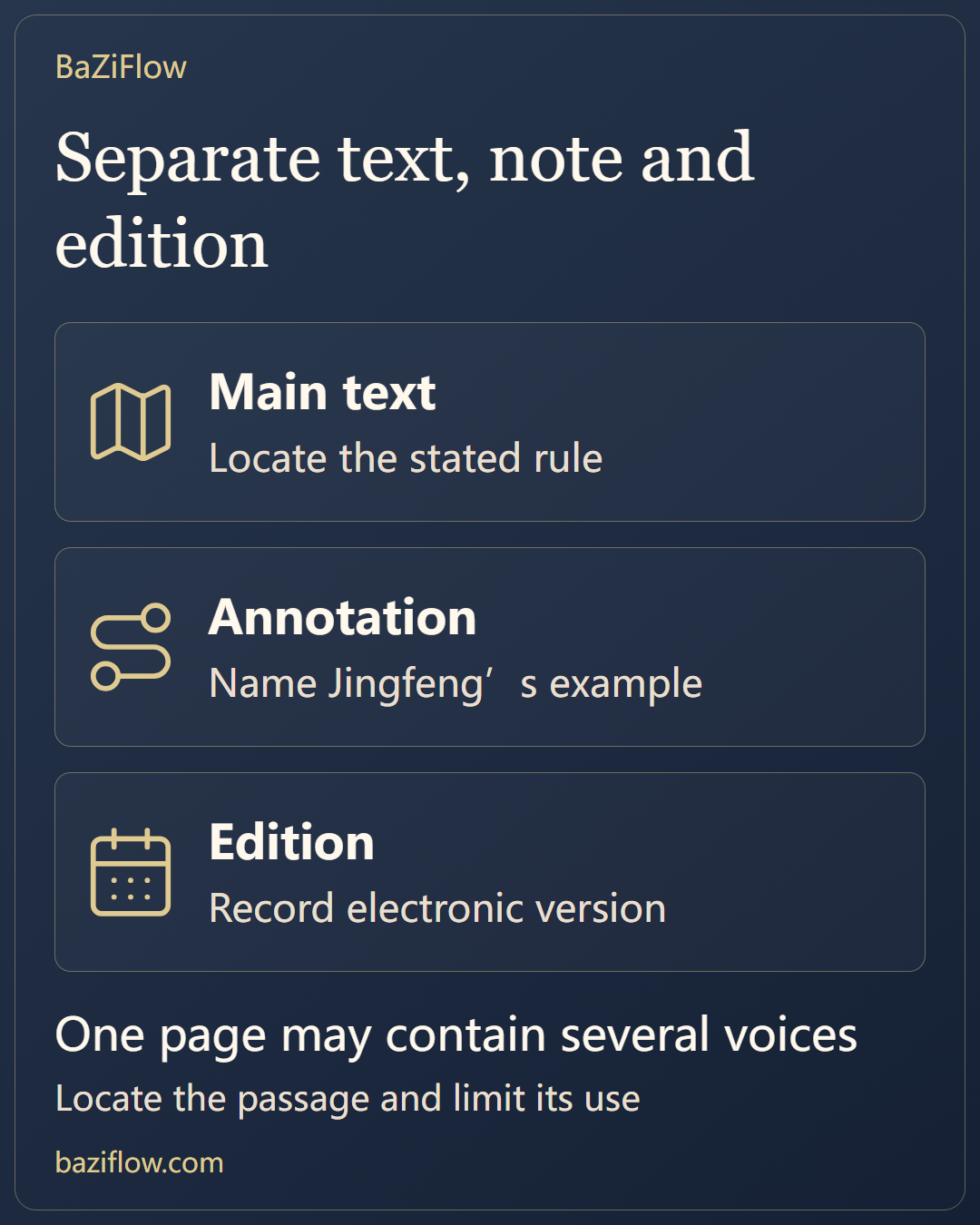
Distinguish editions and textual voices, preserve differing Ye-day passages, and document exactly what a source establishes and leaves unresolved.
The short version6 min read
A source check connects one claim to a particular edition, passage and textual layer. T1299’s three-nine ordering, Jingfeng’s Bi example and the CBETA edition marker answer different questions. Its two Ye-day statements also need separate locations. This article uses actual pages and a small count to establish what a citation supports.
- CBETA 2023.Q4 identifies the electronic edition. The main text, Jingfeng’s annotations and modern editorial information should not be merged into one voice.
- Printed pages twelve and twenty-six are viewer pages thirteen and twenty-seven in this PDF. Confirming their differing Ye-day statements does not explain the cause.
- The ordering and Jingfeng’s Bi example support Jing as inclusive position four, An, from Bi; they do not by themselves establish modern distance names or lived outcomes.
Read first
Match the source to the claim, not to the topic
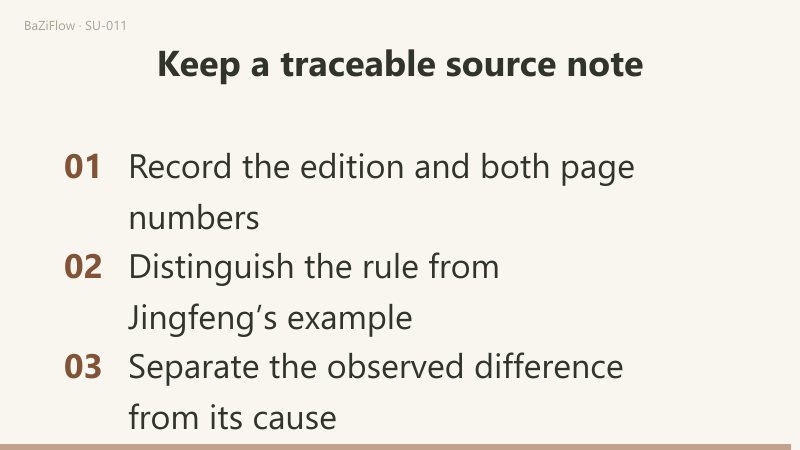
Page references here use the printed number at the foot of the page. The PDF includes a cover, so printed pages 12 and 26 are viewer pages 13 and 27. Keep the two numbering systems distinct.
A source can be relevant to Sukuyō without supporting every sentence in an article about it. A calendar table may establish how a label is assigned. A historical passage may show that a term occurs in a text. A practitioner's guide may document that author's interpretation. None of those functions automatically establishes how a particular person behaves.
Begin a source check by writing the exact claim you want to support. Then identify the passage that addresses it and the limit of that passage. “This is about lunar mansions” is too broad a connection. The useful question is whether the evidence answers this specific claim under the same conditions.
| Claim under review | Useful evidence | What would still be missing |
|---|---|---|
| A sequence has a stated ordering | The identifiable list in its edition | Whether all later adaptations retained it |
| A date receives a certain mansion | The table and date-conversion rule | Any unstated leap-month policy |
| A modern author uses a distance scheme | The author's displayed method | Proof of an identical ancient convention |
| A pair will cooperate successfully | Evidence about the proposed prediction | A source title or symbolic description alone is insufficient |
These are differences of evidential function, not a simple ranking from old to new. An old text can be the right source for a historical term and the wrong source for a modern empirical claim. A modern page can accurately document its own convention without representing every school.
An electronic edition has more than one date and voice
The T1299 PDF hosted by National Taiwan University's Buddhist collection identifies its electronic source as CBETA 2023.Q4 on page 2. That is an edition marker. It does not date the ancient work to 2023, and it does not imply that every layer of the text originated at one historical moment.
The opening material on page 3 identifies translation and annotation roles. When recording a passage, distinguish the work, the electronic edition, the location and the textual layer. A later explanatory note should not silently be attributed to the same voice as the passage it comments on. Nor should a modern paraphrase be enclosed in quotation marks as though it were the original wording.
A cropped image often loses exactly this information. If you have only a screenshot, record that limitation until the complete page is located. Finding similar wording elsewhere may help, but it does not by itself identify which edition was pictured or what was omitted around the extract.
Try a narrowly defined claim: “With Bi as the birth reference, Jing is inclusive position four, An.” On printed page eleven, the three-nine rule counts the birth mansion first and gives the opening order Ming, Rong, Shuai, An. The Jingfeng annotation on the same page then starts from Bi and identifies Zui as Rong, Shen as Shuai and Jing as An. The rule and the named example can be checked against each other.
A source note can therefore say that the rule passage and Jingfeng’s example support Bi-to-Jing at position four, An. It should not expand that into “the entire scripture proves this is the best pairing.” Change the proposed claim to “this position is the modern far-distance category” and the two passages are no longer enough: a source defining distance is needed. The wording of the claim has changed, and so has the evidence required.
Main-text rule
Three-nine start and order
Jingfeng’s note
The named Bi example
Electronic edition
CBETA 2023.Q4
Keep an inconvenient difference visible
The cited electronic T1299 contains a useful caution against flattening a text into one rule. Page 12 gives a favourable statement about the Ye mansion day, whereas the related discussion on page 26 describes undertakings on a Ye day as not succeeding. Both locations should remain in the research note.
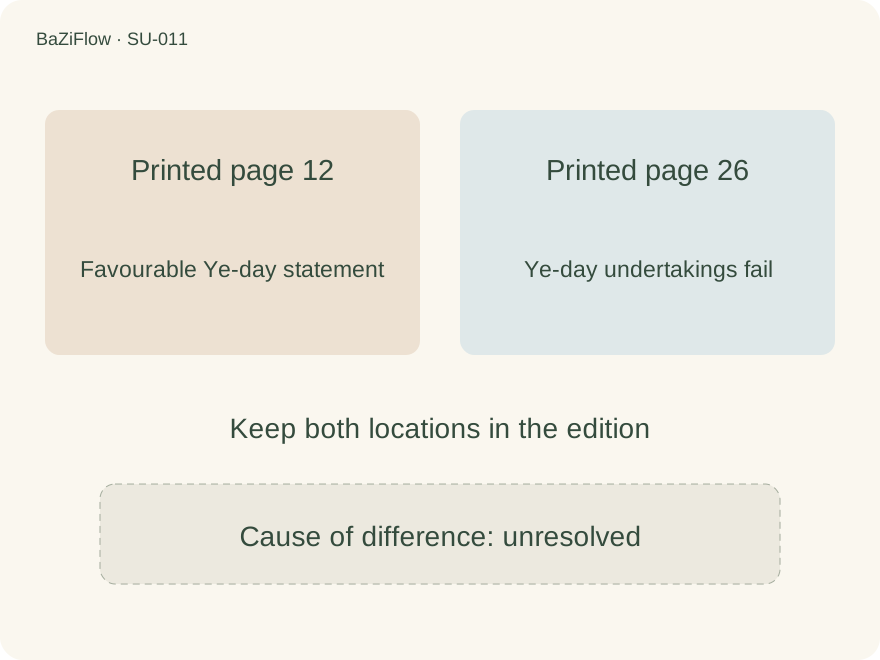
Original source-location cards, not reproductions or a resolved textual history.
The comparison supports a limited finding: these passages in the edition need to be distinguished. It does not establish whether the difference results from compilation, historical change, annotation practice or transmission. Resolving that would require further textual evidence. Do not invent a reconciliation simply because a clean rule would be easier to publish.
Nor does preserving the difference make the entire document unusable. The sequence can still be studied where it is specified. The disagreement instead limits what can responsibly be said about a single consistent auspiciousness rule. A good source note can preserve both useful information and a question that remains open.
Confirmed
- The two Ye passages differ
Unresolved
- The historical cause
Institutional authority does not travel beyond the cited subject
NAOJ's calendar material can help verify mansion lists and calendrical conditions. Citing it is not evidence that NAOJ has tested personality or relationship predictions. In the same way, a practitioner explaining a personal method is a primary source for that explanation, not an automatic authority on every historical lineage.
The US National Archives' written-document worksheet encourages attention to creator, audience, time, place, purpose and corroborating material. We use that general reading method here. It is not a Sukuyō study or an endorsement of the tradition. Naming the limited role of a methodological source is part of the same discipline as locating an ancient passage accurately.
Several websites repeating one sentence may all depend on a single earlier page. Trace that connection before counting them as independent support. A long bibliography with unclear dependencies can look stronger than the evidence actually is. The goal is a path back to material that was read, not a decorative list of links.
Calendar account
- Names and date tables
Practitioner guide
- That author’s interpretation
Document analysis
- Creator, purpose and corroboration
Write the unresolved part into the citation note
A usable note might say: “Three-nine order checked in the identified T1299 edition and passage; modern distance names and real-world relationship outcomes are not established by this passage. Ye-day statements differ between the two recorded locations; cause unresolved.” That is more informative than simply marking the source verified.
If a later edition or study helps resolve the question, add it with the date of the new finding. Preserve what the earlier note actually said rather than silently editing away the discrepancy. This lets another reader distinguish a changed conclusion from a source that was always consistent.
For a practical calculation comparison, see why mansion methods differ. For notes about people's actual experiences, use the separate structure in recording Sukuyō cases. Textual evidence and personal observations can both be useful, but they answer different questions.
Questions readers ask next
Does CBETA 2023.Q4 date the ancient work to 2023?
No. It identifies the electronic source used for this edition. The ancient work, translation or annotation layers and modern electronic preparation are distinct records; the edition date cannot serve as the date of every layer.
Which Ye-day passage should be treated as the original rule?
This check confirms different statements on printed pages twelve and twenty-six but does not establish priority or cause. Retain both locations and seek further textual evidence rather than removing the passage that complicates the preferred rule.
How can “Bi to Jing is position four, An” be checked?
Locate the three-nine rule on printed page eleven: the birth mansion is first and An is fourth. Then read Jingfeng’s Bi, Zui, Shen and Jing example on that page. Together they support this positional count, not a distance scheme or a real relationship outcome.
Was this article helpful?
Part of a learning path
Sukuyō: from the birth mansion to relationship limits · Step 4 of 4 available
Sources & references
Continue reading
Why Sukuyō Natal Mansion Methods Differ: Tell Lookup from Zoning, Then Check the Rule ↗