

Metal: drawing in, forging, Yang and Yin Metal
Content version · · Sources & references
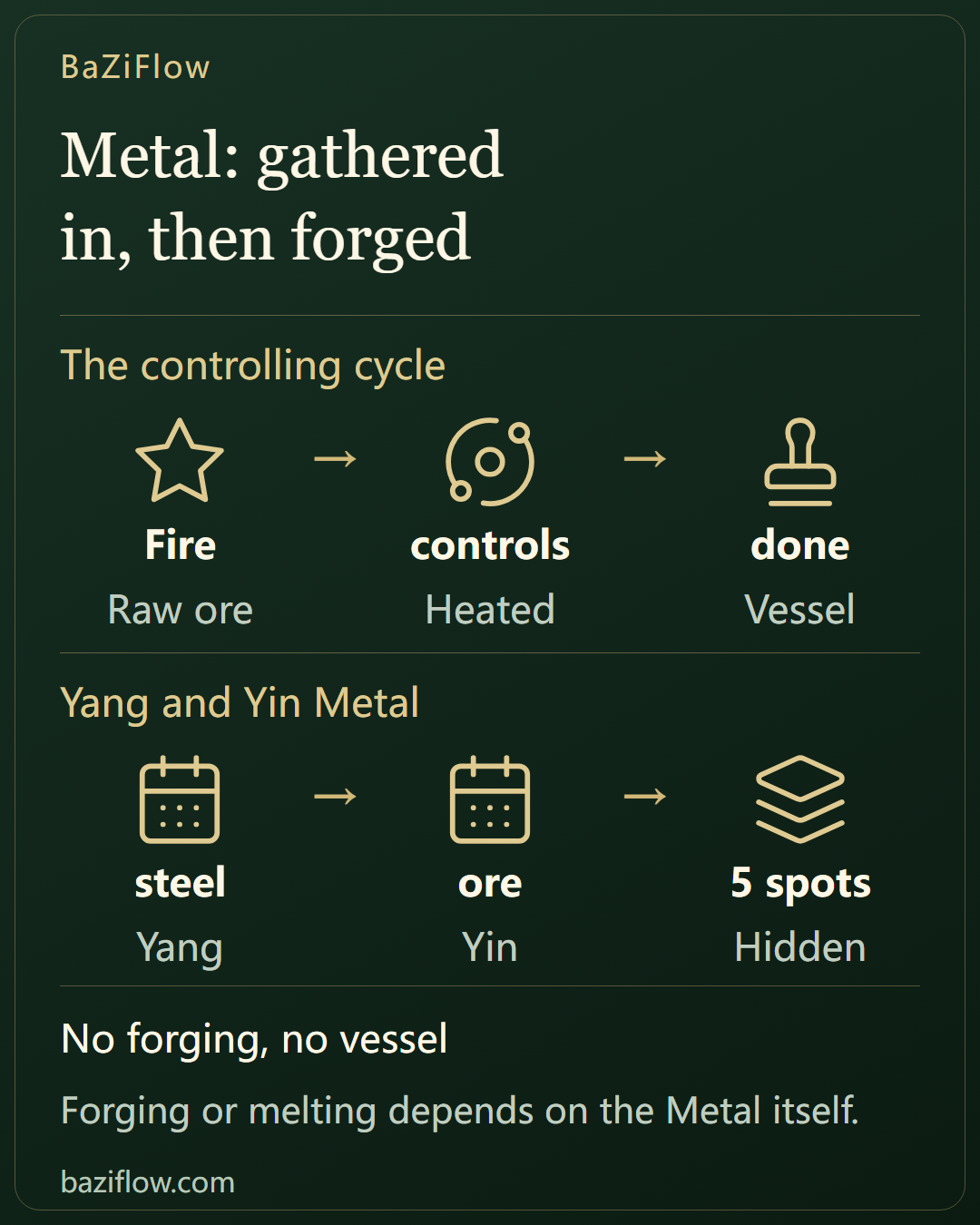
What the Sanming Tonghui says of Metal: the word for holding back, extreme yin with yang inside, no forging no vessel, Fire before and after the vessel, Yang and Yin Metal, and the branches that hide Metal.
The short version8 min read
Metal is the element that draws in. The book explains it with a word meaning "to hold back", says its body is extreme yin with the essence of yang inside, and that it must be forged to become a vessel; the stems are the steel and the ore.
- Metal takes the stems Yang Metal and Yin Metal and the branches Monkey and Rooster; in this site's table it generates Water and controls Wood, and is generated by Earth and controlled by Fire.
- The book says Metal "does not become a vessel unless forged": Fire controls Metal, yet unformed Metal wants Fire and formed Metal does not, so the same Fire depends on which step Metal has reached.
- The stages of the two Metals are mirror images: Yang Metal has Growth at the Snake and Death at the Rat, Yin Metal Growth at the Rat and Death at the Snake; and the same book offers more than one set of images for them.
Read first
Five Elements cycles: learn the relationships, not just the order ↗
The element that draws in
Wood grows, Fire disperses, Water flows, and Metal draws in. In the Sanming Tonghui (三命通会), the Ming-era fate manual, the word given for Metal means "to hold back".
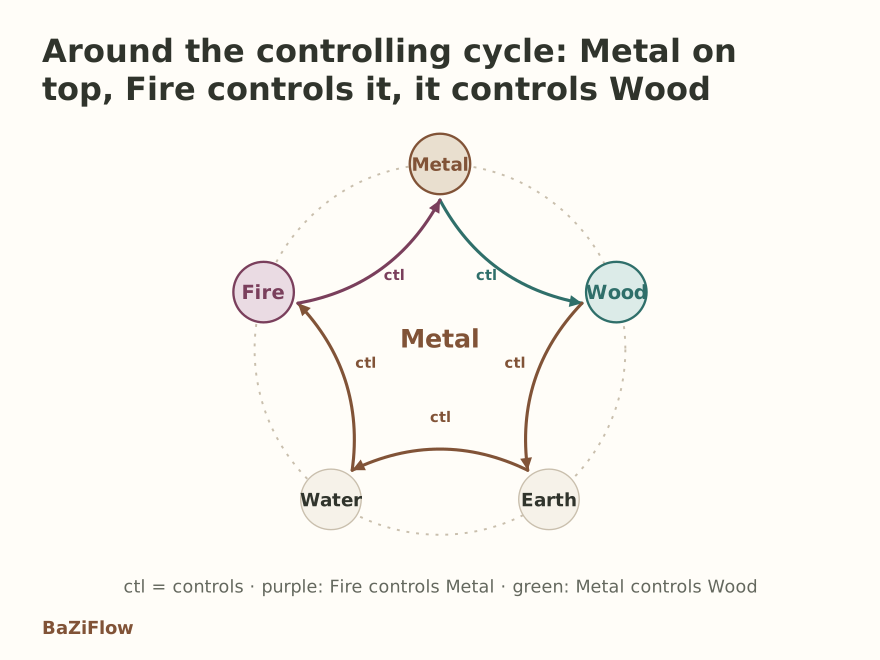
Relation sketch: the elements run in controlling order and every arrow is a control; the two neighbors of Metal are colored, and its stems and branches follow this site's usual entry-level tables.
This picture uses a different order: not the generating cycle but the controlling one. Metal controls Wood, Wood controls Earth, Earth controls Water, Water controls Fire and Fire controls Metal, and following the arrows once round brings you back to Metal. Metal is at the top; the purple Fire beside it controls Metal and the green Wood is what Metal controls. Metal takes the stems Yang Metal (庚) and Yin Metal (辛) and the branches Monkey (申) and Rooster (酉). For the structure of all the lines, see the generating and controlling cycles.
Metal rules the west and answers to autumn. The word metal means to hold back: yin qi begins to restrain the ten thousand things and draw them in. Sifting sand to pick out gold, it is born of Earth, yet born of Earth it is set apart from Earth: that is its natural form.
"To hold back" says that in autumn yin qi begins to check things and pull them in. "Sifting sand for gold" says that Metal has to be picked out of sand: it is born of Earth yet is separate from it and is no longer Earth. The book also places Metal in the west and in autumn, with four as its number (nine once complete) and white as its color.
Extreme yin as body, the essence of yang within
Why should something that draws in be hard? The five-elements chapter explains Metal this way:
Metal takes the extreme yin as its body, yet inside it holds the essence of extreme yang, and so it is hard and unlike other things. Were it yin alone and not hard it would be ice and snow, which melts on meeting yang. So Metal that is not refined does not become a vessel.
The body of Metal is yin, but it holds a core of yang, which is why it is both hard and unlike anything else. With yin alone and none of that yang, you would have ice and snow, which melt at the first heat. So Metal has to be refined before it becomes a vessel. Master Zhang (Zhang Zai) adds one more word on Metal: "following and changing" (从革), meaning that Metal follows the hand of the maker, changes shape, and cannot go back once it has.
Enlarge diagram · scroll sideways to read
Fire before the vessel and after it: two roles
By the controlling cycle Fire controls Metal, which makes Fire look like the enemy. The same passage goes on:
Enlarge diagram · scroll sideways to read
Fire here is no fixed hero or villain: before the Metal is formed it is the forge, and after the vessel is made it has no more use. The book says the same of autumn Metal: "Autumn Metal holds the rule and the command; fire comes to forge it and it becomes the stuff of bells and cauldrons." In autumn Metal is in charge, Fire forges it, and what comes out is bells and cauldrons.
Yang Metal is steel, Yin Metal is mountain ore
The book's section on the stems writes two Metals. Yang Metal (庚) is "in the sky wind and frost, on the earth metal and iron", called yang metal, blunt and hard, "forged by fire into a vessel"; the book shows it with the furnace fire in the Snake forging Yang Metal into bells and cauldrons. For Yin Metal (辛) the heavenly image is the sun and moon and the earthly image is metal, "the metal being the ore of mountain and stone"; it is called yin or soft metal, "moist, not blunt and hard", and it is hurt by blazing forging; it suits Water and Earth to support it.
Enlarge diagram · scroll sideways to read
Look at the last two rows. Yang Metal has Growth at the Snake, where Yin Metal dies; Yin Metal has Growth at the Rat, where Yang Metal dies. The two stems swap Growth and Death. The book is specific: at the Rat Yang Metal meets "cold metal and cold water, the mother weak and the child strong" and so is "metal sunk under water"; at the Snake Yin Metal is buried by the Earth inside the Snake, "heavy Earth buries Metal". One more point: in another chapter, on the heavenly images of the ten stems, the same book likens Yang Metal to the moon and Yin Metal to frost, which differs from the images above. There is more than one set of images; to follow all twelve stages, open the twelve-stage and void-branch article.
Monkey, Rooster, and three more branches that hide Metal
This site's table gives Metal the Monkey (申) and Rooster (酉) branches. The book calls the Monkey "the place where Water and Earth are born" and its Metal blunt and hard, "unlike soft pearls and jade"; the Rooster belongs to the eighth month, when "the metal is white and the water runs clear". Beyond those two, this site's hidden-stem table puts Yang Metal in the Snake and Yin Metal in the Dog and the Ox.
Enlarge diagram · scroll sideways to read
The Snake deserves a second look: it is a Fire branch, yet it hides Yang Metal and is where Yang Metal has Growth. The book writes that Yang Metal "has Growth at the Snake, where the Earth inside the Snake can generate it", and also that "the Snake is the furnace fire that forges Yang Metal into a vessel of bells and cauldrons". One Snake is both the birthplace of Yang Metal and the furnace that forges it. For the division of labor among the three layers, compare how hidden stems unfold.
Three conditions: too hard, too weak, too strong
Metal turns up three times in the run of sayings the book quotes from Xu Dasheng: once against an opponent that is too hard, twice when its own strength is off:
Enlarge diagram · scroll sideways to read
Set against the "forging" above, the same Fire here has become "melting". The book's test for forging or melting lies not in the Fire but in the Metal itself: whether it has become a vessel and whether it is strong enough.
Two cases to test the Metal reading
Check yourself
The Snake belongs to Fire, so why is it also on Metal's list?
The Snake's hidden stems are Yang Fire, Yang Metal and Yang Earth; Metal is second. In the twelve-stage table the Snake is also where Yang Metal has Growth.
When Metal meets Fire, does the book call it good or bad?
It depends on the state of the Metal: unformed Metal wants Fire to forge it; formed Metal no longer needs Fire; weak Metal meeting Fire is melted away.
The element before Metal is Earth and the one after is Water.
Questions readers ask next
Fire controls Metal, so is meeting Fire always bad for Metal?
The book looks at the state of the Metal: unformed Metal wants Fire to forge it; formed Metal no longer needs Fire; weak Metal meeting Fire is melted away. One Fire in three positions gives three verdicts, so the question to ask is whether the Metal has become a vessel and whether it is strong enough.
Why is Yin Metal hurt by forging?
The book calls Yin Metal soft metal, "moist, not blunt and hard": blazing forging damages its quality, and it is best supported by Water and Earth. It leaves room, though: when a chart holds too much Fire, luck running to the northwest is welcome, and when the Metal is too cold it still wants Yang or Yin Fire "to warm the Metal and drive off the cold". So Yin Metal does not shun all Fire; it should not be forged by a fierce one.
How does Metal's "following and changing" differ from Wood's "bending and straightening"?
The Sanming Tonghui quotes Zhang Zai on both in one passage: Wood bends and straightens, "able to bend and then stretch back"; Metal follows and changes, "once changed, it cannot return of itself". Bent Wood springs back; Metal reshaped by the hand stays reshaped. Both lines describe what happens after force is applied, in opposite directions.
Was this article helpful?
Sources & references
Continue reading
Earth (土): The Center That Holds Four Branches, with Yang Earth and Yin Earth ↗
Water (水): Why the Elements Are Counted from Water, and Where It Flows ↗
Missing element in BaZi: does it need a remedy? Four questions after a zero ↗