

Keep Self, Response and movement distinct
Content version · · Sources & references
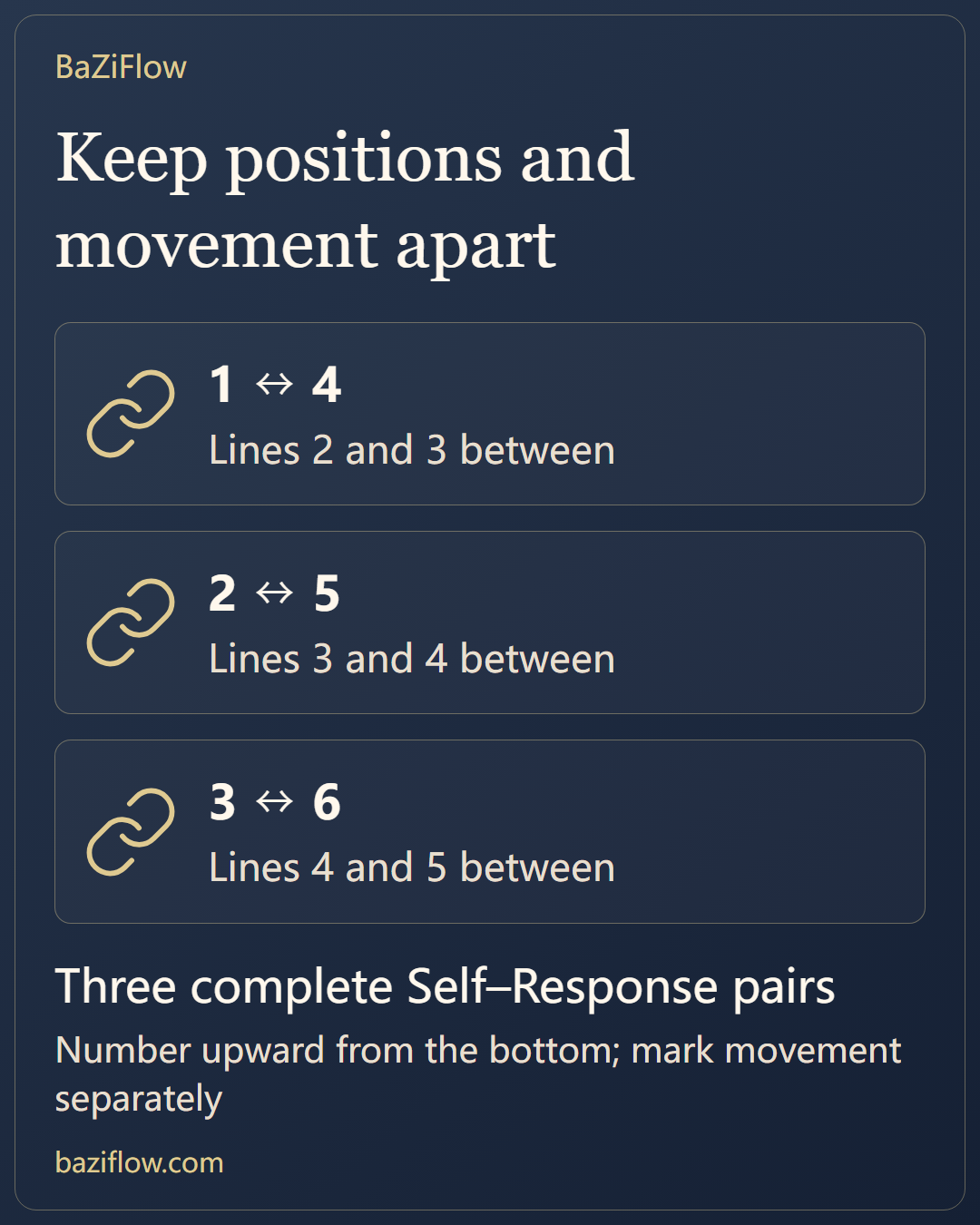
Check the Qian palace sequence and the three-position gap, then distinguish a primary hexagram’s Self from movement, changed charts, and assigned roles.
The short version6 min read
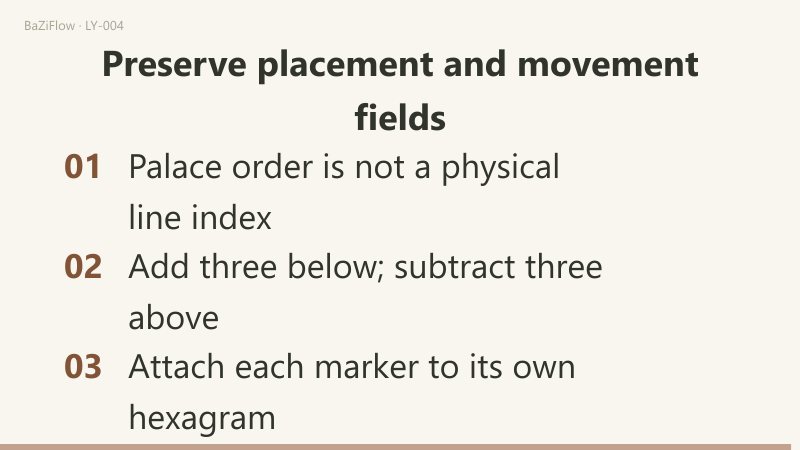
Jin is the seventh member of its palace but places Self at line four; it has no seventh line. Likewise, Qian’s bottom-line movement leaves its original Self and Response at six and three. Look up membership first, derive the paired position, and record movement separately.
- Palace membership order and physical line position are different indices: Wandering Soul uses Self four and Returning Soul uses Self three.
- Two intervening lines make the endpoints three positions apart: add three in the lower half and subtract three in the upper half.
- A changed Gou figure has its own lookup result, which must not overwrite the original Qian figure’s markers.
Read first
Self and Response are positions before they are a story
Shi and Ying, often translated as Self and Response, mark a pair of line positions in a Liuyao chart. A familiar statement in the Golden Strategies assigns Self to oneself and Response to another person. That is a starting convention for interpreting roles, not permission to identify every Response line as a romantic partner or an opponent.
The same work's weather section gives these positions a different frame, relating Response to the sky and Self to the earth. The subject of the question therefore matters. This article first establishes the reproducible placement, then distinguishes it from movement and from an interpretation of who is involved.
Two-party question
- Name each side
Weather question
- Different role frame
Use palace order, not the most conspicuous line
In the eight-palace arrangement, each palace contains eight hexagrams. The pure hexagram places Self at line 6. The next five members place it at lines 1, 2, 3, 4, and 5. The seventh, called Wandering Soul, places it at 4; the eighth, Returning Soul, at 3. These are classification terms in the arrangement. They do not by themselves diagnose a person's mental state or predict a return journey.
The placement song in Bushi Quanshu gives this rule and explicitly pairs each Self position with its Response. Zengshan Buyi illustrates it using the Qian palace. The palace index is a different number from the line index:
| Order in the Qian palace | Hexagram | Self | Response |
|---|---|---|---|
| 1, pure | Qian | 6 | 3 |
| 2 | Gou | 1 | 4 |
| 3 | Dun | 2 | 5 |
| 4 | Pi | 3 | 6 |
| 5 | Guan | 4 | 1 |
| 6 | Bo | 5 | 2 |
| 7, Wandering Soul | Jin | 4 | 1 |
| 8, Returning Soul | Dayou | 3 | 6 |
There is no seventh or eighth physical line. Continuing the Self index upward simply because the palace list continues would be a category error. For a hexagram from another palace, establish its membership and position in that palace before applying the same placement pattern.
A textual detail deserves care: the cited online transcription of Zengshan Buyi writes “Heaven over Earth” for Guan in this passage, whereas the Bushi Quanshu material names it Wind over Earth. We use that corroborated name rather than inventing an alternative structure from the transcription. No claim of manuscript collation is implied.
Bo
- Palace order 6
- Self line 5
Jin
- Palace order 7
- Self line 4
Two intervening lines means a difference of three
The instruction that two positions separate Self and Response describes the lines between the endpoints. Between lines 1 and 4 are lines 2 and 3. Between lines 6 and 3 are lines 5 and 4. Thus the paired indices differ by three, not two.
If Self is at 1, 2, or 3, add three to locate Response. If it is at 4, 5, or 6, subtract three. This arithmetic is a compact way to check the traditional six pairs, not a new casting procedure. Qian gives 6 minus 3 equals 3; Gou gives 1 plus 3 equals 4; Jin gives 4 minus 3 equals 1.
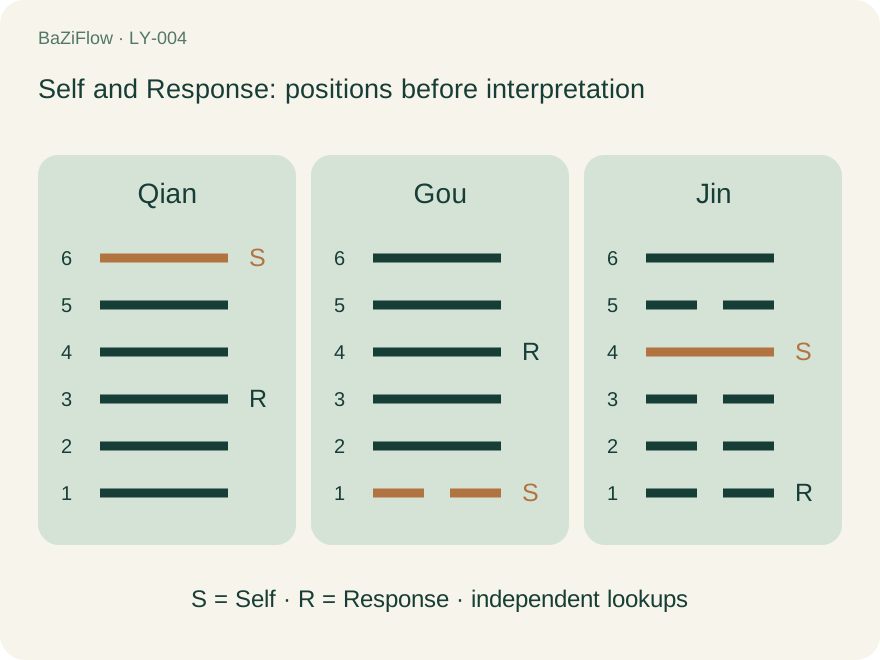
Original BaZiFlow position comparison. The three diagrams are independent lookups, not a claimed sequence of changes in one reading.
Lower half
- 2 + 3 = 5
Upper half
- 5 − 3 = 2
A moving line does not relocate the original Self
Consider a separate supplied exercise: Qian with only line 1 moving. Qian still has Self at 6 and Response at 3. Line 1 receives a movement mark in addition to its other annotations. Reversing its solid line produces Gou, with Wind below Heaven.
Looked up as an independent hexagram, Gou has Self at 1 and Response at 4. That is a true statement about Gou's own placement. It is not a reason to overwrite Qian's original Self at 6. A display that shows independent placements for both primary and changed hexagrams must label which hexagram owns each set of markers.
Movement records which line changes state. Self and Response record positions assigned to the given hexagram. A position can happen to carry both Self and movement, but that coincidence is not the definition of Self. A still Qian hexagram has the same pair of positions; two moving lines also do not create two original Self lines.
For the earlier assembly layers, see Najia, Six Relatives, and Six Spirits. Adding another annotation should preserve the provenance of the existing columns. It should not make the most visually prominent symbol take over their functions.
Original Qian
- Moving 1
- Self 6 / Response 3
Independent Gou
- Self 1 / Response 4
Preserve the question's subject when assigning roles
For a question about coordination between two parties, a reader may use Self and Response as a stated frame for the two sides. Write down which side each term represents before developing an interpretation. This is a record of an interpretive choice, not evidence that the other party agrees, opposes, or has a particular private intention.
A question about a document or object needs its own subject selection. Response is not automatically the object merely because it is “other,” and Self is not automatically the useful category for every question. See choosing the useful god for that separate step.
The Qian chart offers another useful distinction. Its top Dog (戌) Earth line can be both Parents and Self, while its third Dragon (辰) Earth line can be both Parents and Response. Parents comes from Earth generating the Metal palace; Self and Response come from palace placement. These labels can coexist without identifying actual parents or contradicting one another.
An auditable record therefore keeps the primary hexagram, palace position, Self/Response indices, and movement marks separately. It also records the subject used in the explanation. First check the indices against the placement table, then check whether “self” or “other” silently changed referents during the reading. Neither correct arithmetic nor a traditional role label alone supplies a factual verdict about the people involved.
Line 6: Dog Earth
- Parents + Self
Line 3: Dragon Earth
- Parents + Response
Questions readers ask next
Why add three when the wording mentions two positions?
The two intervening positions exclude both endpoints. Going from one to four passes through two and three before reaching four, moving three indices. Checking the reverse pairing, four back to one, helps confirm the rule.
Can Qian and Gou display their own markers side by side?
Yes, provided each set is explicitly attached to its figure as an independent placement. Two correct lookups do not establish a rule that Qian’s Self migrated from six to one; ownership of each field matters.
Is a line marked both Parents and Self contradictory?
The labels describe different dimensions. Parents compares a branch phase with its palace phase, while Self identifies a position by palace order. Their coexistence neither identifies a real parent nor requires deleting one label for visual neatness.
Was this article helpful?
Sources & references
Continue reading
Choosing the useful god: define the subject and retain candidates ↗
Moving lines and changed counterparts: auditing Xu to Song ↗