

Kan: water on water, only the heart passes through
Content version · · Sources & references
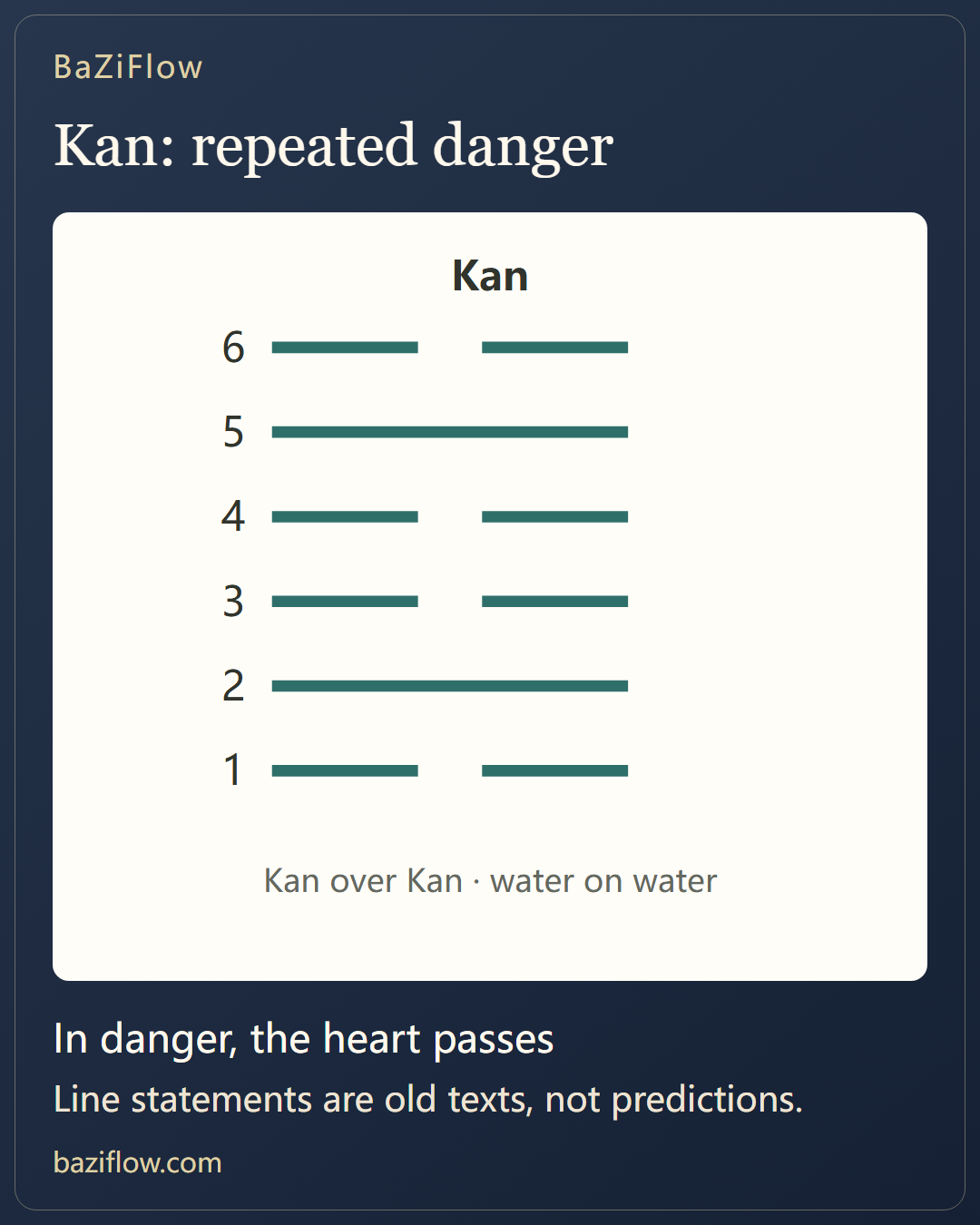
Kan is the 29th hexagram: water on water, each trigram yin, yang, yin. The judgment says "have sincerity; only the heart passes through". The Image runs from wave on wave to teaching, and "ill" shows only at the ends.
The short version8 min read
Kan literally means a pit, a falling in; the Commentary on the Judgments names the hexagram "repeated Kan", danger on danger. Yet the judgment says "have sincerity; only the heart passes through": the Commentary ties "the heart passes through" to the firm central lines held between two yin.
- Kan (坎) is two Kan (water), each trigram yin, yang, yin, so the two yang lines, lines two and five, are each held in the middle. The Shuo Gua says "Kan is falling in"; the Commentary calls it "repeated Kan, danger upon danger".
- The Commentary explains the judgment as not losing trust, with the heart as the firm line at the center, and ends by turning from danger to "setting up dangers to guard the state".
- In the Image, "repeated" is wave after wave and also what the noble person does again and again: make conduct constant and rehearse the work of teaching. "Ill" is written only in lines 1 and 6.
Read first
The Sixty-Four Hexagrams: How Upper and Lower Trigrams Form One Figure ↗
Judgment and Line Statements: Whole Hexagram or Single Line? ↗
Water on water: one yang line between two yin
Kan (坎) is the 29th hexagram. Both the upper and lower trigram are Kan, and the Commentary on the Judgments calls it "repeated Kan" at its first words. Each trigram is yin, yang, yin: a yang line held between two yin lines. The Shuo Gua says "Kan is falling in" and also "Kan is water". Water runs low and falls into hollows, so two meanings land on one figure.
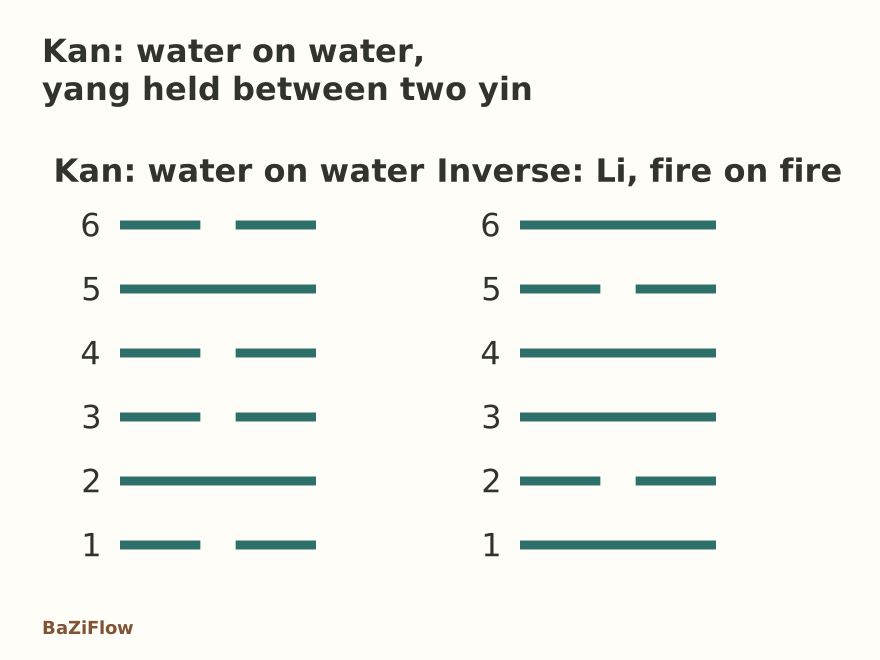
Kan and its inverse Li: the inverse changes every line, so yin, yang, yin becomes yang, yin, yang.
Enlarge diagram · scroll sideways to read
Three words before reading Kan
- Repeated Kan
- The Commentary on the Judgments says "repeated Kan means danger upon danger". Repeated here means layered: a pit on a pit, danger on danger.
- Pit within a pit
- Kan is a pit, and the second word is a smaller pit sunk in the floor of the first. Lines one and three each say "falls into the pit within the pit".
- Sincerity
- The word for "sincerity" in the judgment's "have sincerity": good faith, something to rely on. The Commentary later puts it as "does not lose its trust".
With two Kan stacked there is no third kind of line: each layer holds one yang line, and those are lines two and five. When the Commentary later says "the firm is central", these are the two it means.
The judgment and the Commentary: only the heart passes through
The judgment of Kan is short: "have sincerity; only the heart passes through; going brings esteem". The Commentary on the Judgments first speaks of the danger, then takes the judgment clause by clause, and finally turns to dangers of heaven and earth.
Repeated Kan means danger upon danger. Water flows and does not fill; it passes through danger and does not lose its trust. "Only the heart passes through": it is by being firm and central. "Going brings esteem": to advance brings merit. The danger of heaven cannot be climbed; the danger of earth is the mountains, rivers and hills; kings and nobles set up dangers to guard their states. How great is the time and use of Kan!
Enlarge diagram · scroll sideways to read
"Water flows and does not fill" names two acts of water: it keeps flowing and does not fill the pit. "Passes through danger and does not lose its trust" is holding on to reliability inside danger, which is the judgment's "have sincerity". "Only the heart passes through, by being firm and central" is read off the figure: the two yang lines held in the middle are the heart, firm and in the central place.
The close changes direction. Until then danger is something to go through; the last few clauses say danger is also useful. Heaven's danger cannot be climbed, earth's danger is mountains, rivers and hills, and kings and nobles even set up dangers to guard their states. "Repeated Kan" ends as "great is its time and use".
The Image: water wave on wave, and repeating the work of teaching
The Image takes "repeated" from danger to doing.
Water arrives again and again: repeated Kan. The noble person makes conduct and virtue constant, and repeats the work of teaching.
Enlarge diagram · scroll sideways to read
The first verb means arriving one after another. The water does not surge up once; it comes again and again, and that is "repeated Kan". The noble person's part is also to do things again and again: "constant conduct and virtue" makes behavior steady, and "repeating the work of teaching" is going over the matters of teaching time after time. The same word is layering in the image, and becomes repeated practice in the noble person.
The six lines: "ill" is written only at the ends
Of the six statements, "ill" appears only at the two ends, the bottom line and the top line; the four in the middle do not use the word.
Enlarge diagram · scroll sideways to read
Line 1: "falls into the pit within the pit", and the Small Image says "he has lost the way". Line 3 also says "falls into the pit within the pit", with "coming or going, pit upon pit" before it, and its verdict is "do not act", with the comment "in the end no achievement". Two lines both land in the inner pit; one is ill and the other is "do not act".
Of the middle lines, line 2 seeks "a small gain" and its Small Image says "not yet out of the middle"; line 5 is "the pit does not fill" with "the center is not yet great". The Commentary praises these two as "firm and central", while each Small Image adds a reserve: one has not yet come out, the other is not yet great. Line 4 is the most unusual: "a jug of wine, a bowl of food, and an earthen pot", then "the pact brought in through the window" (readings differ; see below), and "in the end no blame". At the top, line 6 is bound with cords and set in a thicket of thorns, with no release for three years.
Li, Yi and the Xu Gua: handing the danger to the next hexagram
The inverse of Kan is Li (離): every line changes polarity, yin, yang, yin becomes yang, yin, yang, and water becomes fire. Kan flipped over is Kan again, so it is its own reversed form. For the nuclear hexagram, take the middle four lines as two overlapping groups of three: Zhen (moving) comes out below and Gen (stopping) above, and together they read Yi (頤).
Enlarge diagram · scroll sideways to read
The Xu Gua gives Kan a sentence on each side. Before it is Daguo: a thing cannot keep going too far, so it falls into Kan. After it is Li: what has fallen must have something to cling to, so Li follows, and the name Li means to cling. Seen this way, Kan sits between going too far and clinging, the place where a fall has to find something to hold.
Questions readers ask next
Is Kan a hexagram of misfortune?
Not simply. The judgment says "have sincerity, only the heart passes through"; of the six statements, only the first and the top say "ill", and the four in between do not use the word; and the Commentary closes with "great is the time and use of Kan". The hexagram is about danger, but the text does not treat danger only as bad.
What does "sincerity" mean in "have sincerity"?
The word is usually read as good faith or trustworthiness and appears in many hexagrams. Here the Commentary goes on to say "passes through danger and does not lose its trust", changing the word to "trust", so it can be taken as the reliability one keeps even inside danger.
Does "three years" in the top statement mean three calendar years?
Literally it says three years, and the Small Image only repeats "misfortune for three years". The text does not say whether the number is exact or stands for a long time. Quote it as written and do not convert it into some real year.
Was this article helpful?
Sources & references
Continue reading
Daguo: the sagging and the arching ridgepole, two withered poplars, a ford over the head ↗
The Sixty-Four Hexagrams: How Upper and Lower Trigrams Form One Figure ↗
Judgment and Line Statements: Whole Hexagram or Single Line? ↗