

Ace of Cups
Content version · · Sources & references
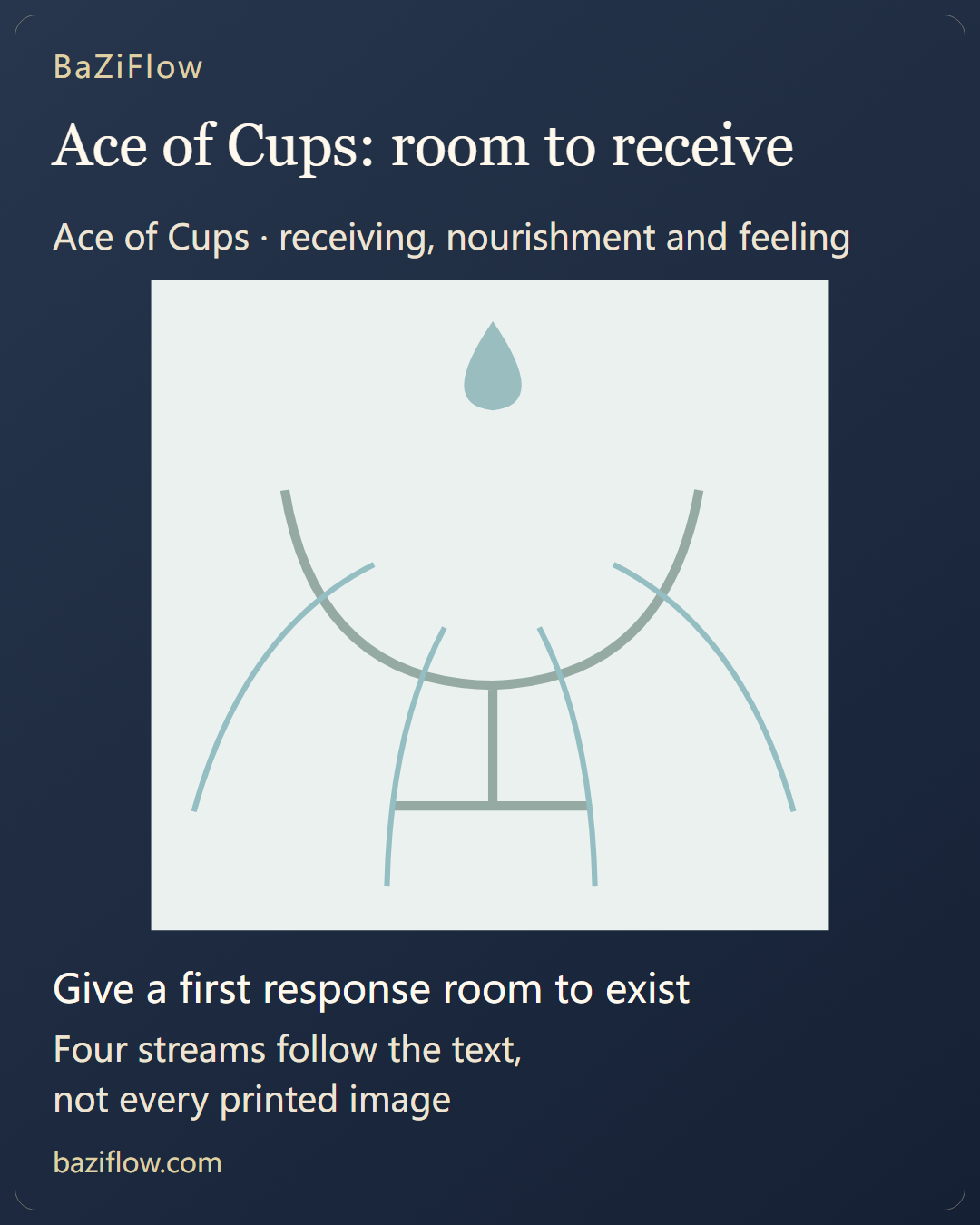
Read the RWS Ace of Cups through its religious imagery and nourishment themes, separating felt experience, chosen expression and another person’s response.
The short version6 min read
A hand holds the cup, a dove lowers a wafer into it, and water flows outward. The Ace begins with receiving and nourishment. A modern reading can give emerging joy some space without demanding that it prove a lifelong direction or a mutual relationship.
- The cup, dove and cross-marked wafer belong to a religious scene; joy and nourishment are not confined to the start of dating.
- The cited Waite text says four streams; the picture shows five, so other printed images need their own check rather than a single settled count.
- A feeling may be real and later change, while choosing to express it does not establish another person’s matching response.
Read first
The source includes a sacramental scene
On the RWS card, a hand reaches out of a cloud holding a golden cup, and a dove carrying a cross-marked wafer descends from above; water lilies float on the pond below and drops fall all around. Five streams pour from the cup in the picture, while the Waite text cited below says four; the teaching diagram here follows the text.
Waite’s description places the cup above water and lilies, held by a hand emerging from cloud. A dove carries a cross-marked sacramental wafer toward it. His language includes a holy table alongside joy, contentment and nourishment. Reducing the entire entry to the start of dating would erase a substantial religious context.
Describing that context does not ask the reader to adopt the belief. It identifies what the historical text is doing before a modern application is added. The text’s abundance and fertility vocabulary likewise should not be converted into factual claims about someone’s health or reproductive circumstances.
There is also a detail worth keeping precise: the cited webpage describes four streams. This article follows that wording rather than rewriting the quotation to match the five streams visible in the picture. It does not use the textual count to settle every deck edition or assign a universal meaning to bodily senses. Comparing a particular printed image with the description would be a separate task.
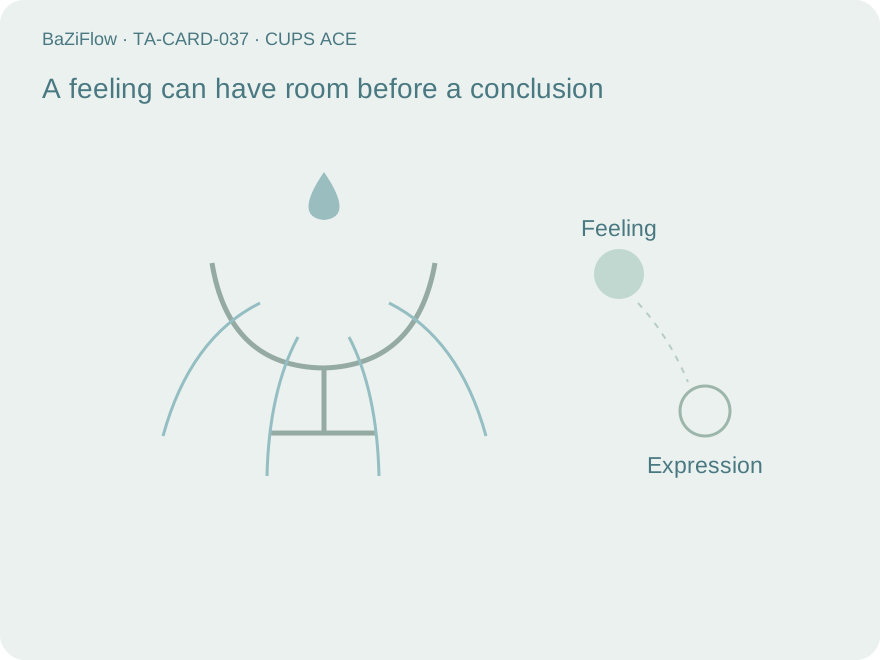
An original BaZiFlow receptivity diagram for the Ace of Cups. Four streams follow the cited webpage’s wording, not a universal image-count claim or a prediction.
The religious action in Waite’s text, not stages in a modern relationship.
Your experience and another person’s response are separate
You leave a small exhibition feeling unexpectedly eager to draw. At home, you note which colors held your attention. That response has already happened. Whether the interest will last, whether you will study art and whether a friend will share your enthusiasm remain different questions.
The Ace of Cups can serve as a prompt to recognize such an opening without requiring it to define the future. A feeling does not need a lifelong outcome to be worth noticing. Equally, its intensity does not establish what someone else feels or promises.
This is a contemporary reflective exercise. The card is not a notification of a new romance, a pregnancy assessment or evidence that an emotional disclosure will be reciprocated.
For the exhibition example, three distinctions can be recorded:
| What happened | A possible response | What remains open |
|---|---|---|
| A work held your attention | Note the color or subject that mattered | Whether this interest will persist |
| You want to tell a friend | Share a specific impression | Whether the friend feels similarly |
| You want to try drawing | Arrange one modest attempt | Whether you want sustained study later |
The exercise gives the feeling a place without turning it into a test of commitment. One drawing can be worthwhile even if it is the only drawing you make that week. A clear note to a friend can be sincere even if the reply is brief.
Expression is also optional in degree and timing. You can say that you are sharing an experience rather than asking for advice, or keep it in a notebook for now. A metaphor of openness should not pressure anyone to disclose more than they choose.
Feeling
- This painting moves me
Expression
- I choose to share a detail
Response
- The other person responds
Leave the other person’s node unfilled
The open cup and four streams in the diagram explore receiving and allowing movement. The two side nodes distinguish a felt experience from its expression. The image does not add another person’s agreement at the end, as though disclosure guaranteed a matching response.
Its stream count follows the cited wording for this teaching image; it is not offered as a reference for counting details in every RWS print. Nor do the streams represent four dates or four events that must occur.
Nourishment in the modern example can be concrete: time to look again, access to an art book or materials for a short trial. These are conditions someone may arrange, not a treatment plan or a promise that an interest will resolve unrelated difficulties.
Compare the Two of Cups, where two figures’ mutual action makes reciprocity a more direct topic. Here the focus is the opening of experience and the space to receive it. A personal beginning should not be confused with an agreement between two people.
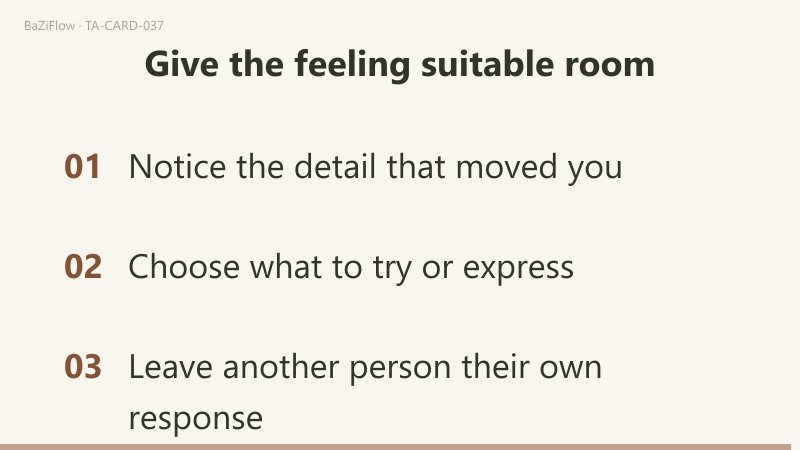
Choose one detail
Here: blue beside gray, not copying the whole work.
Make a little room
A page and some free time can be enough; a long course need not be decided first.
Notice what you enjoy
Wanting to continue or preferring simply to look can both teach you something.
Reversal does not expose a false heart
Waite’s reversed entry uses language of falseness and change. The supplementary list gives quite different assignments concerning steadfastness and a changed position. Together they do not form a calibrated scale of emotional sincerity.
A reversed card therefore cannot justify accusing someone of deception, and an upright one cannot guarantee honest affection. The historical terms remain interpretive claims. The additional-meanings chapter itself acknowledges tension among its assignments and limited connections to the designs.
If an upright and reversed approach asks how easily a feeling can be expressed, identify that as your present-day question. It is not knowledge of the reader’s inner state supplied by the card’s orientation.
Close the example with the detail that moved you, the small action you want to try and the responses still unknown. An experience can be welcomed at its actual scale. It need not be promoted into a completed story before it has had room to develop.
Then
- Quiet blue really appealed
Later
- Want a brighter palette
Both can be true
- Change does not erase the first experience
Questions readers ask next
Does the Ace of Cups always describe a new romance?
No. Waite describes a sacramental scene and includes joy, contentment and nourishment. A modern reading may explore fresh feeling, creative interest or receptivity. Whether romance actually develops depends on real interaction between the people concerned.
Why does this teaching diagram have four streams?
The cited webpage explicitly describes four, so this original diagram follows that textual count. It is not a calibration image for every RWS edition, nor a basis for assigning senses, dates or inevitable events. A printed version should be checked separately.
If an interest changes, was the first feeling insincere?
Not necessarily. The original response and the later change can both be genuine. Notice the specific detail that mattered and adjust what you want to try. Continuing the same activity indefinitely is not required to validate the first experience.
Was this article helpful?