

Attach the rule and conditions to each label
Content version · · Sources & references
Two passages in the same classical work give Tian Peng different flourishing and supporting labels. Learn to retain the source, object, time convention and palace condition instead of blending incompatible tables.
The short version6 min read
For Tian Peng, the winter group is Xiang in volume one and Wang in the volume-three table; the spring group reverses those labels. The difference lies in classification rules. Keep time, palace and assessed object distinct so another reader can reproduce the label.
- A book title alone may hide different definitions in different volumes or tables.
- Time status and palace relations require separate inputs; one cannot fill a missing other.
- Disambiguate relational child (子) from calendrical Rat (子) before applying a month rule.
Read first
Doors, Stars and Spirits: Keep the Qimen Layers Distinct ↗
Choosing a Qimen significator before looking for its palace ↗
Two readers can disagree while using the same book
One reader calls Tian Peng “Wang” in the winter group of months. Another calls it “Xiang.” Both cite Dun Jia Yan Yi. Before deciding that one has made an arithmetic error, ask for the volume and passage: the Siku text contains the two arrangements discussed below.
Wang (旺) and Xiang (相) are traditional status labels, often glossed as flourishing and supporting or active. The glosses are not a measurement scale. This article retains the terms so that a difference in the source is not hidden by translating both as simply “strong.”
A citation that gives only a book title cannot resolve the disagreement. The particular rule, the object being assessed and the time basis must travel with the result.
Tian Peng
Winter
- Vol. 1
- Xiang
- Vol. 3
- Wang
Spring
- Vol. 1
- Wang
- Vol. 3
- Xiang
Only the two compared groups
Compare the two entries without repairing the text
The verse included in volume one treats a same-element month as Xiang and the month of the element produced by the star as Wang. Its water-star example, Tian Peng, is Xiang in early and middle winter and Wang in the first two months. The star section of Qi Men Dun Jia Tong Zong gives the same Wang–Xiang ordering for its Tian Peng example.
The nine-star month table in volume three of Dun Jia Yan Yi instead places Pig (亥) and Rat (子) months under Wang and Tiger (寅) and Rabbit (卯) months under Xiang for Tian Peng. These are different assignments, even before any palace relation has been considered.
| Traditional month group for Tian Peng | Volume-one verse | Volume-three star table |
|---|---|---|
| Early/middle winter; Pig/Rat group | Xiang | Wang |
| First/second months; Tiger/Rabbit group | Wang | Xiang |
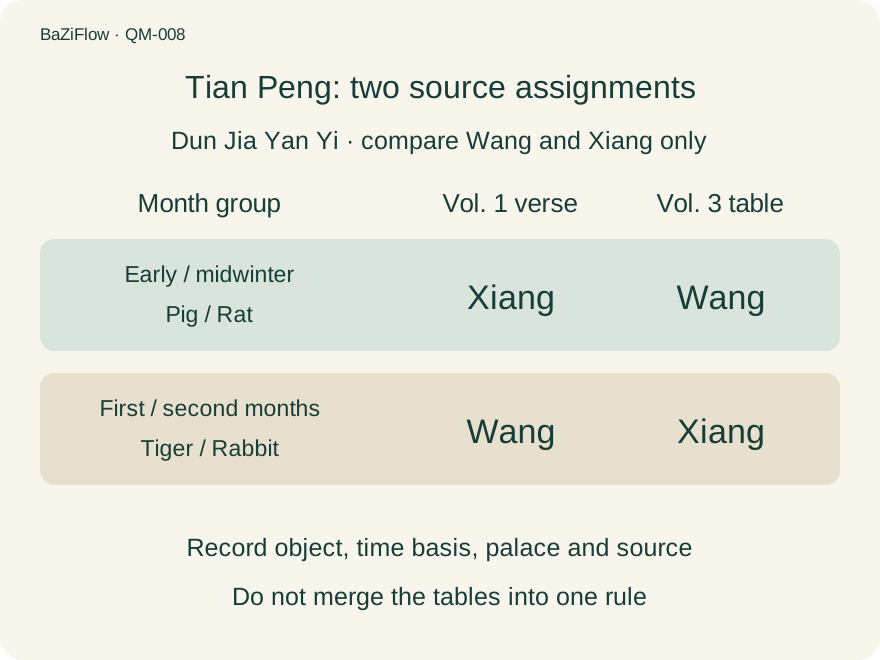
Original BaZiFlow source comparison. Only the explicitly stated Wang and Xiang entries are compared; other status terms are not combined into a single reconstructed table.
The comparison preserves the sources' traditional month terminology. It does not calculate the month for a modern civil date. Near a seasonal boundary, an applied reading still needs its calendar convention and boundary definition rather than treating the printed group names as a complete date conversion.
Only the two named columns are compared here. The surrounding prose and tables also use other status terms in different ways. Taking one formula from one passage and filling its remaining columns from another would create a tidy table at the cost of inventing a unity the cited material does not establish.
Volume 1
Xiang
- Month relation
- Same element
- Tian Peng / Water
- Winter / Water
Wang
- Month relation
- Generated element
- Tian Peng / Water
- Spring / Wood
A relation word is not always a calendar label
Tong Zong's wording about a star being Wang in its “child month” can be misread if the character for child is treated automatically as the Rat branch. Its following example puts Tian Peng's Wang in the first two months. The context is the generated-element relationship: water generates wood.
The worked example therefore constrains the meaning of the short term. Reading it as only the Rat month would conflict with the example in the same passage. This is a small but consequential distinction between an element relationship and a calendar designation.
A reliable note retains the definition with the chosen rule. It should not identify every appearance of a short traditional marker as the same entity, and it should not switch definitions midway through an example. Source comparison is one task; applying a declared version consistently is another.
Generated-element relation
Palace information answers a different question
Time is not the only condition in traditional strength discussions. Tong Zong's introductory notes use the metal Open door to discuss both season and the palace it occupies. These are separate inputs, not two names for a single score.
Suppose an exercise supplies only “Open door in Kun 2.” Under the selected element correspondence, it is possible to describe the earth-palace and metal-door relation. The season has not been supplied, so the record cannot also claim that the door has the appropriate timing. Conversely, knowing a season does not tell us where the door currently lies.
This limited relation does not establish a favorable real-world outcome. It is one component of a traditional reading, not a complete chart or an observed causal effect. Even the name Open cannot show that a proposal will be approved or that an actual entrance is available.
There is a further category change to watch. Tong Zong also lists door states against eight seasonal nodes, including Rest at the winter solstice and Life at the beginning of spring as Wang. That is a door-and-seasonal-node table. It must not silently replace a star-and-month table just because both use the same status word.
Month not supplied
Write enough for another reader to reproduce the label
For a star, knowing its identity and month may permit a time label under a specified table while leaving palace relations unknown. For a door, knowing its palace may permit a local element relation while leaving its timing unknown. These are different missing-data situations; assigning both a generic medium score would conceal the distinction.
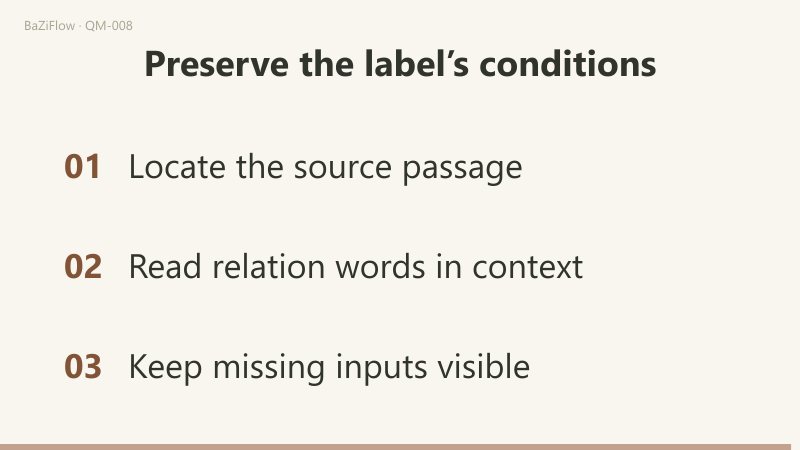
Retain the assessed object and layer, source passage, time scale and boundary convention, actual palace, and any missing inputs. If two sources are compared, give each its own result. If only one is being applied, name it and resist borrowing whichever entry looks more convenient from the other.
The significator and palace-selection discussion explains why this object was chosen in the first place. The door, star and spirit categories help prevent a table for one class from being used on another. Neither step can be replaced by a single strong-or-weak badge.
These labels describe states within declared traditional rules. They are not measured physical energy and do not by themselves predict success. The useful result here is a traceable classification whose conditions are visible, including the places where the texts do not agree.
Star + month
- Palace still unknown
Door + palace
- Time still unknown
Questions readers ask next
Why not choose Wang for both winter and spring?
That combines two definitions into a result neither complete table provides. Compare each source as a whole, or apply one declared definition consistently instead of choosing labels entry by entry.
Does Open in Kun two reveal its month?
The earth-palace and metal-door relation is local information, not a season. Leave timing unspecified until a date and month convention are established.
Should conflicting status labels be averaged?
Retain their definitions and separate results first. Wang and Xiang are not a shared measurement scale with an automatic numerical average. Naming the adopted passage is more reproducible than inventing a middle score.
Was this article helpful?
Sources & references
Continue reading
Three Wonders, Six Instruments and Two Stem Layers ↗
Door restriction, striking punishment and tomb entry differ ↗