

Evidence across reading systems
Content version · · Sources & references
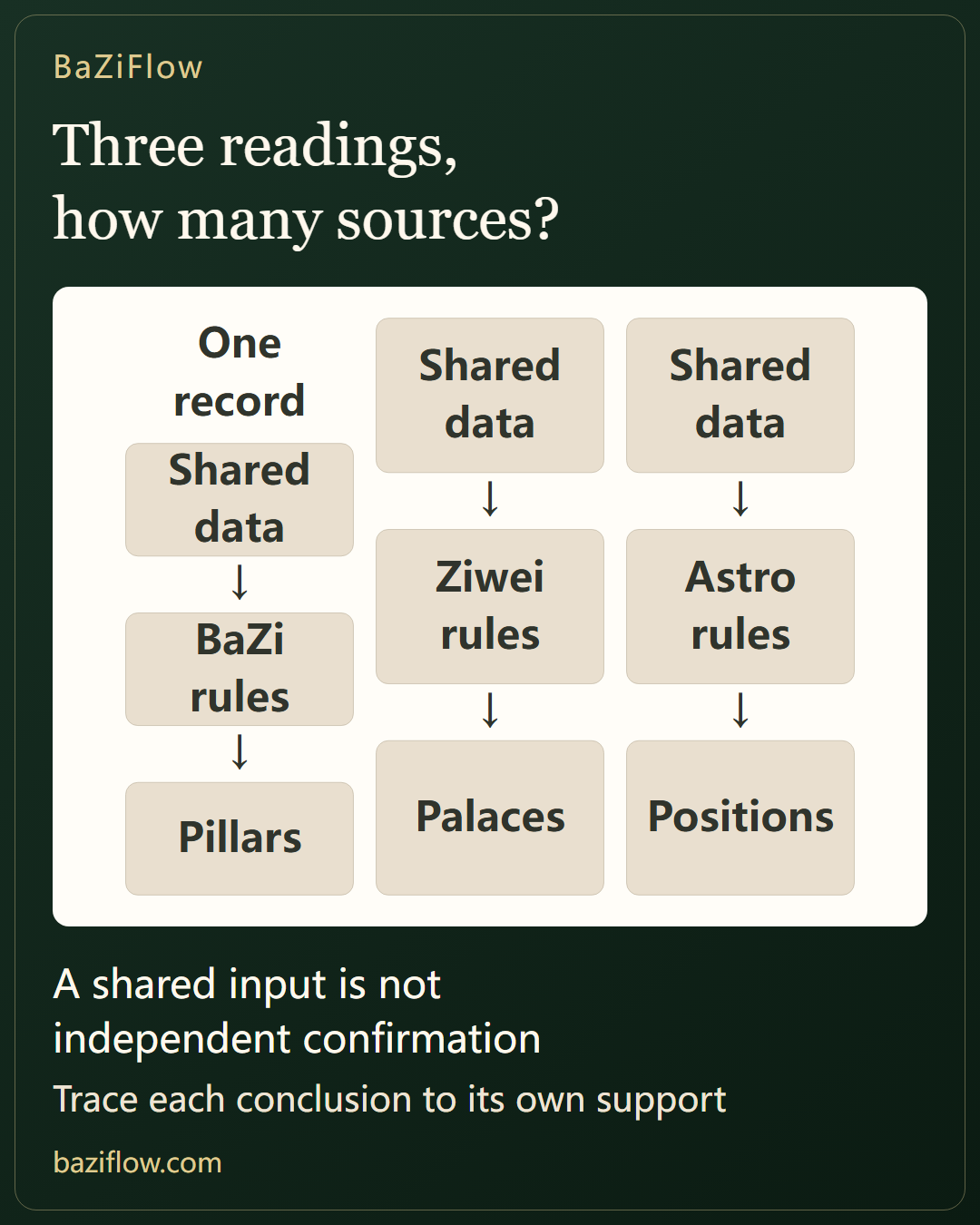
Track shared inputs, method-specific calculations and interpretations before writing a synthesis. Compare equivalent claims, preserve disagreement and avoid turning repeated descriptions into extra evidence.
The short version5 min read
If three readings encourage learning, have you gained three independent confirmations? Identify their shared information and the proposition each actually addresses before comparing them.
- A shared birth record remains one input and can carry uncertainty into several paths.
- Pillars, palaces and planetary positions are different objects despite overlapping vocabulary.
- A synthesis preserves reasons and differences while checking costs and schedules separately.
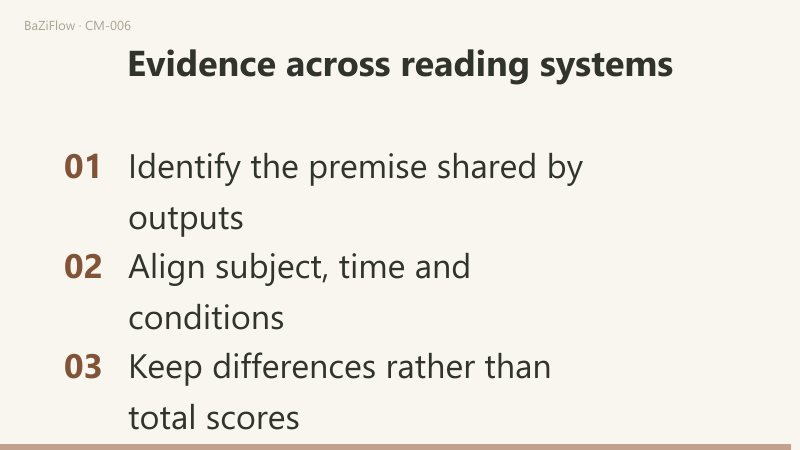
Read first
Start with a ledger, not a combined score
Give the reading three layers: the information supplied, the processing performed by each method, and the interpretation attached to its output. This makes a synthesis auditable. It also reveals where several apparent reasons are actually repetitions of one premise.
A birth date used by three systems is still one item of supplied information. If that date or its meaning is uncertain, several outputs may inherit the same uncertainty. Agreement among them does not independently confirm the original record. Save its provenance once, then show which paths depend on it.
This guide uses fusion to mean reading several methods together. It does not promise that every BaZiFlow tool exposes the same fields, settings or synthesis mechanism. Inspect the features and explanations actually available in the current interface.
| Layer | What may be shared | What stays method-specific |
|---|---|---|
| Input | A person's original record and its source | Whether a method uses each item |
| Processing | Confirmed meaning of time and place | Calendar handling, conventions and calculation |
| Output | The identity of the person being discussed | Fields, reference objects and time layers |
| Interpretation | A topic such as learning | The argument, qualifications and unresolved differences |
Keep shared inputs and separate reasoning visible
- Shared premise
- Information or an assumption used by several outputs without becoming several independent sources.
- Traceable synthesis
- A summary whose claims can return to each method’s fields, argument and conditions.
The same word can hide a different object
BaZi pillars, Ziwei palace placement and astrological planetary or house positions are not interchangeable quantities. Even the word house or palace does not create a one-to-one correspondence between methods. Identify the actual object before translating its symbolic role into a shared vocabulary.
The date-and-time discussions in volume two of San Ming Tong Hui and the life-and-body placement passage in volume two of Ziwei Doushu Quanshu provide traditional textual entry points. Swiss Ephemeris documentation supplies a technical account of house-calculation parameters. These sources have different evidential roles. They document particular rules or calculations, not demonstrated personal predictive performance.
If a shared time is corrected, follow its dependencies through the relevant paths. Some fields may require recalculation; other material may be unaffected or still unreviewed. Updating one paragraph does not automatically repair every conclusion that relied on the old premise.
Pillars
- Stems, branches and references
Ziwei palace
- Topic and placement rules
Astrological house
- Spatial division and method
Compare a proposition, not a topic heading
Three sections headed learning may be discussing different things: a long-term structure, resources within a period, or a reflective approach to a present choice. First specify the subject, time and conditions. Only then decide whether the statements agree, conflict or simply address different questions.
For example, a recommendation to maintain a routine can coexist with advice to leave room for change if they concern different activities. If both concern the same activity at the same time, there may be a real trade-off. A graceful phrase about balancing stability and change does not resolve the issue unless it explains the relevant conditions.
When equivalent propositions remain opposed, preserve the disagreement and its reasons. Do not automatically prefer the more appealing statement. The guide to conflicting conclusions offers a way to locate the difference before deciding what can be said together.
Maintain a routine
- Activity
- Regular revision
- Time
- Every morning
Leave room for change
- Activity
- Optional lecture
- Time
- Weekend evening
Keep the paths visible in the finished synthesis
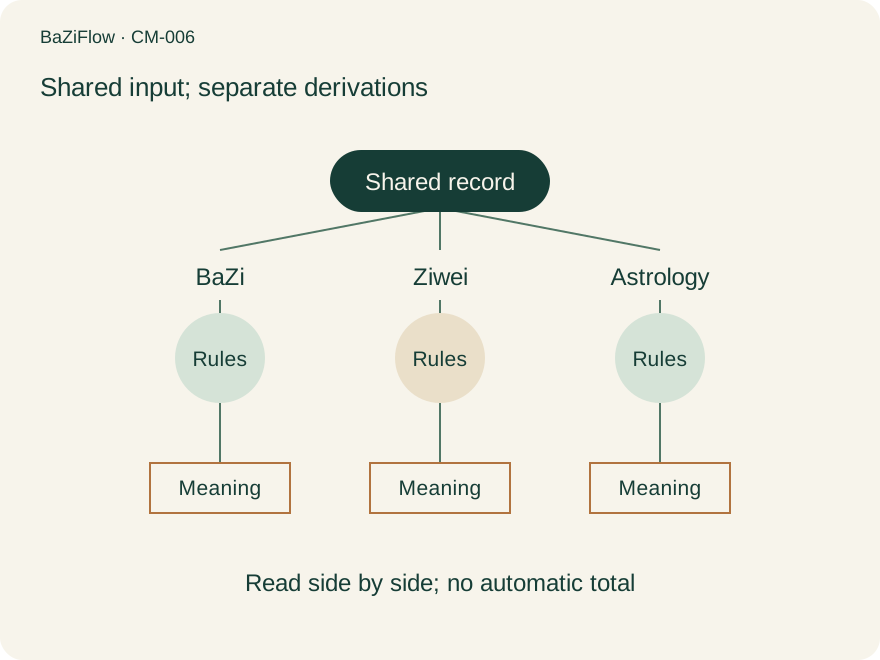
Original BaZiFlow evidence-path diagram. The three paths are instructional, not proof of validity or a promise of identical product fields.
The diagram branches from a common record and keeps the outputs beside each other. It deliberately avoids a total score. The purpose is to let a reader trace a sentence back through the method that produced it, while recognizing that the initial data may be shared.
Descriptions such as cautious, organized and stability-seeking may overlap in ordinary language. They might also come from similar writing conventions. Before presenting them as several input-specific reasons, identify what distinctive evidence supports each one. Repeated wording is not automatically repeated observation; agreement is not proof develops that distinction.
Nor should scores from different scales be averaged without an established meaning for the operation. Different ranges, definitions or reference populations do not become compatible merely because each is displayed as a number. This article supplies no weighting formula and no majority-vote rule for deciding future events.
Cautious
- Find the specific support
Organized
- Check for a paraphrase
Stability-seeking
- Not automatically another vote
Separate synthesis from the decision it may prompt
A readable final account can name the common record, state what each method addresses, and distinguish aligned claims from disputed or unknown ones. Then place real-world constraints alongside the account. They should not disappear into symbolic language.
For a learning activity, enrollment requirements, cost and available time can be checked directly. Several encouraging interpretations do not establish that the activity is feasible. Conversely, understanding those practical limits does not require forcing the symbolic methods to produce one common verdict.
Retain the original passages and the conventions used, not just the polished conclusion. If the synthesis cannot be unpacked, it may conceal exactly the differences it was meant to explain. Its value lies in making those differences intelligible while keeping the strength of each claim within its actual support.
Cost
- Direct check
- Does the available budget cover it?
Time
- Direct check
- Does it conflict with confirmed plans?
Eligibility
- Direct check
- Are enrollment conditions met?
Complete the learning claim
Specify the person, activity, period and conditions before deciding whether two passages address the same proposition.
Mark common information
If all passages use the same recorded birth time, keep it as a shared premise rather than three checks.
Name the actual trade-off
When both activities require the same limited evening, record the scheduling conflict instead of dissolving it into a polished phrase.
Questions readers ask next
Can agreement count as three votes?
First establish whether the support is independent and the propositions match. Several passages built on the same record or similar wording do not automatically provide separate confirmations.
Can palaces and houses be mapped directly?
Names alone do not define a correspondence. Identify each reference, division or placement method, then state whether you are comparing a computed field, symbolic topic or interpretation.
When should disagreement remain unresolved?
If subject, time and conditions match but conclusions still oppose each other, retain the arguments and unknowns. Without further support, a forced winner or elegant compromise adds no evidence.
Was this article helpful?
Sources & references
Continue reading
When Readings Disagree, Locate the First Divergence ↗