

Extracting lines and changing a line
Content version · · Sources & references
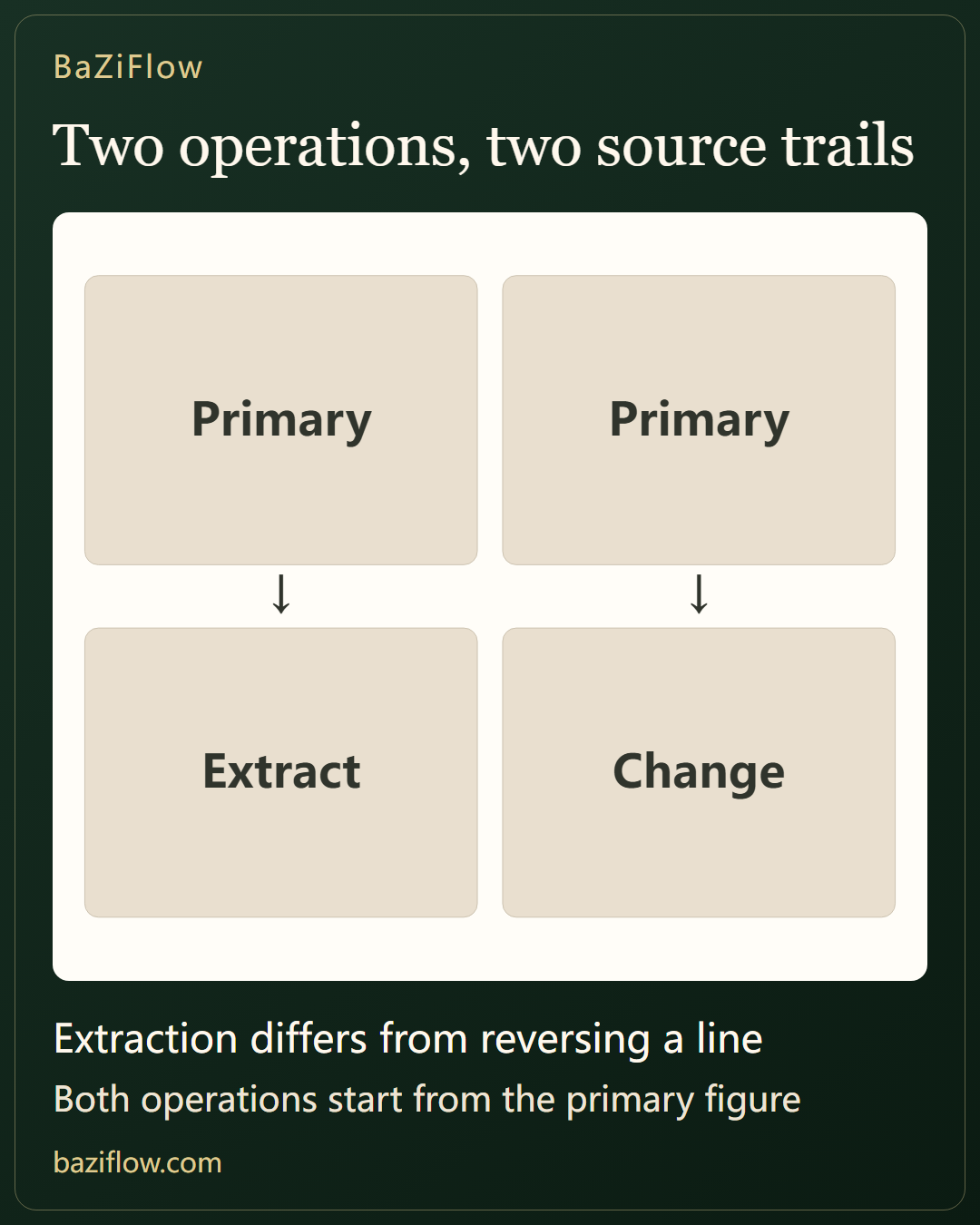
Audit two independent operations on Jiji: extract its inner trigrams to form Weiji, or change line three to form Zhun, while preserving the Qian–Kun textual caveat.
The short version6 min read
Jiji yields Weiji through nuclear extraction but Zhun when its third line changes. Both operations start from the unchanged primary figure. One reuses overlapping interior positions; the other reverses one designated line. Source indices explain the difference more clearly than the names alone.
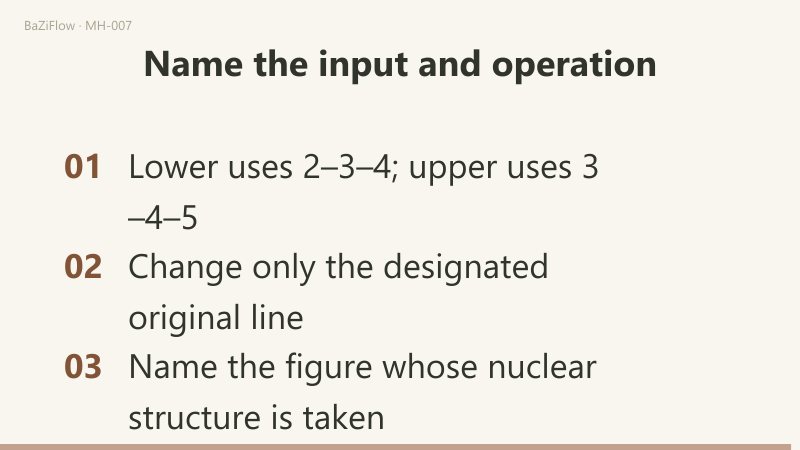
- The lower nuclear trigram uses original positions two, three and four; the upper uses three, four and five, overlapping at two positions.
- Jiji is yang–yin–yang–yin–yang–yin upward. Extraction gives Weiji; changing only its third yang line instead gives Zhun.
- The Qian–Kun note preserves another treatment involving the changed figure. State which procedure and input figure are being used.
Read first
Meihua Yishu: from eight trigrams to sixty-four hexagrams ↗
Determining a moving line: position first, then the change ↗
A diagram can be correct for the wrong reason
Suppose a worksheet lists three figures: Jiji, Weiji and Zhun. The names alone do not tell you how they are connected. A reader might assume that the middle figure is a step toward the last, or that the three stand for successive dates. Neither assumption follows from drawing six lines. To audit a Meihua worksheet, ask which operation produced each figure and which earlier figure supplied its lines.
The primary hexagram is the six-line figure being used as the starting point. A nuclear figure extracts overlapping groups from its interior. A changed figure reverses the yin or yang state of the designated moving line. Extraction and replacement are separate operations. This article examines that distinction before attaching any interpretation to the results. For the basic arrangement of two trigrams, see how trigrams form hexagrams.
Follow the source positions, not the printed order
Volume one of the Meihua Yishu describes nuclear extraction in its section on forming the mutual or nuclear trigrams. The outermost lines are set aside, leaving the four interior positions. In the usual explicit construction, original positions 2, 3 and 4 form the lower nuclear trigram; positions 3, 4 and 5 form the upper one. Read each group upward, just as you read an ordinary trigram.
The overlap matters. Original lines 3 and 4 are used in both groups. You are not dividing four lines into two equal halves, nor cutting the original hexagram into its existing lower and upper trigrams. Written as source indices, the resulting six positions are 2–3–4–3–4–5, counted from the new bottom upward. This index sequence is a compact audit trail: it records where every line came from.
The same section says that the eight trigrams suffice and that assigning a full hexagram name is unnecessary. Accordingly, a note identifying the two extracted trigrams already records the structural result. Below, the full name is added as a cross-check against the Zhouyi, rather than presented as a requirement imposed by that passage.
Lower
- 1
- 2
- 2
- 3
- 3
- 4
Upper
- 1
- 3
- 2
- 4
- 3
- 5
One starting figure, two independently checkable results
Take Jiji, hexagram 63, as a supplied example. The Zhouyi identifies its lower trigram as Li and its upper trigram as Kan. Its lines, counted upward, are yang, yin, yang, yin, yang, yin. We are starting with that given structure; no unreported date or number is claimed to have generated it.
| Operation | Original positions used | Result |
|---|---|---|
| Lower nuclear trigram | 2, 3, 4 | Yin–yang–yin: Kan |
| Upper nuclear trigram | 3, 4, 5 | Yang–yin–yang: Li |
| Change original line 3 | Replace its yang with yin only | Zhen below Kan: Zhun |
The two nuclear trigrams combine as Kan below Li, the arrangement identified as Weiji in the Zhouyi. For the second operation, return to the original Jiji and stipulate that line 3 moves. Its lower Li becomes Zhen, while the upper Kan remains unchanged. The result is Zhun, whose Zhouyi entry specifies Zhen below Kan. The moving position here is a teaching condition; selecting a moving line is a separate procedure.
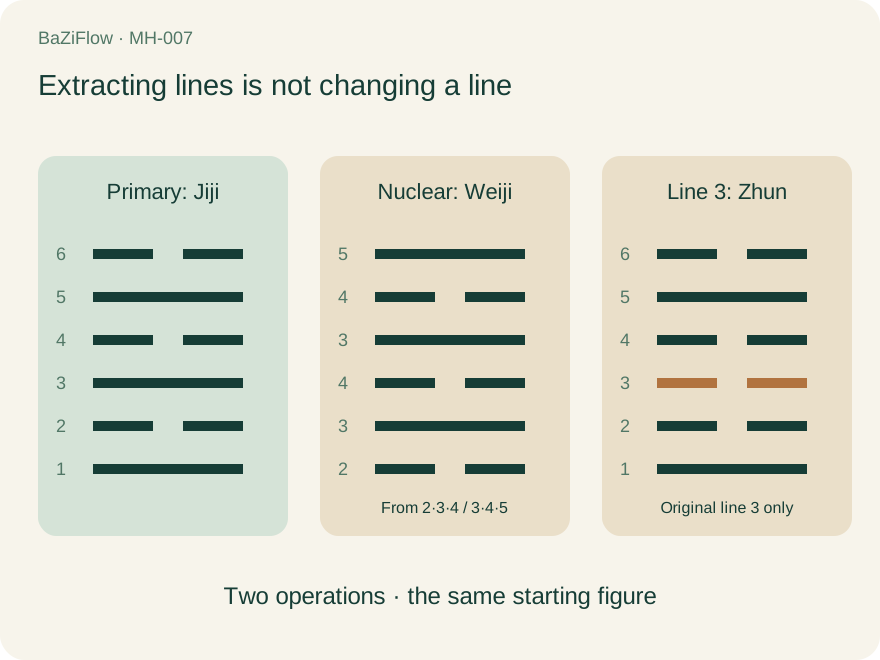
Original BaZiFlow structural diagram. Both operations start from the supplied primary figure; moving line 3 is a teaching condition.
Check the changed result by comparing all six positions. Five must still match the original, with only position 3 reversed. Check the nuclear result differently: compare each new line with its recorded source position. Applying the one-line-change test to a nuclear figure would test the wrong operation.
Jiji
Zhun
The circle identifies Jiji’s third line; reversing only it yields Zhun, while Weiji comes from a separate extraction.
The Qian and Kun note deserves to remain visible
The nuclear-trigram passage also records an alternative statement concerning Qian and Kun: it directs attention to the nuclear structure of their changed figures. A purely mechanical extraction from six yang lines produces six yang lines again; extraction from six yin lines likewise reproduces six yin lines. That mathematical observation does not erase the additional instruction preserved in the text.
A worksheet should therefore state whether it is showing the general positional extraction or following this particular treatment of Qian and Kun. Under the latter treatment, the changed figure has to be established first. If its moving line is unknown, there is no basis for silently choosing one. The source introduces this note as another saying; this article preserves that distinction rather than declaring a uniform practice across every Meihua lineage.
There is also a practical naming issue. The nuclear figure of the original and the nuclear figure of the changed hexagram are different records, even if a particular example happens to produce the same lines. Always identify the input figure. A label such as “nuclear” by itself loses information when several transformations appear on one page.
Position extraction
- Qian → Qian / Kun → Kun
Alternative note
- Changed figure first
The BaZiFlow Meihua tool adopts the changed-figure treatment: for Heaven or Earth with a moving line, it first makes the changed figure, then extracts positions 2–3–4 and 3–4–5 from that figure. It does not simply relabel the changed figure as nuclear. Without a moving line, it shows no nuclear result for these two figures. A general structural nuclear link in the library is a separate, labeled operation.
Why names cannot supply a missing argument
Jiji and Weiji are often rendered with English names involving completion. It is tempting to turn their names into a story about a finished project becoming unfinished. In this exercise, however, Weiji comes from extraction, while the stipulated change leads to Zhun. Calling Weiji the changed figure would be a structural error before any discussion of prediction begins.
The diagrams establish relationships among line patterns. They do not, by themselves, demonstrate that a real event will occur, assign a duration, or prove which figure represents a particular person. Those claims need their own stated interpretive rules and evidence. The safe record is concrete: preserve the initial six positions, identify the source indices of the nuclear trigrams, and record the one designated change.
Once those items agree, a reader can reproduce the worksheet without guessing what the author intended. The next question is how the roles of body and use are assigned, which belongs to the body-and-use distinction.
Nuclear audit
- Check each source index
Change audit
- Only one position differs
Questions readers ask next
How do four interior lines supply a six-position nuclear figure?
The groups overlap. Original positions two, three and four supply the lower group, while three, four and five supply the upper. Positions three and four appear twice, giving the source sequence 2–3–4–3–4–5.
Can line three be changed before extracting Jiji’s nuclear figure?
After that change the input is Zhun, so extraction produces a nuclear structure of Zhun. To obtain Jiji’s nuclear figure, extract from unchanged Jiji. The independently specified change and extraction cannot silently become consecutive steps.
Why preserve an additional instruction for Qian and Kun?
Pure positional extraction reproduces their all-yang or all-yin patterns, but the transmitted text also records looking at the nuclear structure of their changed figures. State which treatment is adopted; the latter requires an established changed figure.
Was this article helpful?