

Monthly Virtue Combination: four Yin stems, all twelve months
Content version · · Sources & references
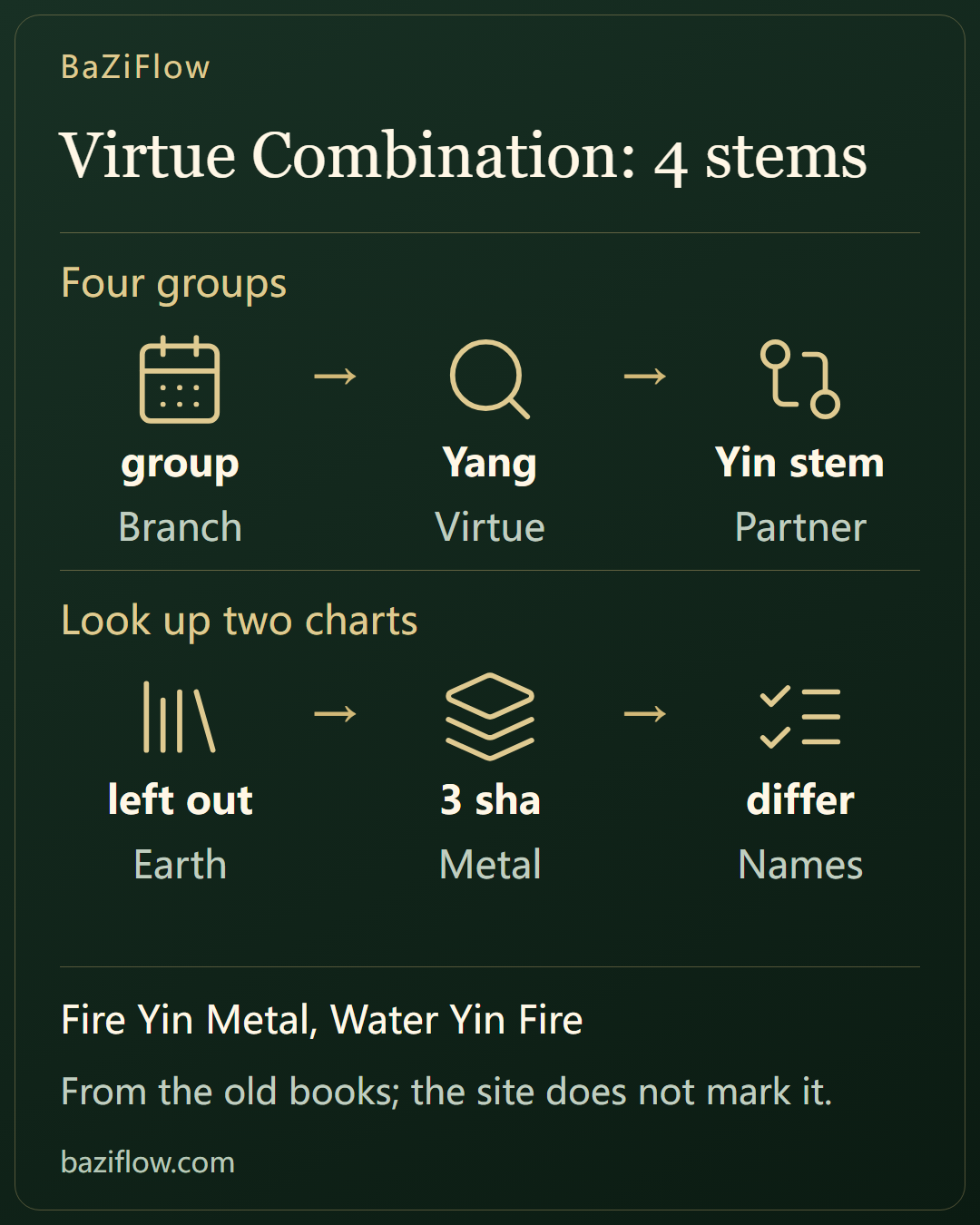
The Monthly Virtue Combination is the Five-Combination partner of the Monthly Virtue stem. All twelve months have one, yet Yang Earth and Yin Water never appear. The site does not mark it.
The short version10 min read
The Monthly Virtue Combination needs no base of its own: take the Yang stem of the month's Three Harmony group, then the Yin stem it combines with, and look for that Yin stem among the stems of the four pillars.
- Every one of the twelve months has a Monthly Virtue Combination, because the virtue is always a stem; of the ten stems, Yang Earth and Yin Water belong neither to the virtue nor to its partner.
- In the Dragon, Goat, Dog and Ox months the Heavenly Virtue Combination and the Monthly Virtue Combination are the same character; in the other eight months they differ.
- The site's chart does not mark this shensha; and the old books have a second thing with a similar name, the "heaven and earth combination", which asks whether both stem and branch combine.
Read first
Symbolic Stars in BaZi: Check the Reference and Rule Before the Meaning ↗
Four Yang stems, four Yin stems: every month has one
The Monthly Virtue Combination (月德合) starts one step earlier than it sounds: fix the month's Three Harmony group, take the Yang stem of its element as the Monthly Virtue (月德) (Fire gives Yang Fire, Water Yang Water, Wood Yang Wood, Metal Yang Metal), and swap it for its Five-Combination partner. Yang Fire goes to Yin Metal, Yang Water to Yin Fire, Yang Wood to Yin Earth, Yang Metal to Yin Wood; those four Yin stems are the Combination, searched among the year, month, day and hour stems.
The engine behind the site's chart has no entry for this star. The table below was worked out independently, by pairing each virtue stem with its Five-Combination partner, and then compared with the months listed in the Xieji Bianfang Shu (协纪辨方书, juan 5) and the Sanming Tonghui (三命通会, juan 3); all twelve rows agree.
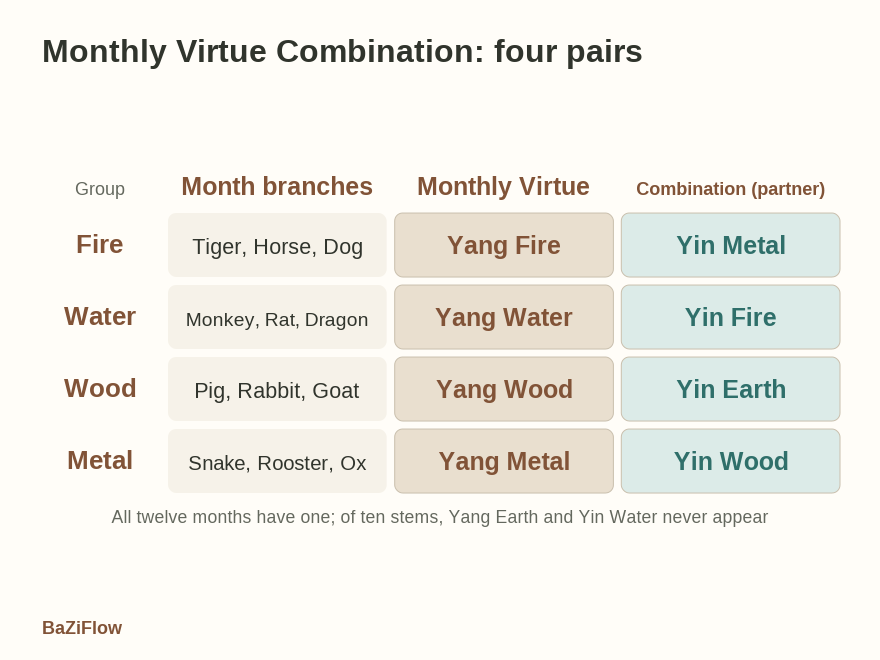
Look-up table: each row is a Three Harmony group, the middle column is the Monthly Virtue (Yang Fire, Water, Wood and Metal, as in the site's Monthly Virtue article), and the right column is its Five-Combination partner; every entry was checked month by month against the month list in juan 5 of the Xieji Bianfang Shu.
The definition is short, and comes from the Kaoyuan (考原) as the almanac quotes it:
The Monthly Virtue Combination is, for each month, the stem that the Monthly Virtue combines with. Take Yang Wood, Yang Fire, Yang Water and Yang Metal as the virtue, and then Yin Earth, Yin Metal, Yin Fire and Yin Wood are the Combination. The virtue and its Combination have no Yang Earth and no Yin Water.
The almanac rules also give the months in four short lines: months 1, 5 and 9 take Yin Metal; months 2, 6 and 10 take Yin Earth; months 3, 7 and 11 take Yin Fire; months 4, 8 and 12 take Yin Wood. That is exactly the four rows of the picture. Because the virtue lands on a stem, its Combination can only land on a stem too, and there is none of the gap that the Heavenly Virtue has when it falls on a direction.
Why Yang Earth and Yin Water are missing: one passage in the Kaoyuan
Of the ten stems the virtue uses four, its partners use four, and Yang Earth and Yin Water are left over. The Kaoyuan leaves a passage for those two:
Yang Earth sits at Snake, mother of Metal; Yin Water sits at Ox, tomb of Metal; Rooster is the true seat of Metal, where Yang Metal and Yin Metal do not go; join them and you have the full Snake-Rooster-Ox group. Metal means punishment, the reverse of virtue. Snake, Rooster and Ox are called the Three Killings, also Breakage, also Red Sand.
The sense is this: Yang Earth falls on Snake and Yin Water on Ox, and with Rooster, the true seat of Metal, the three make the Snake-Rooster-Ox Metal group; Metal stands for punishment, the opposite of virtue, and the same three branches are also called the Three Killings, Breakage and Red Sand. So Yang Earth and Yin Water are kept outside the virtue and its Combination. This is the Kaoyuan's reasoning from directions and phases, not a calculation; the site has no such mark to check it against.
Enlarge diagram · scroll sideways to read
Side by side with the Heavenly Virtue Combination: four months alike, eight different
Both Combinations are Five-Combination partners; the difference is whether the Monthly or the Heavenly Virtue is combined. Separate the twelve months into first, middle and last months of a season:
Enlarge diagram · scroll sideways to read
The Sanming Tonghui explains in passing why the last months coincide, when it gives the Monthly Virtue: Yang Water, Yang Wood, Yang Fire and Yang Metal are the Monthly Virtue, "and for the Dragon, Goat, Dog and Ox months the Heavenly Virtue belongs to the same stems". In those four months the two virtues are one stem, so their partners are one character. The first months differ: the Heavenly Virtue takes a Yin stem, so its partner is Yang; the Monthly Virtue takes a Yang stem, so its partner is Yin.
Two practice charts: the Day Master itself, and the month pillar itself
Both charts below are invented for practice, with month stems that follow the Five Tigers rule. The books do not fix where in a chart to look, so every stem of the four pillars is simply checked.
Enlarge diagram · scroll sideways to read
In the first chart Yang Fire is the Monthly Virtue itself (a different shensha), and its partner Yin Metal falls on the day stem, so the Day Master is itself the Combination. The second is a hit by the month pillar alone: the Pig month's stem is Yin Earth, the pillar Yin Earth Pig, with no help from the year, day or hour.
A hit by the month pillar: only six, all in Yin-branch months
A month pillar can hit on its own only when the month sits on a Yin branch. All four partners are Yin stems, while a month on a Yang branch (Tiger, Monkey, Dragon, Horse, Dog, Rat) always carries a Yang stem and can never touch them. With the usual Five Tigers rule for month stems, only six month pillars hit by themselves:
Six month pillars whose own stem hits the Combination
Yin Wood and Yang Metal years: Yin Earth Rabbit, Yin Wood Rooster
The Rabbit month is in the Wood group with Yang Wood as the virtue, partner Yin Earth; the Rooster month is in the Metal group with Yang Metal, partner Yin Wood. Both year stems give the same pair.
Yang Fire and Yin Metal years: Yin Earth Pig; Yin Fire and Yang Water years: Yin Wood Snake
The Pig month takes Yin Earth and the Snake month Yin Wood; Yin Earth Pig appears in Yang Fire and Yin Metal years, Yin Wood Snake in Yin Fire and Yang Water years.
Yang Earth and Yin Water years: Yin Earth Goat, Yin Wood Ox
The Goat month is in the Wood group and takes Yin Earth, the Ox month is in the Metal group and takes Yin Wood; both appear in Yang Earth and Yin Water years.
That complements the Monthly Virtue article: the month pillars that hit the virtue itself all sit in Yang-branch months, while the ones that hit its Combination all sit in Yin-branch months, and no month pillar can hit both.
One word, three uses in the books
"Virtue combination" (德合) means at least three different things in the old books, and they are easily mixed up:
Enlarge diagram · scroll sideways to read
The first is date selection. The Xieji Bianfang Shu quotes the Wuxing Lun (五行论), which calls it a meeting of the essences of the five phases: where it governs, all evils vanish; on the days it governs, a hundred blessings gather, suited to sending out armies, appointing officials, receiving titles and building halls. The editor adds (juan 10) that the old lists of what each virtue suits are "only a broad sketch and not a set of rules", so they need not be followed item by item.
The second is chart reading. Juan 10 of the Sanming Tonghui lists the Heavenly and Monthly Virtue Combinations among the lucky stars (the same column has Heavenly Virtue, Month Void, Heavenly Pardon, the Academy Star and others), and adds a line about a combination of three things: where the Canopy Star, the Tomb Spirit and the Heavenly and Monthly Virtue Combinations circulate in the pillars, the book says there will be "a bond with water's edge and rocks, and a will to practice the Way and seek immortality". That is the book's own verdict, not a conclusion of the site.
The third is the easiest to confuse: juan 6 names a pattern, the "heaven and earth combination", which asks whether both layers of a pillar combine:
Stems that combine win the hearts of the worthy, branches that combine win the hearts of the many; where stem and branch both combine it is called the heaven and earth combination, as with Yang Wood Rat meeting Yin Earth Ox, or Yang Earth Dog meeting Yin Water Rabbit.
Yang Wood Rat and Yin Earth Ox: the stems Wood and Earth combine, and the branches Rat and Ox combine. This is a relation between whole pillars and has nothing to do with the Monthly Virtue Combination.
The closest companion is the Heavenly Virtue Combination. The virtue stems themselves are in Monthly Virtue, how the pairs form is in the five stem combinations, and the weight such marks deserve in a whole chart is in the place of shensha.
Questions readers ask next
My month branch is Pig. Which character is the Monthly Virtue Combination?
Pig belongs to the Wood group, so the virtue is Yang Wood and its Five-Combination partner is Yin Earth; look for Yin Earth among the stems of the four pillars.
Can the stem of the month pillar itself hit the Monthly Virtue Combination?
Yes, but only in months with a Yin branch: when a Pig, Rabbit or Goat month has Yin Earth as its stem, or a Snake, Rooster or Ox month has Yin Wood. A Yang-branch month always has a Yang stem, and the four partners are all Yin stems.
Is the heaven and earth combination another name for this one?
No. It is a chart pattern from juan 6 of the Sanming Tonghui in which a pillar's stem and branch both combine with another pillar, such as Yang Wood Rat with Yin Earth Ox. It has nothing to do with the month.
Was this article helpful?
Sources & references
Continue reading
Heavenly Virtue Combination: The Five-Combination Partner of the Month's Virtue ↗
Hall of Letters: A Pillar Whose Na Yin Sits on Its Own Establishment Spot ↗