

Tian Xiang: three grades and a missing transformation
Content version · · Sources & references
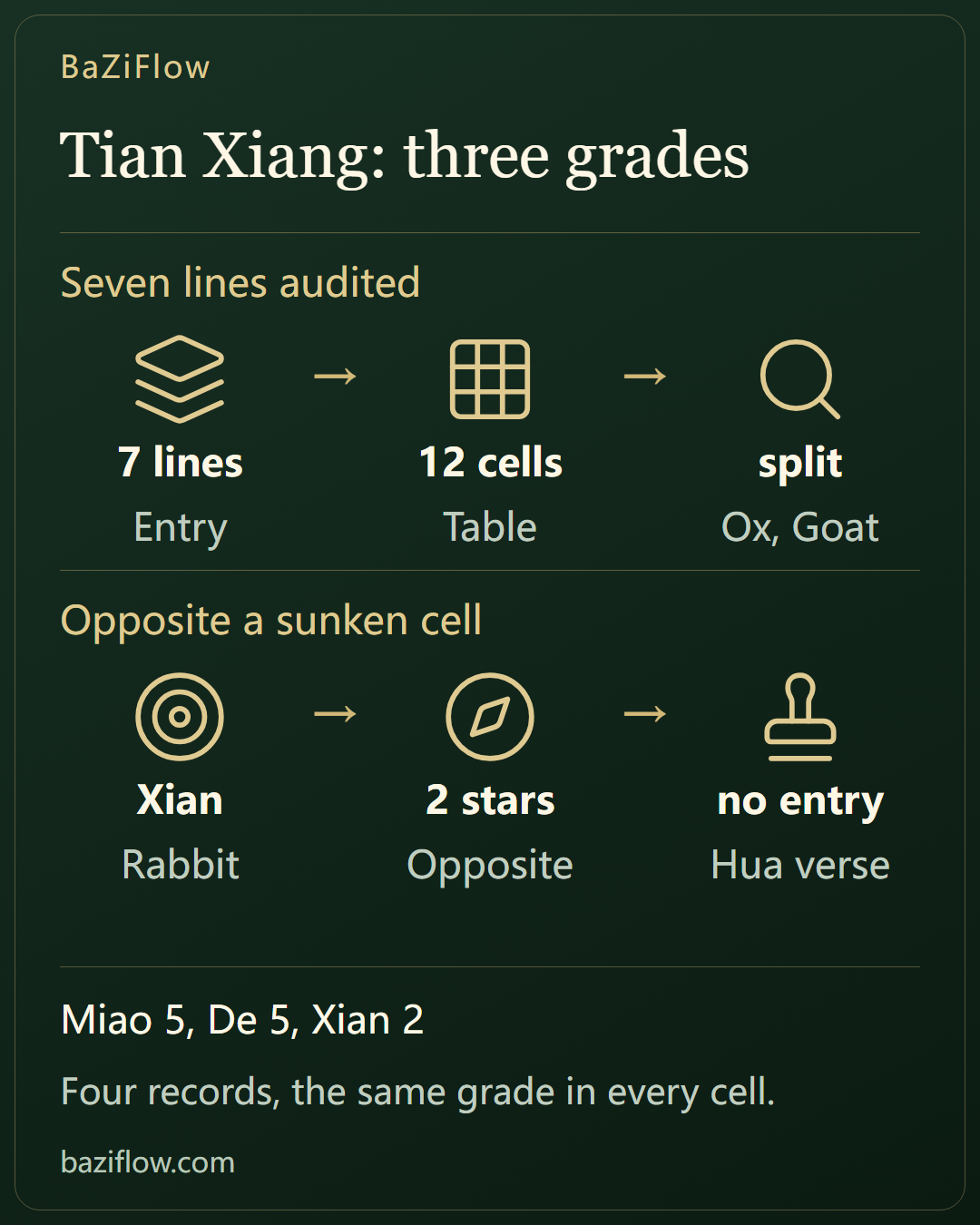
Tian Xiang is Water and the book calls it the Seal. Seven entry lines checked against the grade table, the juan 3 list and the engine, why Ox and Goat are split, who faces a sunken cell, and why the Hua verse skips it.
The short version9 min read
Tian Xiang is Water, the Seal and the fifth star of the Southern Dipper: its twelve cells use three grades, Lian Zhen and Po Jun face it on the sunken cells, and the birth-year verse never names it.
- The entry, the juan 2 table, the juan 3 list and the engine give the same grade for every one of Tian Xiang's cells; the only twist is that the entry writes Ox (Miao) and Goat (De) on separate lines.
- The book's "fifth" is a seat among the six Southern Dipper stars; the "fifth" of the placement verse is a count of cells from Tian Fu. For Tian Xiang the two counts happen to coincide.
- When Tian Xiang sits on Rabbit or Rooster, Lian Zhen and Po Jun stand opposite together; of the fourteen main stars, Tian Xiang and Qi Sha are the two the birth-year verse never names.
Read first
The fourteen major stars: learn the roster and its structure ↗
One "fifth", three records
The book calls Tian Xiang (天相) the "Seal" and a civil star on the career side; but where it lands on a chart is decided only by "the fifth cell after Tian Fu". The fifth in its description and the fifth in its placement are two different things.
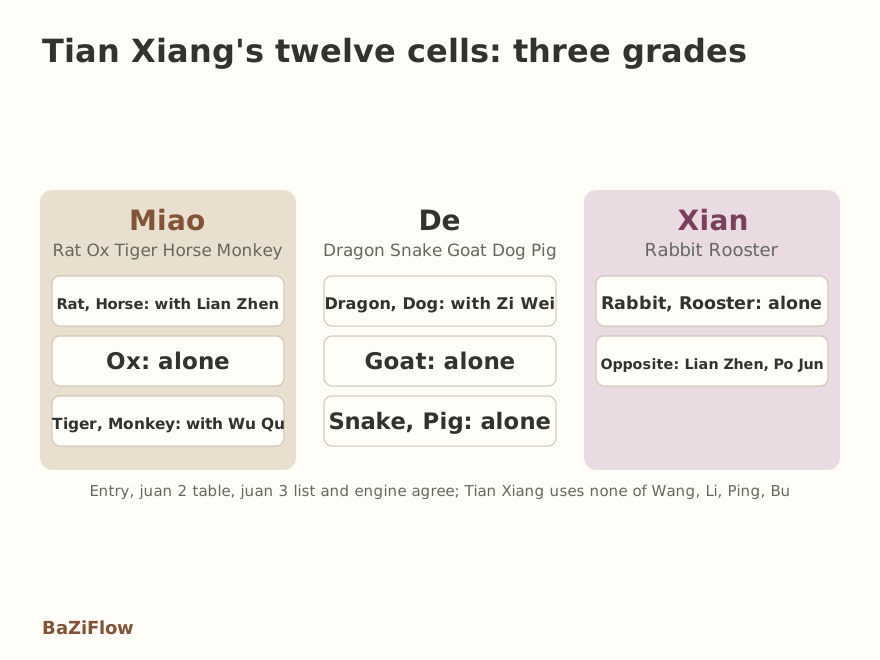
Comparison chart: grades follow the juan 2 table, and the partner stars were derived from the placement verse and checked on iztro charts; "alone" means no other main star in the palace.
The picture sorts Tian Xiang's twelve landing cells into three grades: Rat, Ox, Tiger, Horse and Monkey are Miao, Dragon, Snake, Goat, Dog and Pig are De, and Rabbit and Rooster are Xian. The three sections below all return to it, so first see how the book introduces the star. The juan 1 reply to "what does Tian Xiang govern?" settles its background in the first sentence:
Tian Xiang belongs to Water and is the fifth star of the Southern Dipper. It is the star that administers rank and title, a star of good fortune and goodness; its qi turns into the Seal, and it is the civil star of official career, aide to the Emperor's seat.
Taken apart, that is four items: the element is Water; the fifth star of the Southern Dipper; the star of rank and of good fortune; and a transformed qi called the Seal, civil star of the career side, aide to the Emperor's seat. In the engine's star table (iztro 2.6.0) Tian Xiang is Water too. Juan 2, in its list assigning each star to a Dipper and an element, squeezes all this into one line:
Tian Xiang is Water, Southern Dipper, turns into the Seal, and is the master of the Career palace.
Enlarge diagram · scroll sideways to read
Seven entry lines, and the Ox and Goat are written apart
The last passage of the juan 2 Tian Xiang entry sorts the twelve branches into seven lines: one grade each, and for some lines a named partner. Lay it next to the juan 2 grade table and the partners the engine puts in each palace, and compare line by line:
Enlarge diagram · scroll sideways to read
Juan 3 adds a list in its section on stars sharing a palace: "Tian Xiang, Miao on Rat, Horse, Ox, Tiger, Monkey; De on Dragon, Dog, Snake, Pig, Goat; Xian on Rabbit, Rooster". The entry, the juan 2 table, the juan 3 list and the engine do not differ on a single cell. Having no disagreement is itself a result: whichever record you quote for Tian Xiang's grade, the answer is the same.
One detail hides in the seven lines. Of the six pairs of opposite cells, five share a line (Rat-Horse, Rabbit-Rooster, Dragon-Dog, Tiger-Monkey, Snake-Pig), and only Ox and Goat are pulled apart:
Ox palace is Miao, Goat palace is De, and with lucky stars it is the wealth-and-officer pattern.
The reason lies in the table: Ox is Miao and Goat is De, so this pair differs by one rung and could not honestly be written as one line. Count the rungs once more: of the twelve cells five are Miao, five are De and two are Xian, and the other four grades (Wang, Li, Ping, Bu) are never used.
Sunken on Rabbit and Rooster: who stands opposite
The two cells where Tian Xiang is sunken are Rabbit and Rooster. When Master Xiyi writes about Tian Xiang, one line is devoted to sunken ground:
On sunken ground, when Tan Lang, Lian Zhen, Wu Qu, Po Jun, Yang, Tuo and Qi Sha crowd in
It names five main stars, Tan Lang, Lian Zhen, Wu Qu, Po Jun and Qi Sha, plus "Yang and Tuo", the shorthand for Qing Yang (擎羊) and Tuo Luo (陀罗), which are auxiliary malefic stars and are not cast here. Using the placement verse, cast the two charts where Tian Xiang lands on Rabbit (Zi Wei on Snake) and on Rooster (Zi Wei on Pig); the five main stars stand like this:
Enlarge diagram · scroll sideways to read
The two charts have exactly the same structure. Lian Zhen and Po Jun stand together in the opposite palace, Tan Lang and Wu Qu share the cell two before, Qi Sha is two cells after, and Tian Fu is on the trine. The text never says what "crowd in" refers to, so the sketch keeps to positions that anyone can recompute from the verse. Two things are certain: Po Jun is opposite Tian Xiang on every chart, all twelve without exception, while Lian Zhen is opposite it only on these two charts, with Tian Xiang on Rabbit or Rooster.
In the Hua verse, Tian Xiang is nowhere to be found
Every line of the Tian Xiang entry ends with a few birth-year stems, such as "people born in Ding, Ji, Gui, Jia years". They are easily taken for birth-year transformation stems, and counting the ten lines of the juan 2 verse on the four transformations shows they are not:
Enlarge diagram · scroll sideways to read
The verse writes one line per stem, each naming four stars that turn into Lu, Quan, Ke and Ji in turn. Of the fourteen main stars, twelve appear at least once; the two missing are Tian Xiang and Qi Sha. The ten-stem table of iztro, the engine, agrees with the verse for the most part, and the one difference is the Ke of the Ren stem: the verse writes Tian Fu, iztro takes Zuo Fu. In neither version do Tian Xiang or Qi Sha appear.
Why the entry picked those stems for each line is not explained in the text. The one thing that can be confirmed is that they are not the transformation stems.
Two cross-check problems
Tian Xiang lands on Rooster. Which grade do the entry and the table record, and which stars sit with it and across from it?
Both record the sunken rung; Tian Xiang sits by itself, with Lian Zhen and Po Jun on the other side.
Born in a Bing year, what does Tian Xiang turn into in the verse?
Nothing: the Bing line is Tian Tong to Lu, Tian Ji to Quan, Wen Chang to Ke and Lian Zhen to Ji, and Tian Xiang is not in it.
The star before Tian Xiang is Ju Men; how grades are read is in brightness levels, the full use of the verse is in birth-year transformations, and the star that always faces Tian Xiang is Po Jun.
Questions readers ask next
Is the "Seal" of Tian Xiang an object like a stamp?
No. "Seal" is the name the juan 1 reply gives to this star's transformed qi, in the same column as the other stars' qi names, and it sums up the star's character. No star on a chart is called Seal. "Civil star of the Career palace" and "aide to the Emperor's seat" are two further names from the same sentence, each saying its own thing rather than steps of one argument.
If Tian Xiang is sunken on Rabbit or Rooster, is there nothing to read there?
There is plenty. Xian is one rung of the grade table, and the book and the engine record the same rung for both cells, so the grade itself is not in dispute. What remains to be read is the position in the whole chart: who is opposite, and who stands two cells before and two cells after. Those come from the placement, and each of the two cells occurs once in the twelve charts.
Are stems such as "Ding, Ji, Gui, Jia" in the entry the birth-year transformation stems?
They are a different matter. Birth-year transformations are looked up in the ten lines of the juan 2 verse, and Tian Xiang is not in them. Why the entry picks those stems for each line is not explained in the text, and this page does not invent a reason.
Was this article helpful?
Sources & references
Continue reading
Ju Men (巨门): Six Entry Lines Audited, the Dragon-Dog Clash and a Fixed Chart ↗
Tian Liang (天梁): Dipper Seat Two, Placement Six, and Two Places the Book Disagrees ↗