

Compare original records before the answers
Content version · · Sources & references
Compare hourly Qimen with coin-cast Najia Liu Yao through their inputs, position frameworks and reading records, without treating shared terms as interchangeable rules.
The short version6 min read
Hourly Qimen preserves a chosen moment and chart settings; coin-cast Najia Liu Yao also needs six original values. Palace six is not line six. To compare interpretations, fix one subject, deadline and observable outcome before reading either record.
- The comparison is scoped to hourly Qimen and coin-cast Najia, with their settings retained.
- Identical time and primary line shapes can coexist with different moving-line values.
- Shared words and numerals do not create conversion rules between the frameworks.
Read first
What would let someone reproduce the record?
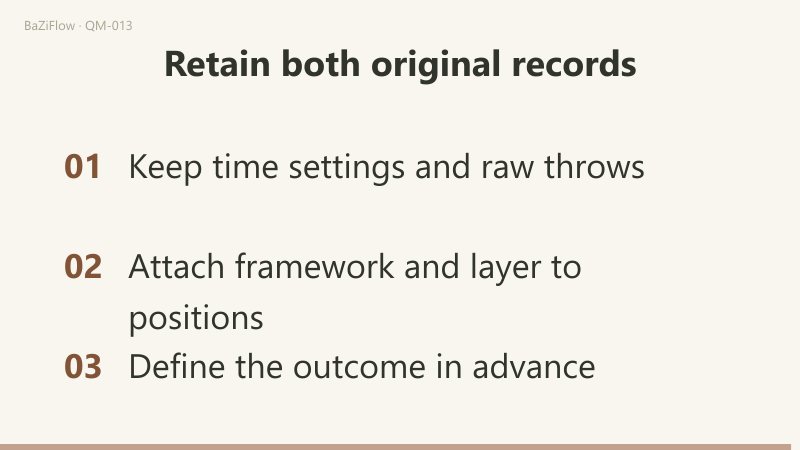
Suppose two notes discuss whether a venue will be confirmed before an agreed deadline. One note comes from Qimen Dunjia and the other from Liu Yao. Both may mention the five elements, support, control or an empty position. Yet those shared words conceal different ways of producing a record. A time-based Qimen chart starts with a chosen moment and a declared charting convention. A coin-cast Liu Yao record also needs the original outcomes of six throws. A timestamp cannot reconstruct those throws.
This comparison concerns hourly Qimen and coin-cast Najia Liu Yao. It does not cover every annual, monthly or daily Qimen method, nor every practice using a six-line figure. Defining that scope prevents a familiar example from being mistaken for a universal rule. For the layers in a Qimen display, see reading a Qimen chart.
Hourly Qimen
- Time + chart settings
Coin Liu Yao
- Time + six raw throws
Two coordinate systems, no conversion table
A Qimen chart places several kinds of symbols in a nine-palace arrangement. The palaces act as addresses shared by different layers. A door and a star in one palace are not two votes that can simply be counted. Their identities, layers and relationships need to remain visible in the record.
Liu Yao begins with six ordered line positions, read from the bottom upward. Najia adds stems and branches according to its own assignments; the Six Relatives describe relationships within that framework. Self and Response mark roles at particular line positions, while moving and changed lines connect the original and resulting figures. None of these positions can be substituted directly for a Qimen palace.
A small drawing makes the distinction testable without casting either system. Use the familiar south-at-the-top Luo Shu layout for Qimen: 4, 9, 2 across the top; 3, 5, 7 across the middle; 8, 1, 6 across the bottom. Beside it, number six horizontal lines from 1 at the bottom to 6 at the top. Palace 6 is not line 6. The shared numeral does not supply a correspondence.
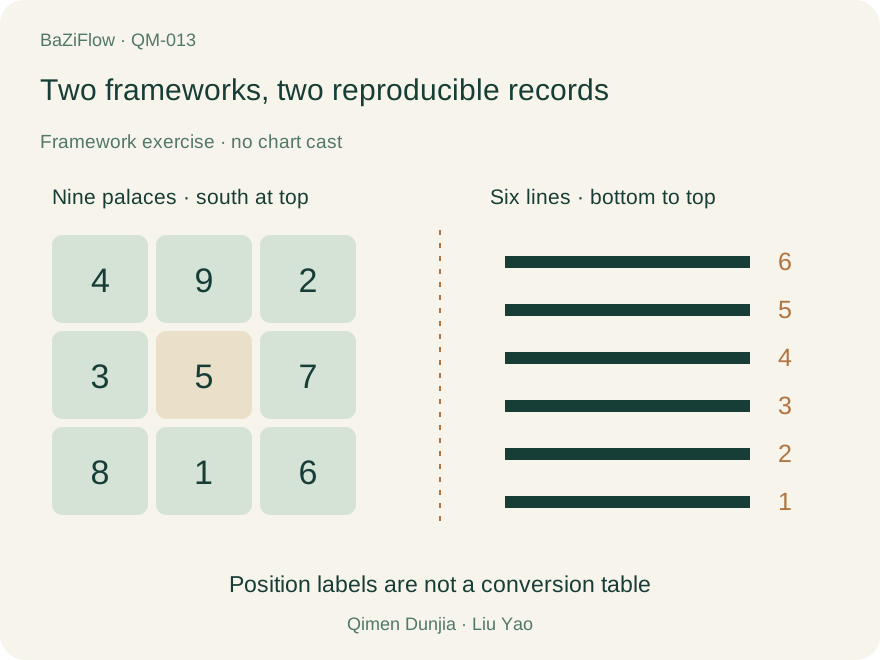
Original BaZiFlow teaching diagram of position frameworks; no stars, doors, stems or personal chart have been assigned.
Check that each number from 1 through 9 appears once in the grid and that the six-line drawing starts at the bottom. These checks can detect missing or repeated numbers and some line-order errors. They cannot establish that every coordinate was copied correctly: orientation and individual positions still need comparison. Symbol selection and eventual outcomes require separate evidence.
South ↑
Top
- Left
- 4
- Middle
- 9
- Right
- 2
Middle
- Left
- 3
- Middle
- 5
- Right
- 7
Bottom
- Left
- 8
- Middle
- 1
- Right
- 6
All digits once; also verify their coordinates
Why the manuals organize their material differently
Volume 1 of Dunjia Yanyi distinguishes Qimen methods by time scale. Its hourly examples describe arrangements of leading symbols, stars and doors in particular configurations. The useful point for this comparison is the layered palace structure, not the text's claims about successful outcomes.
Volume 1 of Zengshan Buyi separately treats Najia assignments, the Six Relatives, Self and Response, moving lines and the Useful God. A reader therefore has to preserve both the six-line structure and the question-dependent choice of what to examine. This is not merely another set of names for Qimen's layers.
| To reconstruct a reading | Hourly Qimen | Coin-cast Najia Liu Yao |
|---|---|---|
| Starting material | Chosen moment, time zone, charting convention | Question, casting time and six original throws |
| Position framework | Nine palaces carrying several layers | Six lines in bottom-to-top order |
| Subject of interpretation | Declared representative symbol and reason | Declared Useful God, line and role |
| What to recheck | Palace placements and layer relationships | Line assignments, changes, day and month context |
It would be misleading to shorten this to “Qimen is spatial; Liu Yao is temporal.” Time is already part of Qimen chart construction. Liu Yao also describes roles and relationships. Their differences lie in how observations and conventions are organized, not in ownership of separate parts of life.
Palace 6
- Qian coordinate
Line 6
- Top position
Make the comparison answerable before reading either chart
Return to the venue example. Define confirmation in advance as a written response from the venue received before the stated deadline. If one interpretation discusses the organizers' enthusiasm and the other discusses cost, they have not made comparable statements, even if both end with the word favorable.
Save each interpretation before the outcome is known. In the Qimen note, explain why a chosen symbol represents the confirmation under discussion. In the Liu Yao note, state why a particular Useful God is relevant. Record any conditions attached to each conclusion. Later, compare each note with the same observable event. A tentative telephone conversation should not silently become written confirmation merely because that rescues an interpretation.
This is a modern record-keeping proposal, not a claim that the classical books already describe controlled testing. It also avoids constructing an unfalsifiable combined answer by taking reassuring phrases from one method and convenient qualifications from the other. Agreement on an undefined adjective is weak evidence; disagreement is information worth preserving, not an instruction to cast repeatedly until the answers match.
One predefined observation criterion
Similar terminology still needs its own scope
Useful God in Qimen can refer to a symbol selected to stand for the subject of a question. In Najia Liu Yao, the choice must be explained through the relevant line relationships and question. Void also requires the applicable cycle and data layer to be named. Copying a label across systems does not copy the conditions that give it meaning.
There are differences within each tradition as well. Rotating and flying Qimen arrangements are not interchangeable settings, and Liu Yao schools differ in how they choose representatives or weigh special states. A careful account identifies the convention actually used instead of making one author's treatment stand for every school. Historical case narratives help us study an argument; their survival in a book does not establish a modern accuracy rate.
Once the record is complete, disagreements can be traced to inputs, conventions or interpretation. Without it, comparison becomes a contest between summaries. To examine the second framework on its own terms, continue with the structure of a Liu Yao reading.
Qimen term
- Named chart layer and rule
Liu Yao term
- Line relationship and rule
Questions readers ask next
Can an exact timestamp recover the six throws?
It does not contain the individual outcomes. Even a primary figure leaves 7 and 9 indistinguishable as yang lines despite their different movement status. Keep the original values or mark the reconstruction gap.
Does one occurrence of every digit verify the palace drawing?
Check the arrangement and orientation too. Swapping one and nine passes a count test while reversing their north–south positions. The six-line framework separately needs bottom-up order.
Do two favorable summaries verify each other?
Check whether they concern the same observable event. Enthusiasm in one and budget in another do not become the same claim through a shared adjective. Fix the deadline and confirmation criterion in advance.
Was this article helpful?
Theme: Decisions & questions
Sources & references
Continue reading
What is Liu Yao? From a single question to an assembled hexagram chart ↗
Meihua and Liuyao: the same figure, different records ↗
Combination, clash and star in BaZi, Ziwei and astrology: different rules ↗