
What are the Ten Gods? Start from the Day Master's relationships
Content version · · Sources & references
Ten Gods are names for a stem’s relationship to the Day Master: five element positions split by polarity. Derive all ten for a Yang Wood Day Master and keep branches, Luck Pillars and kinship mappings on separate layers.
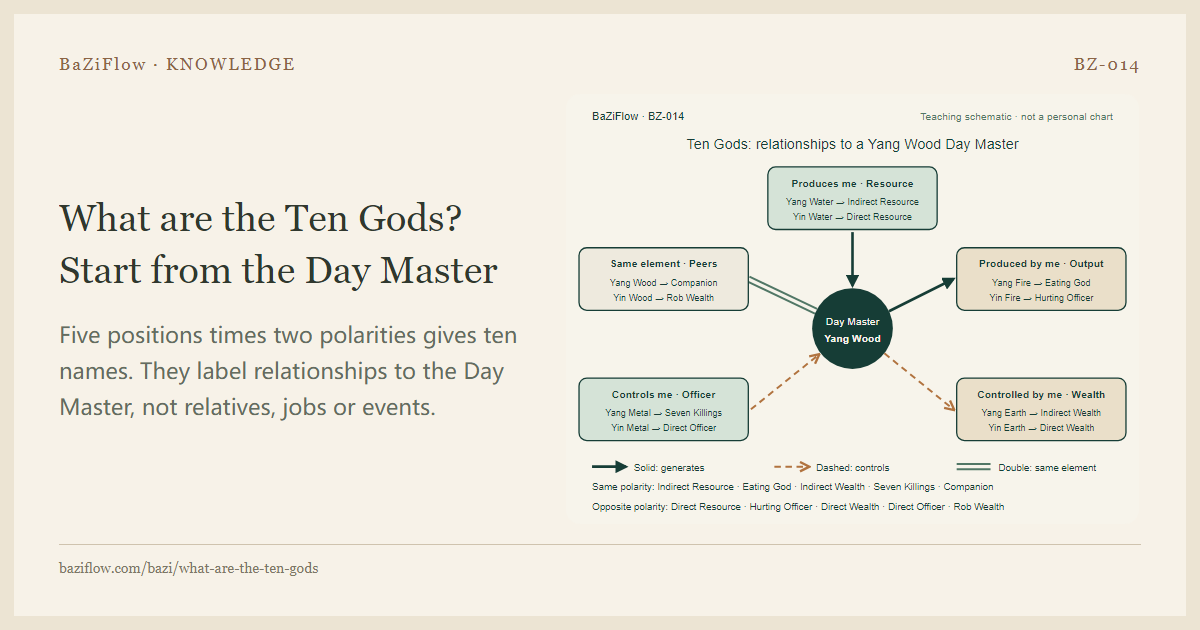
Five positions times two polarities gives ten names. They label relationships to the Day Master, not relatives, jobs or events.
Read first
Reading a BaZi chart for the first time: the four pillars and the Day Master ↗
Five Elements cycles: learn the relationships, not just the order ↗
Why does the same stem have two different labels?
Put two teaching notes side by side. In one, Yang Fire (丙) is labelled Eating God; in the other, the same Yang Fire is Direct Officer. That is not necessarily a contradiction. The missing field is the Day Master. Yang Wood produces Fire, while Fire controls Yin Metal. Yang Fire shares Yang Wood's polarity but has the opposite polarity to Yin Metal, so the relationship name changes.
This is the central job of the Ten Gods: to label a relationship between a reference stem and another stem. The word “God” does not turn the label into a deity, a prediction or a personality category. Start with the Day Master, then check the generation and control cycles.
Build the lookup from five relationships
There are only five element relationships to identify: same element, produced by the Day Master, controlled by it, controlling it, or producing it. Split each into matching and opposite yin-yang polarity. That produces the following ten labels, using the English terminology adopted here; other translations may name the same relationship differently.
| Relationship to the Day Master | Same polarity | Opposite polarity |
|---|---|---|
| Same element | Companion | Rob Wealth |
| Produced by me | Eating God | Hurting Officer |
| Controlled by me | Indirect Wealth | Direct Wealth |
| Controls me | Seven Killings (Indirect Officer) | Direct Officer |
| Produces me | Indirect Resource | Direct Resource |
“Direct” here is not a measure of honesty. In the Wealth, Officer and Resource pairs it indicates opposite polarity; the corresponding Indirect label has matching polarity. The peer and output pairs have separate names instead. Seven Killings is also called Indirect Officer. Older texts can call Indirect Resource inverted food or owl; when interpreting such a passage, keep its own conditions rather than assuming every alias carries an identical judgment.
Keep a worked chart fragment, not a personality profile
For a Yang Wood reference stem, all ten lookups are shown below. Each row can be checked by element direction first and polarity second. This is a set of teaching pairs, not ten assertions about one person's life.
| Stem | Element and polarity | Relation to Yang Wood | Ten God |
|---|---|---|---|
| Yang Wood (甲) | Wood, yang | same element, same polarity | Companion |
| Yin Wood (乙) | Wood, yin | same element, opposite polarity | Rob Wealth |
| Yang Fire (丙) | Fire, yang | produced by me, same polarity | Eating God |
| Yin Fire (丁) | Fire, yin | produced by me, opposite polarity | Hurting Officer |
| Yang Earth (戊) | Earth, yang | controlled by me, same polarity | Indirect Wealth |
| Yin Earth (己) | Earth, yin | controlled by me, opposite polarity | Direct Wealth |
| Yang Metal (庚) | Metal, yang | controls me, same polarity | Seven Killings |
| Yin Metal (辛) | Metal, yin | controls me, opposite polarity | Direct Officer |
| Yang Water (壬) | Water, yang | produces me, same polarity | Indirect Resource |
| Yin Water (癸) | Water, yin | produces me, opposite polarity | Direct Resource |
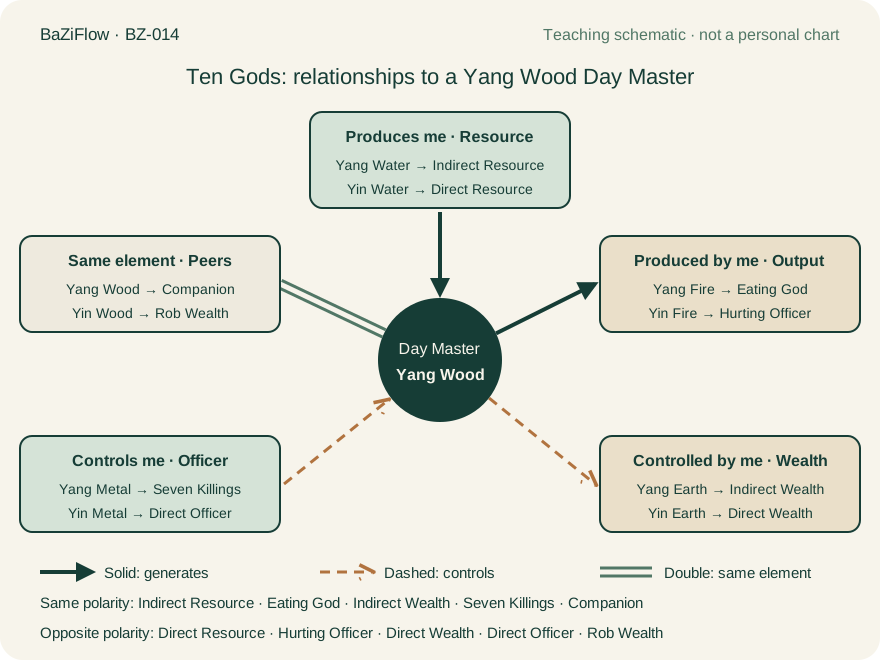
Original BaZiFlow teaching diagram; it names relationships between a Day Master and stems, not a personal chart.
Now test an unseen pair: Yin Fire (丁) receiving Yang Wood (甲). Wood produces Fire and the polarities differ, so the label is Direct Resource. Reverse the reference to Yang Wood and Yin Fire becomes Hurting Officer. A correct label therefore needs the ordered pair, not just the two element names.
Attach a field before counting anything
A stem exposed in the natal year position, a stem hidden in the month branch, and a stem in a Luck Pillar can all receive a Ten God label. They are not three occurrences in the same layer. For branches, the usual route is to compare their hidden stems with the Day Master; a displayed branch label may show only its main qi.
Record the field as well as the label. “Natal year stem: Direct Officer” can be checked; “many officers” cannot, unless the counting scope is supplied. A generated paragraph mentioning wealth is not evidence of a Wealth stem. Nor does a count establish strength, which depends on additional seasonal and root conditions.
Read the historical names as historical analogies
The day-master section of Yuan Hai Zi Ping organises generation and control by polarity, but its peer terminology is not identical to the modern table. The text's examples of Yang Wood with Yin Metal, Yang Metal and Yang Fire agree respectively with Direct Officer, Seven Killings and Eating God here. Do not quietly replace a historical “blade” category with a modern peer label when quoting the text.
Volume five of San Ming Tong Hui explains the naming through social analogies: shelter, support, service and control. Its account of Eating God compares offspring supporting parents, not parents feeding children. Such an explanation tells us why a term was chosen; it does not establish that an actual relative or event is present in a chart. Kinship correspondences are an additional interpretive layer, with their own sex and school conventions.
Once the labels and fields are clear, Ten God combinations asks a different question: what further conditions are needed before two labels can be discussed as a working relationship?
Part of a learning path
BaZi: from the four pillars to time layers · Step 4 of 4 available
Sources & references
Continue reading
Roots, exposed stems and seasonal support in BaZi ↗