

What the ten stems and twelve branches each do
Content version · · Sources & references
Separate the jobs of Heavenly Stems and Earthly Branches—element, polarity, month and hour—then see why parity limits the cycle to sixty pairs.
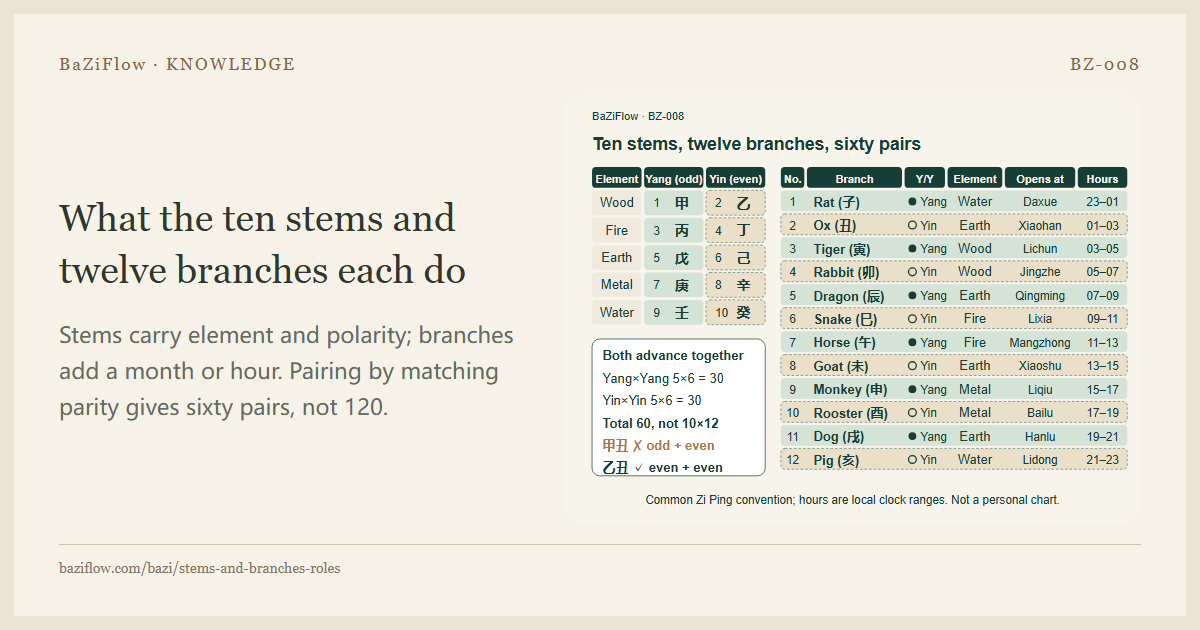
Stems carry element and polarity; branches add a month or hour. Pairing by matching parity gives sixty pairs, not 120.
Read first
Five Elements cycles: learn the relationships, not just the order ↗
A thirty-second test before any theory
Write 1 to 10 in one row and 1 to 12 beneath it. Step both rows forward together—1–1, 2–2, 3–3—wrapping each row when it runs out. You return to 1–1 after 60 steps, not 120. That is why the stem-and-branch calendar has sixty pairs, and why some pairs never appear in a valid chart.
In a Four Pillars chart the ten Heavenly Stems (天干) and twelve Earthly Branches (地支) do different jobs. Each pillar has a stem on top, the visible layer, and a branch underneath, which carries an element but also a month or two-hour period, and contains hidden stems.
Stems: ten cells of element times polarity
Number the stems 1 to 10. Odd numbers are Yang, even numbers are Yin, and each neighbouring pair shares one element: Yang Wood (甲) and Yin Wood (乙); Yang Fire (丙) and Yin Fire (丁); Yang Earth (戊) and Yin Earth (己); Yang Metal (庚) and Yin Metal (辛); Yang Water (壬) and Yin Water (癸). Five elements times two polarities gives exactly ten.
How elements generate and restrain one another is covered in the five-element cycles; here a stem needs only element and polarity. Whether a hidden stem also appears in the stem row is a rooting question, explained in roots, exposed stems and seasonal support; hidden-stem tables are not listed here.
Branches: element plus a place in time
Number the branches 1 to 12: Rat (子), Ox (丑), Tiger (寅), Rabbit (卯), Dragon (辰), Snake (巳), Horse (午), Goat (未), Monkey (申), Rooster (酉), Dog (戌), Pig (亥). In the ordering used to build the sixty pairs, odd positions (Rat, Tiger, Dragon, Horse, Monkey, Dog) are Yang and even positions are Yin. Some classical writers use a body-versus-function reading in which Rat, Snake, Horse and Pig swap polarity; check a source's convention first.
Tiger and Rabbit are Wood; Snake and Horse, Fire; Monkey and Rooster, Metal; Pig and Rat, Water. Dragon, Goat, Dog and Ox are Earth, each closing a season.
Branches also mark time. Months: in the common Zi Ping convention a month changes at a jie solar term, so the Tiger month opens at the Beginning of Spring (Lichun), the Rabbit month at Awakening of Insects (Jingzhe), and so on to the Ox month at Minor Cold (Xiaohan). The reasoning is in solar terms and month pillars. Hours: the day is split into twelve two-hour blocks. The Rat hour is 23:00–01:00, the Ox hour 01:00–03:00, and so on to the Pig hour, 21:00–23:00. Because the Rat hour straddles midnight, schools differ on whether 23:00 onward belongs to the same day or the next; check your software's setting and whether it uses local standard or apparent solar time.
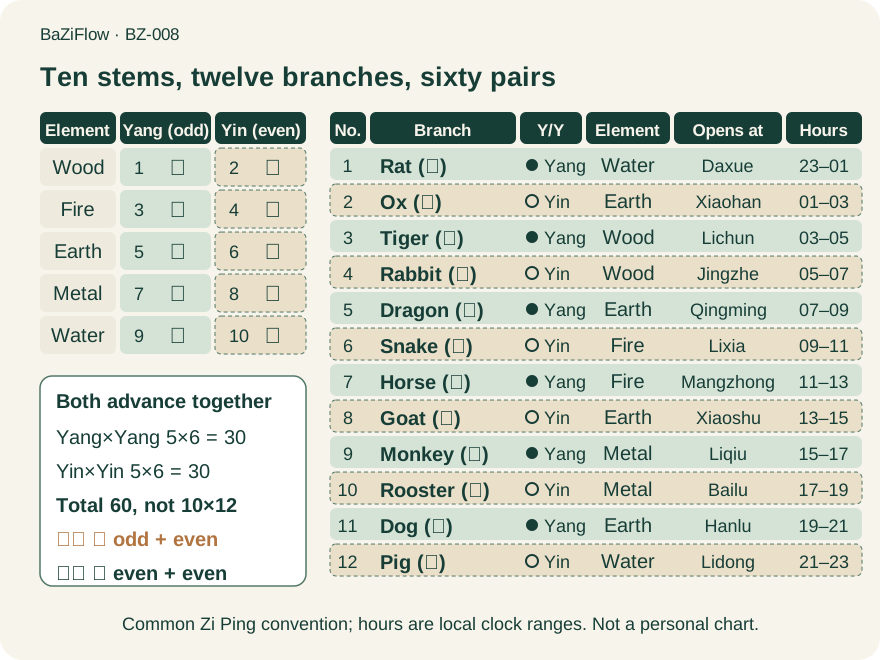
Original BaZiFlow teaching diagram of a common Zi Ping convention; not a personal chart.
Why sixty and not one hundred and twenty
If any stem could sit on any branch, there would be 10 × 12 = 120 pairs. The calendar instead advances both sequences by one each time, starting from stem 1 with branch 1, so their parity always matches. Yang stems meet only Yang branches, and Yin stems only Yin branches: 5 × 6 = 30 plus 5 × 6 = 30 gives 60. Equivalently, 60 is the least common multiple of 10 and 12.
Practice: validate a pair without any birth data
- Yang Wood with Ox (甲丑): stem 1 is odd, Ox is branch 2 and even. The parities differ, so this pair never occurs. In notes, suspect a typo.
- Yin Wood with Ox (乙丑): stem 2 and branch 2, both even. Valid; it is the second pair of the cycle.
- Your turn: Yang Metal with Monkey (庚申) is stem 7 with branch 9, valid; Yin Metal with Monkey (辛申), stem 8 with branch 9, is not.
Validity says nothing about fortune. Check structured positions, never a character spotted in running text.
The division of labour in one paragraph
A stem carries element and polarity on top; a branch adds a month or an hour underneath and holds hidden stems; together they step through sixty pairs. The familiar zodiac animal is simply the year branch's animal name; whether the year changes at the Beginning of Spring or at the lunar new year is a separate convention not covered here. For traditional imagery of each branch, see the older Earthly Branches guide; that imagery is cultural symbolism, not a tested personality prediction.
Part of a learning path
BaZi: from the four pillars to time layers · Step 2 of 2 available
Sources & references
Continue reading
Roots, exposed stems and seasonal support in BaZi ↗