

Heavenly Virtue: a stem or a branch from the month
Content version · · Sources & references
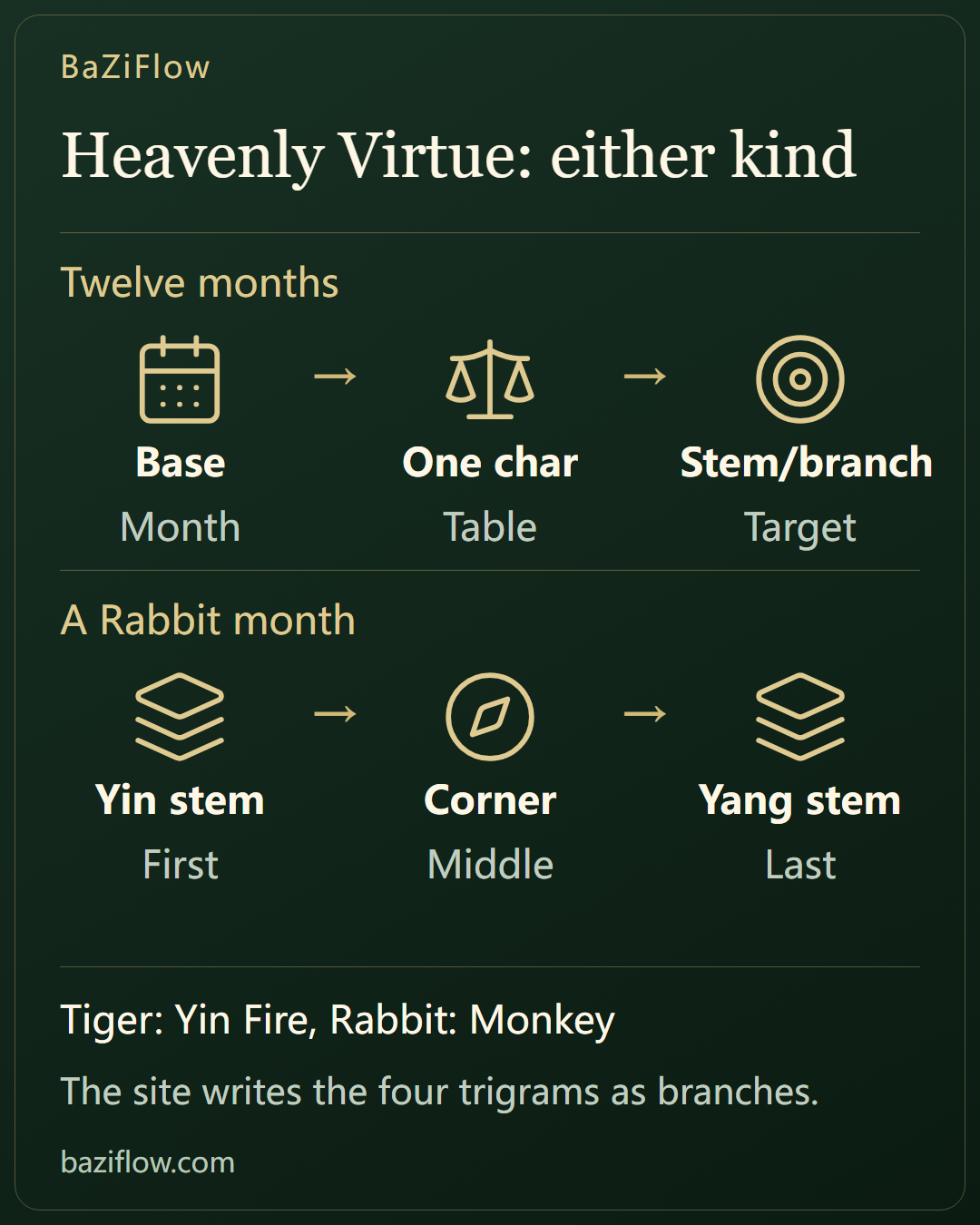
Heavenly Virtue starts from the month branch, and twelve months find one character each, eight on a stem and four on a branch. A table, two almanac readings and a rival month list sort stems from branches.
The short version10 min read
The base of Heavenly Virtue is the month branch: look up the branch of the birth month in a table of twelve, find one character, then search the four pillars for it. That character is a stem eight times and a branch four times, and where you search changes with it.
- The twelve months fall into three kinds: first months of a season take Yin stems, last months take Yang stems, and middle months take the four corner trigrams, which the site writes as the branches Monkey, Pig, Tiger and Snake.
- Juan 5 of the Xieji Bianfang Shu explains the table twice: Cao Zhengui sorts months by "favoring what is not yet born" and "what is in its tomb", the Kaoyuan note by each Three Harmony group's "virtue". Both reach the same table.
- Juan 3 of the Sanming Tonghui quotes Huzhongzi for a month list that shares not one month with the site's, and the site does not use it. A month stem can hit on its own in only four month pillars: Ren Chen, Xin Si, Bing Xu, Yi Hai.
Read first
Symbolic Stars in BaZi: Check the Reference and Rule Before the Meaning ↗
Twelve months, twelve targets, three kinds
Heavenly Virtue (天德贵人) looks only at the month branch: take the branch of the birth month, find one character in the table, then search the four pillars for that character.
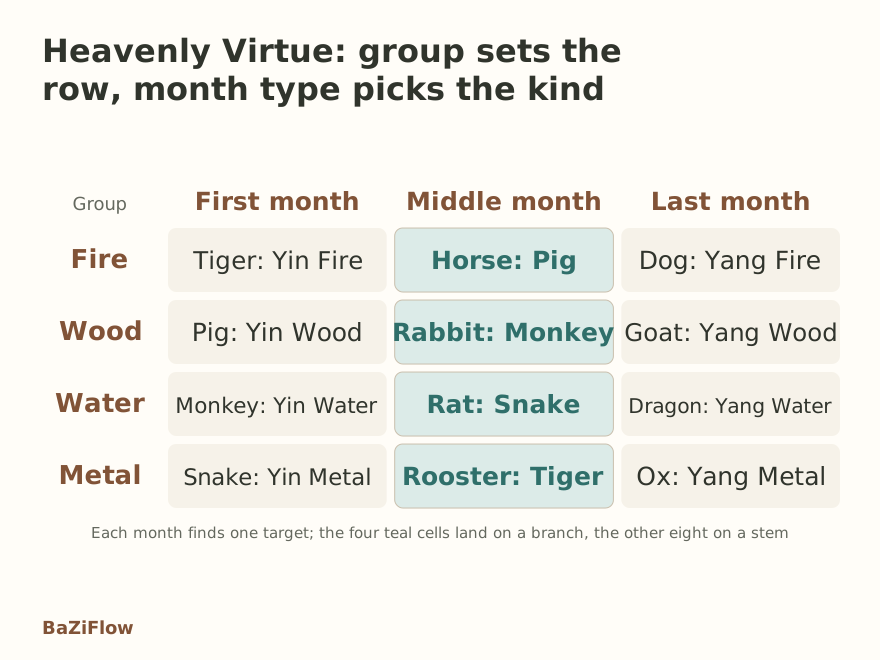
Comparison table: one cell for each of the three months of each Three Harmony group, checked month by month against the site engine's Heavenly Virtue table; the engine writes Kun, Qian, Gen and Xun as Monkey, Pig, Tiger and Snake, and the teal cells land on a branch.
The four rows are the four Three Harmony groups, and the three columns are each group's three months: the first month of a season (Tiger, Snake, Monkey and Pig months), the middle month (Rat, Rabbit, Horse and Rooster months) and the last month (Dragon, Goat, Dog and Ox months). First months take a Yin stem, last months take a Yang stem, and middle months take a direction, one of the trigrams Kun, Qian, Gen and Xun (坤乾艮巽); the site's engine writes those four directions as the branches Monkey, Pig, Tiger and Snake.
Cao Zhengui's sorting: favor what is not yet born, favor what is in its tomb
The Xieji Bianfang Shu (协纪辨方书) is the Qing court's almanac, and its juan 5 first copies out the month list of the Kanyu Jing (first month Yin Fire, second month Kun, third month Yang Water...) and then quotes Cao Zhengui on why it runs that way:
In the four opening months a Yin stem is the Heavenly Virtue because Heaven's way favors what is not yet born: in the first month Yang Fire is born while Yin Fire is not... In the four closing months a Yang stem is the Heavenly Virtue because Heaven's way favors what is in its own tomb: in the third month Yang Water is in its tomb... In the four middle months a trigram of the four corners is the virtue because Heaven's way is then transforming and completing.
Read it like this: the first month of a season is when an element is just born, so the Yang stem already exists and the Yin stem does not yet, and the Heavenly Virtue falls on the Yin stem that is not yet born. The last month of a season is when the element enters its tomb, and the Virtue falls on the Yang stem. The middle month is the turning month, and the Virtue falls on one of four direction trigrams.
Enlarge diagram · scroll sideways to read
A second road in the same juan: reading it from the group's "virtue"
In the same juan a note called the Kaoyuan takes another angle and starts from the Three Harmony groups:
The Tiger, Monkey, Snake and Pig months are the Growth places of the elements, so they are matched with Yin stems; Dragon, Dog, Ox and Goat are the tomb and storehouse places of the elements, so they are matched with Yang stems; Rat, Horse, Rabbit and Rooster are the places where the elements are at their prime, so they are matched with the trigram of the tomb's own palace.
The three months of a Three Harmony group make one group, and the group's element is the element of the "virtue". Months 1, 5 and 9, Tiger, Horse and Dog, form the Fire group, so Fire is the virtue: month 1 is Yin Fire, month 9 is Yang Fire, and month 5 falls at Qian, because the tomb of Fire is the Dog and the Dog belongs to the Qian palace. The Water, Wood and Metal groups follow the same pattern.
Enlarge diagram · scroll sideways to read
The two roads reach one table: Cao Zhengui explains first and last months through birth and tomb, the Kaoyuan note explains the virtue through the Three Harmony group, and all twelve results agree.
Only the four middle months need a second look. At the end of the same passage the Kaoyuan note says the four trigrams are used "in place of Dragon, Dog, Ox and Goat" because the virtue "does not use branches": Qian stands for Dog, the tomb of Fire; Xun for Dragon, the tomb of Water; Kun for Goat, the tomb of Wood; and Gen for Ox, the tomb of Metal.
The site engine has to search the chart for a character, so it writes Qian, Xun, Kun and Gen as Pig, Snake, Monkey and Tiger, which matches the Sanming Tonghui notes such as "Pig holds Qian". So for a Horse month the site searches the four branches for Pig. The Kaoyuan itself names no branch to search for.
Another month list in the same entry, which the site does not use
The entry on the two virtues in juan 3 of the Sanming Tonghui (三命通会) begins by saying where Heavenly Virtue sits:
Heavenly Virtue: the heavens have 365 and a quarter degrees, and apart from the twelve palaces... the five and a quarter degrees left over are scattered among the twelve side palaces: Yang Wood, Yang Metal, Yang Fire, Yang Water, Yin Wood, Yin Metal, Yin Fire, Yin Water, Qian, Kun, Gen, Xun, and are called "spirits stored, sha sunk"... These twelve palaces can turn harm into good, and so are called Heavenly Virtue.
Those twelve places are exactly the twelve targets that appear in the table above: the eight stems Yang Wood, Yin Wood, Yang Fire, Yin Fire, Yang Metal, Yin Metal, Yang Water, Yin Water plus the four corner trigrams. The book notes that Tiger holds Gen, Snake Xun, Monkey Kun and Pig Qian, which is why the site writes the four directions as Tiger, Snake, Monkey and Pig. The places agree. How the months are matched to them is another matter, and the same entry quotes Huzhongzi with a different table:
Heavenly Virtue is the virtue of Yang. The first month starts from the branch just before the Qian trigram, Pig, and runs forward: first month Pig, second month Rat, third month Ox, fourth month Tiger, fifth month Rabbit, sixth month Dragon...
Set the two tables side by side:
Enlarge diagram · scroll sideways to read
In twelve months the two tables share not one cell. The site's engine uses the left one, which agrees month by month with the Xieji Bianfang Shu; the Huzhongzi list is not used here. Right after quoting it, the book itself says that the star-astrology school follows the later list, while the earlier account gives the stems and branches for the Heavenly and Monthly Virtue Noblemen.
Three sample charts, and the month pillar's four chances
Run each through the site's engine and note three different landings:
Enlarge diagram · scroll sideways to read
In the third chart the hit is the day master itself: the day stem is Yin Fire, and the site engine counts the day stem among the four stems, and the book's line that the virtue should appear on the day also points to the day pillar. In the first chart the month pillar Ren Yin holds no Yin Fire, and the hit comes from the year stem.
A month stem can reach Heavenly Virtue by itself in just four month pillars: Ren Chen, Xin Si, Bing Xu and Yi Hai. With any other month pillar, the hit must come from the year, day or hour stem, or from a branch.
The Monthly Virtue Nobleman also starts from the month branch but lands only on a stem; the one before this is the Tai Chi Nobleman.
Questions readers ask next
I was born in the first lunar month. Is my Heavenly Virtue Yin Fire?
The "first month" in the table means the Tiger branch, the month that begins at the Start of Spring, not a month counted from the lunar new year. A Tiger month finds Yin Fire, and there is a hit only if one of the four stems really is Yin Fire.
A Rabbit month finds Monkey. Does that Monkey have to be on the hour pillar?
No. A Rabbit month finds a branch, so a Monkey on any of the year, month, day or hour pillars counts. Because the target is not a stem, whether Monkey appears among the stems is beside the point.
Which matters more, Heavenly Virtue or Monthly Virtue?
The books hold two statements. The Sanming Tonghui entry quotes the Ziping Fu saying that a Resource sharing a place with Heavenly Virtue never runs into official punishment, and concludes "Heavenly Virtue beats Monthly Virtue"; elsewhere the two are listed side by side. The site looks them up separately and ranks neither.
Was this article helpful?
Sources & references
Continue reading
Monthly Virtue (月德贵人): Four Yang Stems Found from the Month Branch ↗