

Read a palace in context
Content version · · Sources & references
A cropped palace can show a star name while hiding its context. Learn to track palace coordinates, related positions and timing layers before interpreting it.
The short version5 min read
A crop may establish a star’s recorded location while hiding its references and timing layer. Reading the whole chart means recovering those conditions, not reciting every symbol. Use a star-free palace map to see why Wealth and Spouse lead to different sets of positions.
- A palace topic and its branch address are different fields; Wealth does not occupy the Dog (戌) palace in every chart.
- With Life in the Tiger palace, Wealth in the Dog palace refers to the Tiger, Horse and Dragon palaces; Spouse in the Rat palace leads to a different set.
- Keep resident stars, related-palace references and timing layers separate; unseen conditions remain unknown.
Read first
Decide how much context the question needs
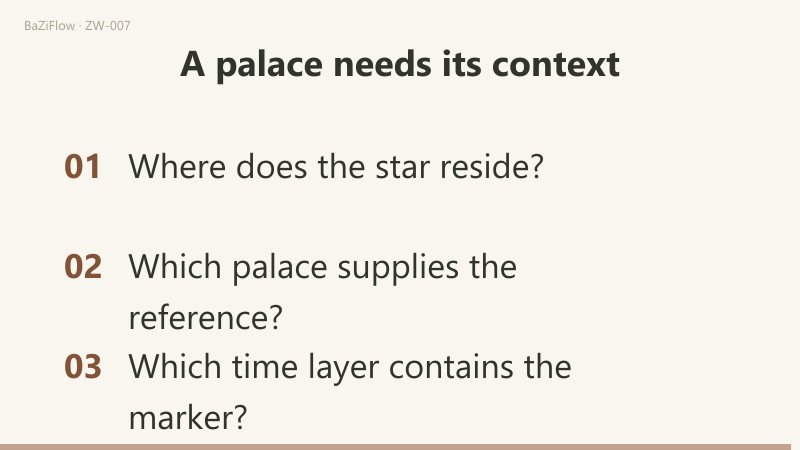
“Is this star actually located in the Spouse palace?” is a narrow question. A clear record of that palace can answer it. “What does this arrangement mean for a relationship?” is broader and requires the additional positions and conditions specified by the chosen traditional method. Neither question requires reciting every star in twelve long paragraphs by default.
For an income question, employment terms and financial records are also relevant evidence, but they are not chart fields. A palace name cannot establish a salary. For a relationship question, the other person's stated views remain information to learn from that person, not facts to extract from a symbolic position.
Ask for the missing palace names, branch labels, legend and selected period when those are needed. This does not justify collecting unrelated private history. The request should explain which uncertainty the additional information can resolve.
Residence check
- Read the focus palace
Relationship reading
- Add related records
Give each palace two addresses
The topic name and branch location do different jobs. Wealth names a topic; the Dog (戌) palace identifies a place in the branch layout. Wealth is not in the Dog palace in every chart. Copying a location from another person's chart would therefore corrupt the comparison before any interpretation began.
Here is a star-free teaching framework. Set Life in the Tiger (寅) palace and arrange the traditional twelve palace names in reverse sequence. Wealth is then in the Dog (戌) palace, Career in the Horse (午), Wellbeing in the Dragon (辰) and Spouse in the Rat (子). No birth date or person has been assigned to this example.
| Focus position | Other two triad positions | Opposite position |
|---|---|---|
| Wealth (Dog) | Life (Tiger); Career (Horse) | Wellbeing (Dragon) |
| Spouse (Rat) | Wellbeing (Dragon); Travel (Monkey) | Career (Horse) |
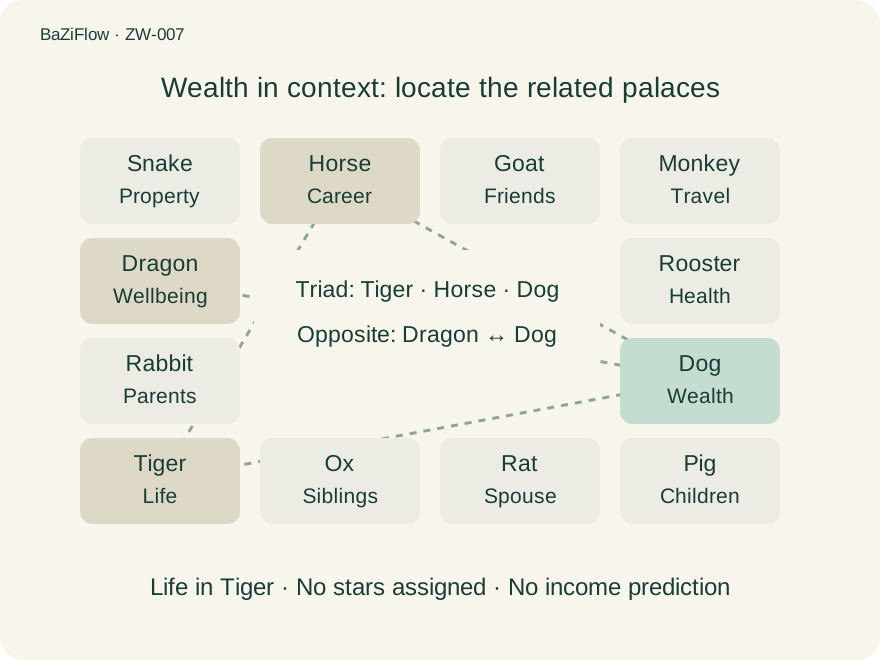
Original BaZiFlow palace map. Lines show positional relationships; no stars or personal financial outcomes are assigned.
Notice how changing the question changes the starting position and the references. Property may sound closely related to money, but it is not Wealth's opposite palace. Spouse faces Career rather than Life. These are positional checks, not claims that a job causes a particular relationship outcome. The three sides and four directions guide develops the geometry.
Try a calculation without placing any stars. Keep Life in the Tiger palace. From Wealth in the Dog palace, count four branch steps forward to the Tiger, four more to the Horse and four more back to the Dog. Six steps from the Dog reach the Dragon. These reproduce the triad and opposite positions. Starting instead at Spouse in the Rat palace gives the Dragon and the Monkey at four-step intervals, with the Horse opposite. The reading list changes with the starting position; the palaces have not exchanged their locations.
Wealth
- Opposite: Wellbeing
Spouse
- Opposite: Career
Referencing a star does not relocate it
Keep resident stars, triad references and opposite-palace references in separate parts of the notes. A star consulted across the chart remains in its recorded palace. Pooling everything into one list would make it impossible for another reader to reconstruct what was actually present in the focus palace.
The same discipline helps compare two screenshots showing the same major star. Their other conditions may differ, but an unseen condition is not automatically different—or automatically identical. Mark it as unknown until the relevant record is available. Reusing a familiar interpretation with different names would conceal this information gap.
A legible crop can still be useful: it may support an accurate transcription of the visible star. The error comes when that limited observation is promoted into a complete account of a person's income or relationships.
Main star
- Record A
- Same name
- Record B
- Same name
Co-residents
- Record A
- Not shown
- Record B
- Not shown
Transform source
- Record A
- Unconfirmed
- Record B
- Unconfirmed
What can be checked in the sources
The palace sequence appears in the “Placing the Twelve Palaces” (安十二宫例) passage of the Zi Wei Dou Shu Quan Shu, volume two, and in a modern palace reference. The “Taiwei Fu” (太微赋) passage in volume one discusses stars together with position and combination. This supports studying the tradition as a method with conditions, rather than as isolated name definitions.
The old judgments about rank, wealth or bodily outcomes are not independent evidence about a current reader. Identifying how the text reasons does not validate those predictions. Nor does obtaining a complete screenshot remove the need to separate historical interpretation from present-day facts.
Use the twelve-palace introduction if the topic names are unfamiliar. For your next reading note, identify the question first, then list the recorded position, its time layer, relevant references and remaining unknowns. A complete account of the evidence can legitimately end without a personal forecast.
Visible fields
- Palace and branch
- Recorded star
Missing context
- Related palaces
- Year and legend
The missing year can matter more than another star name
A cropped chart may show a transformation marker clearly while hiding the selected year and the legend. Before interpreting the marker, establish whether it belongs to the natal chart, a decade layer or an annual layer. The visible symbol alone does not answer that question.
Adding more star descriptions will not repair a mistaken time reference. Keep the original chart settings and the selected period with the image. Do not combine fragments from different years into a single natal record, or infer a layer solely from a color whose legend has been removed.
This is one reason to read a palace in context. Context includes where information belongs and when it applies; it is not simply a larger number of symbols to discuss.
Natal
Birth-chart record
Decade
Selected period
Annual
Selected year
One display, separate layers
Questions readers ask next
Is Property the palace opposite Wealth?
No. In the fixed twelve-palace order, Wealth faces Wellbeing and Spouse faces Career. Property may sound financially related, but everyday associations do not determine opposite positions.
Does whole-chart reading require twelve full interpretations?
No. Checking whether a star resides in a palace is a narrow transcription task. A broader traditional interpretation requires the relevant positions and timing layers specified by the chosen method, not automatically every symbol.
Can two people with the same main star receive one reading?
That shared field alone is insufficient. Co-resident stars, references, transformation sources and timing layers may differ. If those fields are missing, mark them unknown rather than assuming equality or inventing differences.
Was this article helpful?
Sources & references
Continue reading
Three sides, four directions: the four palaces read together ↗