

Peril–Attain: the adjacent pair mid-row
Content version · · Sources & references
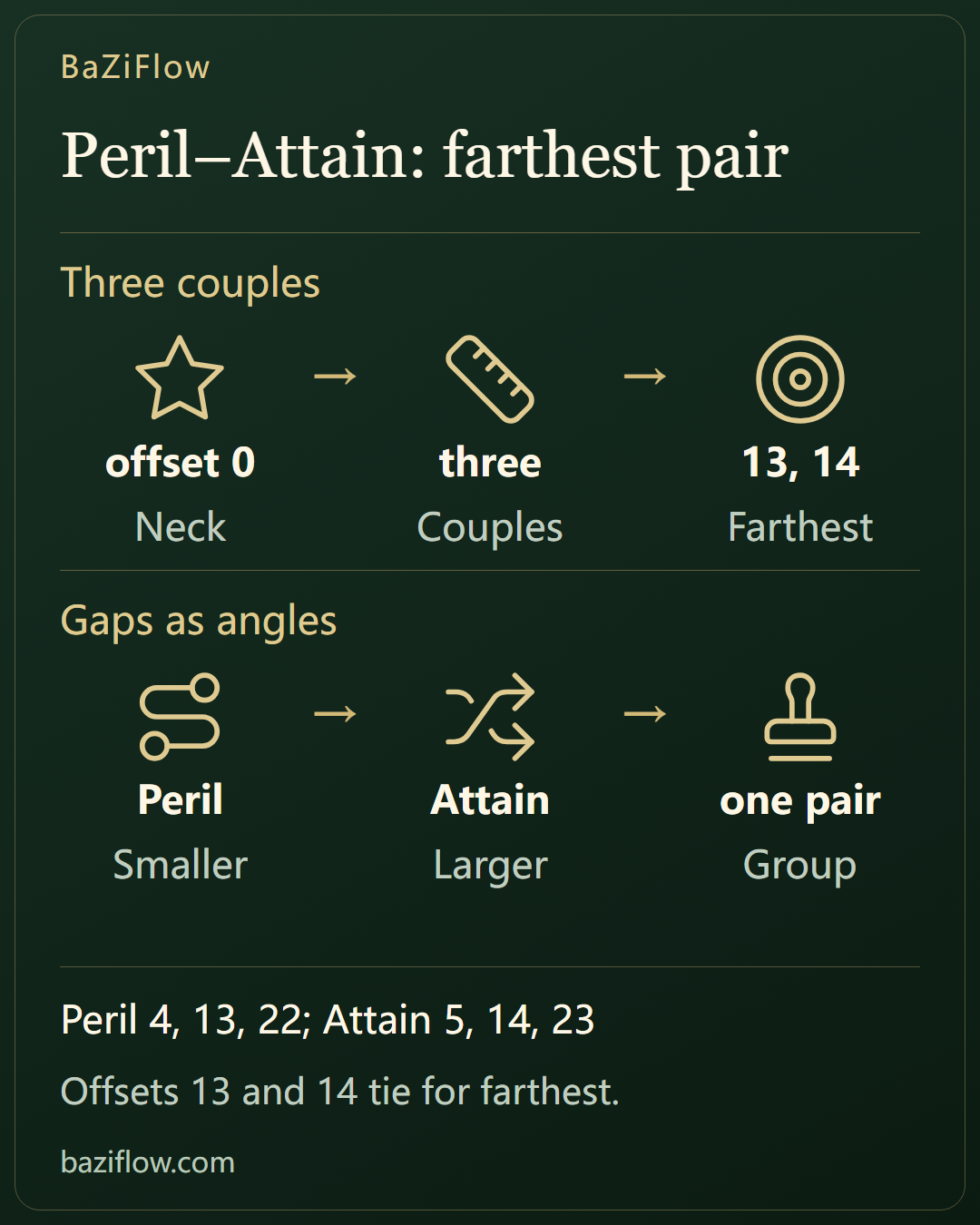
Peril lands on offsets 4, 13 and 22 and Attain on 5, 14 and 23, side by side mid-row; 13 and 14 are the farthest places from the start. A ring, three couples, an angle diagram and two readings of Peril days.
The short version6 min read
The two places farthest from the start on the ring of 27, offsets 13 and 14, are one Peril and one Attain; Peril lands on offsets 4, 13 and 22 and Attain right after it on 5, 14 and 23, an adjacent couple in the middle of every row.
- In each row of nine, Peril holds the exact middle, place 5, and Attain follows at place 6. From one starting mansion the three Peril places and three Attain places come in adjacent couples, the smaller offset being Peril and the larger Attain.
- 27 is odd, so the ring has no exact opposite: the farthest places from the start are offsets 13 and 14, both at gap 13, the largest a short gap can be. Only Peril–Attain reaches it.
- Chapter 3 and the second fascicle agree on an Attain day, but one passage of the second fascicle gives two Peril-day lines: one suits engagements, one lists Peril with Break as unsuitable for marriage; "another view" adds Fate, Womb, Peril and Break.
Read first
The pair in the middle of each row
The exact middle of each row of nine is place 5, called Peril (危); right after it, place 6, is Attain (成). With three rows, Peril has three landing places and so does Attain, and every Peril is followed directly by an Attain.
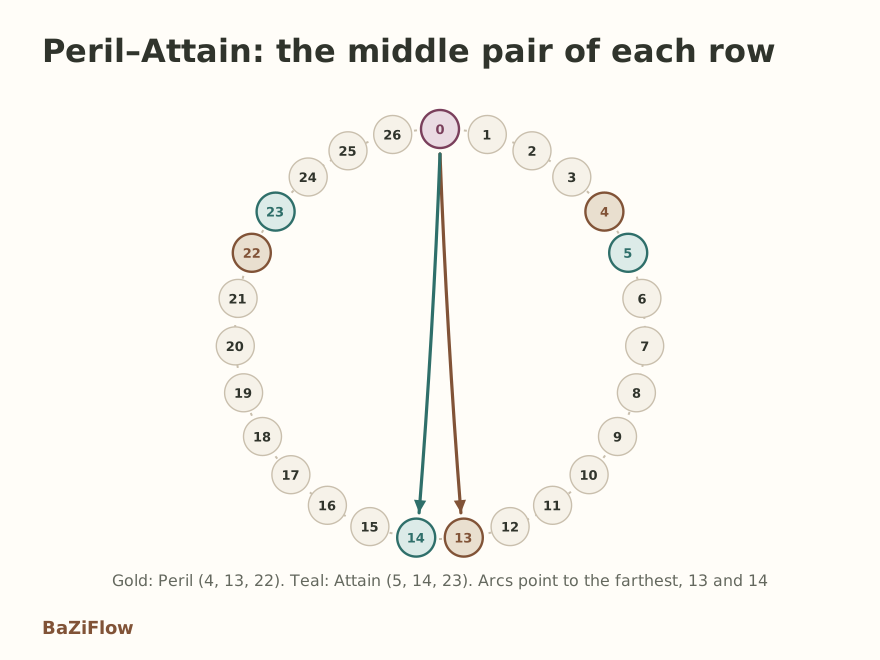
Sketch: the ring of 27 mansions starting at Neck, with the start at offset 0 (place 1 if the start is counted); the two arcs run to offsets 13 and 14, the farthest places from the start.
The picture starts at Neck (亢). Gold is Peril at offsets 4, 13 and 22: Tail, Bond and Star. Teal is Attain at 5, 14 and 23: Winnowing Basket, Stomach and Extended Net. The two arcs run from the start to offsets 13 and 14, which are the farthest places from it.
Three couples of adjacent places
From one starting mansion, the Peril and Attain places come in adjacent couples: 4 and 5, 13 and 14, 22 and 23. In each couple the smaller offset is Peril and the larger is Attain.
Enlarge diagram · scroll sideways to read
"Adjacent" here means that, seen from one starting mansion, two landing places sit next to each other, not that two people sit next to each other. One starting mansion meets only one of them in a given pairing; the other turns up for a different partner.
Gaps as angles
Divide the ring into 27 equal parts and one step is 360 divided by 27, about 13.3°. The three short gaps of Peril–Attain are 4, 5 and 13 steps:
Enlarge diagram · scroll sideways to read
Offsets 4 and 23 are each other's reverse, as are 5 and 22 and as are 13 and 14. Thirteen steps is about 173°, close to the half-circle 180° and the largest a short gap can be, a size none of the other four groups reaches. For example Neck sees Bond at offset 13, Peril, and Bond sees Neck at offset 14, Attain. Putting 4, 5 and 13 into near, middle or far bands needs a convention of its own, which near, middle and far distances takes up.
Two readings of a Peril day in the book
An Attain day is described in the same terms in both places. Chapter 3 says an Attain day suits study of the Way and compounding remedies, and the second fascicle says:
On an Attain-mansion day it is suitable to practice the Way and study, to compound long-life remedies, and to perform rites of accomplishment, all auspicious.
A Peril day is different: that passage has two statements close together.
On a Peril-mansion day it is suitable to form friendships and settle engagements; banquets and gatherings are all auspicious.
Soon afterward it says:
On Peril and Break days, traveling out and in, moving house, trade and marriage, tailoring, shaving and bathing are all inauspicious.
Enlarge diagram · scroll sideways to read
The site takes no side here and records only the facts: the words on an Attain day agree across the two places, while those on a Peril day already coexist in two forms within one passage. When quoting, say which sentence it is: "Peril day", "Peril and Break days" or "another view".
Spotting Peril–Attain by its neighbors
There is a small trick for recognizing Peril–Attain: the offset is one of 4, 5, 13, 14, 22 and 23, and in each adjacent couple the smaller is Peril and the larger Attain.
See whether the offset is one of the six
4, 5, 13, 14, 22 or 23; if not, it is not Peril–Attain.
Compare the two neighbors
4 Peril and 5 Attain, 13 Peril and 14 Attain, 22 Peril and 23 Attain: the smaller is Peril, the larger Attain.
Subtract from 27 for the reverse
The reverse of 4 is 23 (Attain), of 5 is 22 (Peril) and of 13 is 14 (Attain).
Two Peril–Attain exercises
Wings looks at Room, and Room at Wings: what are they?
Wings is place 10 and Room place 15. From Wings to Room the offset is 5, Attain; from Room to Wings it is 22, Peril. 5 plus 22 is 27.
And Horn looking at Legs, Legs at Horn?
Horn is place 12 and Legs place 25. From Horn to Legs the offset is 13, Peril; from Legs to Horn it is 14, Attain. Whoever counts first, the nearer way round is 13 steps.
Next to Peril–Attain in the table is Ease–Break. For where the six groups come from, see the six relationship types; for the book's own sorting of these names, see Friend–Decline.
Questions readers ask next
Does "Peril" mean the mansion is dangerous?
Peril is the name of the fifth place in a row. When choosing days the book says in one place that on a Peril day it is suitable to form friendships and settle engagements, and in another lists Peril with Break as "not suitable". It does not treat Peril as danger throughout, so it matters which sentence you are reading.
Why do both 13 and 14 count as "farthest"?
Twenty-seven places have no exact middle. Thirteen steps forward is fourteen steps back, and fourteen forward is thirteen back, so the short gap of both 13 and 14 is 13 and they are tied for farthest.
Is Attain "better" than Peril?
In both places the book says much the same about an Attain day, study and the practice of the Way and the compounding of remedies, while its words on a Peril day differ. That only shows how much the text says about each word and whether it agrees with itself; it does not show that one place is better for a person than the other.
Was this article helpful?
Sources & references
Continue reading
Ease–Break (安壊): six places every third step, and opposite verdicts on Ease and Break days ↗