

Tai Yang: twelve positions as a day
Content version · · Sources & references
Master Yuchan likens Tai Yang's twelve positions to a day; juan 2 adds a grade table and a day/night clause. Side by side they differ at Ox, Horse and Rooster. Plus co-residents and the father-star habit.
The short version7 min read
Tai Yang is the third star of the Zi Wei sequence. The book describes its twelve landing points as the sun at different heights of a day, an image that mostly agrees with the juan 2 table and parts company with it at Rabbit, Horse, Ox and Rooster.
- Tai Yang always sits three branches before Zi Wei; only Tai Yin, Ju Men and Tian Liang ever share its palace, and the other six positions are solitary.
- Yuchan's "day" and the juan 2 table are two records: the image peaks at Horse, yet the table's top grade falls on Rabbit alone.
- Juan 2 also has a "born by day or night" line, whereas the engine table behind the site grades by branch only and has no day/night axis.
Read first
The fourteen major stars: learn the roster and its structure ↗
Reading twelve positions as one day
Tai Yang (太陽) is "the essence of the sun", and when the book discusses its state in the twelve positions it often borrows the height of the sun across a day. Master Yuchan's passage in juan 1 of the Zi Wei Dou Shu Quan Shu (紫微斗數全書) lines the twelve branches up as a path from sunrise to sunset:
At Tiger and Rabbit it is first rising; at Dragon and Snake it ascends the hall; at Horse it is the sun hung in mid-sky; at Goat and Monkey it stands in a side enclosure; at Rooster it sinks in the west; at Dog, Pig and Rat it loses its radiance.
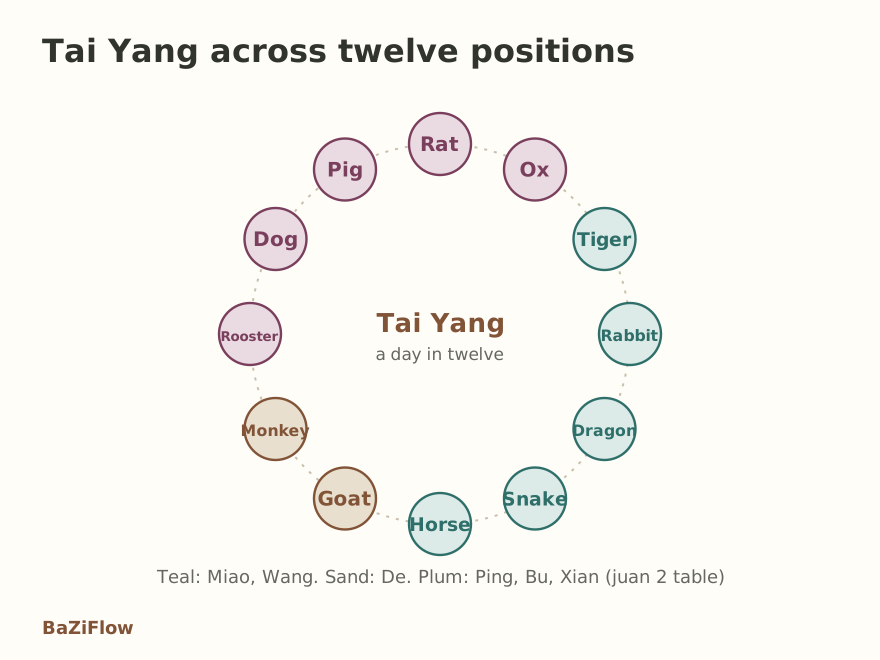
Ring sketch: colors follow the grades of the juan 2 Miao/Wang table, and the branch names in the body follow Master Yuchan's passage in juan 1; the Ox is not named there.
The ring draws that path on the twelve branches, colored by the grades of the juan 2 table: the five teal cells (Tiger, Rabbit, Dragon, Snake, Horse) are Miao or Wang, the two sand cells (Goat, Monkey) are De, and the five plum cells are Ping, Bu or Xian. Yuchan gives the Ox no name, so the ring leaves it bare.
The juan 2 section that assigns each star its Dipper and element writes it as "Tai Yang: Fire, belongs to both Dippers, turns into nobility, ruler of Career".
Two records side by side: the imagery and the table
Place Yuchan's names beside the juan 2 grades, position by position:
Enlarge diagram · scroll sideways to read
The broad shape agrees: high around Dragon, Snake and Horse, middling at Goat and Monkey, falling from Rooster onward. The disagreements come in two places. The first is the peak: the image tops out at Horse, whereas the juan 2 table gives Miao to Rabbit alone and Wang to Horse. The second is the Ox, which Yuchan's passage never names and the table grades Bu.
One more mismatch sits inside juan 2 itself: its prose on Tai Yang says "Ox palace, sunken" and "Dog palace, sunken", while the table grades those two cells Bu, one grade above Xian.
Born by day or night: a second condition beyond position
The Life-palace entry for Tai Yang in juan 2 contains this clause:
Born at night: sunken; born by day: Miao and Wang.
It adds a variable to the star: whether the birth fell by day or by night. The sentence does not say where day ends and night begins, and we do not supply that. What does need saying is that the engine data behind site charts gives Tai Yang a single row looked up by branch and no day/night axis, so the Tai Yang grade shown on a chart corresponds only to the table above.
Enlarge diagram · scroll sideways to read
Wherever the birth hour matters, recheck the birth time first; how the hour and day-change settings alter a chart is covered in leap months, hours and the day boundary.
Who shares the palace, and the Rooster cell
Tai Yang can meet only three partners. Tai Yin (太陰) joins it at Ox and Goat, Ju Men (巨門) at Tiger and Monkey, Tian Liang (天梁) at Rabbit and Rooster; Rat, Horse, Dragon, Dog, Snake and Pig leave it alone.
Enlarge diagram · scroll sideways to read
The Rooster cell is the one place in Tai Yang's whole row where the book and the engine part ways. The records side by side:
| Source | Tai Yang at Rooster |
|---|---|
| Juan 2 grade table | Ping |
| Juan 2 prose on Tai Yang ("Rabbit palace Miao, Rooster palace Ping") | Ping |
| Master Yuchan's imagery in juan 1 | sinking west |
| iztro 2.6.0 star table | Xian |
The book's own records agree and the engine grades lower. When you compare a real chart, the grade follows the version of the software used; the same discrepancy is worked through with Tai Yang and Tian Liang at Rooster in reading paired stars through their relationship.
Borrowing Tai Yang to read the Parents palace
When it comes to the Parents palace, juan 2 sets down a convention:
In reading the Parents palace, take Tai Yang as the father star and Tai Yin as the mother star.
This is the habit of borrowing one star to stand for one kind of person: when reading Parents, first look for where Tai Yang is. Work a position through. The twelve palaces run from the Life palace against the order of the branches, so the Parents palace is the branch after the Life palace. Suppose the Life palace is at Tiger; the Parents palace is then Rabbit. Suppose Zi Wei is at Horse; Tai Yang lands three branches before it, at Rabbit. Tai Yang therefore sits exactly in the Parents palace, graded Miao there, with Tian Liang as its co-resident.
Look up the branch of Tai Yang
Take that cell in the juan 2 table and note the name Yuchan gives the position, if any (the Ox has none).
Write the two records side by side
Where imagery and table disagree (Horse, Ox, Rooster), record "two statements" instead of merging them.
Send day-or-night clauses back to the hour
The book's day/night line needs the birth hour; if the hour is in doubt, verify it before quoting.
Two Tai Yang lookups
Tai Yang at Goat: who shares the palace, and where is Zi Wei?
Tai Yin shares it; Zi Wei is three positions after Goat, at Dog; Goat is De and Yuchan calls it the side enclosure.
At one Rooster, what do book and engine each record?
The table and prose of juan 2 say Ping, iztro 2.6.0 says Xian, and Yuchan says sinking west.
Before Tai Yang in the six-star order comes Tian Ji and after it Wu Qu; a lookup drill on Tai Yang at Rabbit, Horse and Rat in the same table is in star brightness levels.
Questions readers ask next
Horse is "the sun hung in mid-sky", so why is the table not Miao there?
"Mid-sky" is Master Yuchan's description of the Horse position, while the table separately grades Horse as Wang and gives Miao only to Rabbit. Both records stand, and putting them side by side is more honest than rewriting one into the other.
The text says "sunken" for Tai Yang at Ox and Dog but the table says Bu. Which is right?
Both are the book's own records. The prose "sunken" looks like a general word for low positions, while Bu sits one grade above Xian. Say which passage you are citing, then label the grade with the seven names used in the table.
Does the Tai Yang grade shown on a chart already allow for day and night births?
The iztro 2.6.0 star table used for site charts gives Tai Yang one row graded by branch and no day/night axis. To use the book's "day or night" line you need the birth hour and a separate judgment, and that line does not say where day ends.
Was this article helpful?
Sources & references
Continue reading
Tian Ji (天機): A Six-Rung Grade Ladder and the Co-residents Behind It ↗
Wu Qu (武曲): Three Lines Tying It to Wealth, and Which Can Be Checked by Position ↗