

Two voices in a relationship
Content version · · Sources & references
Use relationship readings without letting a score or symbol speak for either partner. Separate one chart, a comparison of two charts and the agreements people actually make.
The short version6 min read
A relationship reading can overlook the other person’s voice. Start with one recent disagreement, identify what happened and ask what each person needs. Then distinguish a proposal from the arrangement both people actually accepted.
- A zodiac label or single palace cannot decide a relationship on behalf of two people.
- Your interpretation, a partner’s statement and a shared agreement have different sources.
- A specific request still leaves room for refusal or an alternative proposal.
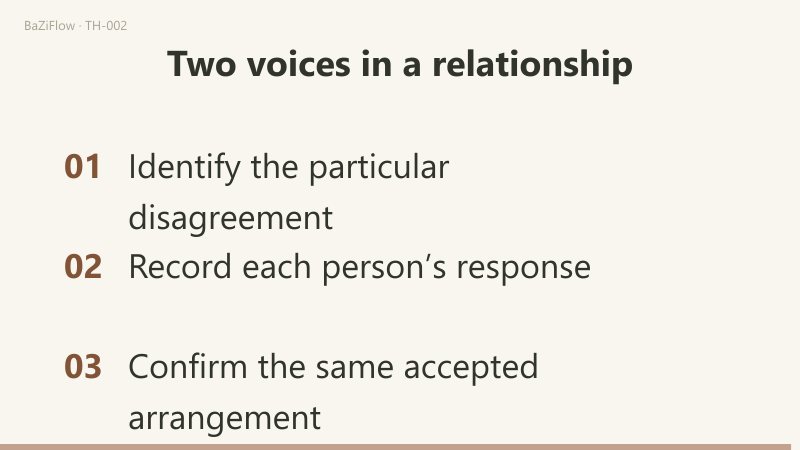
Begin with a disagreement that has a date and a subject
Suppose weekend plans keep changing at short notice. The practical questions concern how much notice each person needs, which changes are unavoidable, and how you will tell each other. Calling one partner inherently unpredictable does not answer those questions. It assigns an identity before the discussion has begun.
The broad question “Are we compatible?” can contain many separate concerns: routines, shared work, ways of speaking and long-term plans. Choose one situation first. A symbolic reading may suggest another angle to consider, but it should not replace the accounts of the two people involved.
A last-minute change
- What can be checked?
- Which event changed and its effect
An unpredictable person
- What can be checked?
- A broad claim without a specific event
Keep both voices attached to the same issue
- Expectation
- Something one person wants; it does not establish the other person’s acceptance.
- Agreement
- Terms that both people actually accept, rather than acceptance inferred from silence or a reading.
Use a reading as a question, not someone else's testimony
If an interpretation makes you think your partner wants more space, identify that as your interpretation. Ask what they actually want. Do not present the chart as proof of their unspoken feelings, or treat disagreement with the reading as evidence that they do not understand themselves.
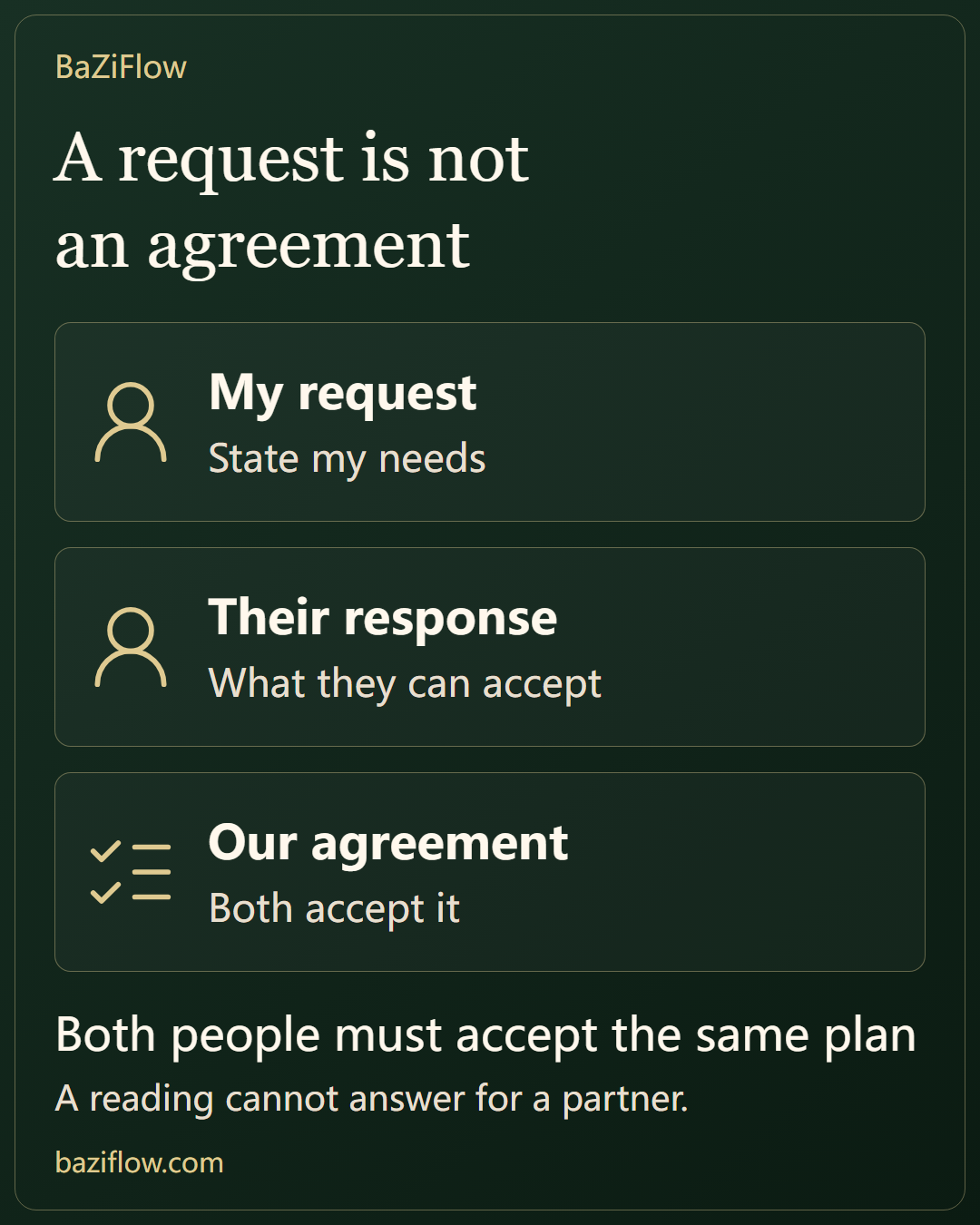
The Gottman Institute's discussion of a softened start-up recommends describing a situation and a need without turning a complaint into a judgment of character. That is a communication reference, not a guarantee that a conversation will succeed and not evidence for a chart interpretation. A request remains a request; it does not become an agreement until both people actually accept it.
| A label that closes discussion | A question that leaves room for an answer |
|---|---|
| You never plan anything | How far ahead would we like to confirm this activity? |
| We are simply incompatible | Which recent arrangement has been hardest to coordinate? |
| You should care more | What kind of contact helps each of us feel considered? |
These are illustrative prompts, not a script for getting compliance. Either person may have a different account, propose another arrangement or decline. Softer wording does not make it acceptable to turn one person's expectation into a joint conclusion.
My interpretation
- A possible question
Their account
- Their actual words
Choose the appropriate knowledge route
If the concern began with two zodiac-animal labels, start with compatibility beyond zodiac signs. A full BaZi reading involves more positions and conditions than a single label. Simplifying two people to those labels removes much of the tradition's own structure before any real-world claim is considered.
More chart detail still does not automatically produce a verdict on the relationship. Whether people communicate, respect a refusal and keep an agreement is observed in their interactions. A traditional combination or clash term should not become an instruction to stay together or separate.
For Ziwei, the limits of the Partner Palace provides another entry point. Identify whose chart is being read and which time layer and conditions are in view. A position in one person's chart cannot serve as the other person's testimony.
The iztro palace guide describes the Partner Palace in relation to the chart owner's approach to relationships and partner preferences, while emphasizing the wider chart. Here that is treated as a teaching convention. It is not presented as a validated psychological assessment or as a single-palace determination of a relationship's outcome.
A’s Partner Palace
- Whose information?
- A’s chart
- What does it establish?
- Not B’s personal testimony
B’s direct response
- Whose information?
- B’s statement
- What does it establish?
- What B actually expressed
Comparing two records introduces another task
When both people's charts are used, keep the identities and sources attached to each statement. A description belonging to person A must not silently become person B's character in a synthesis. A comparison also needs to specify whether the passages concern the same question and period.
The guide to relationship readings across systems helps with that distinction. Similar language can conceal different assumptions. Nor does agreement between several symbolic readings replace the need to ask a partner about their actual experience.
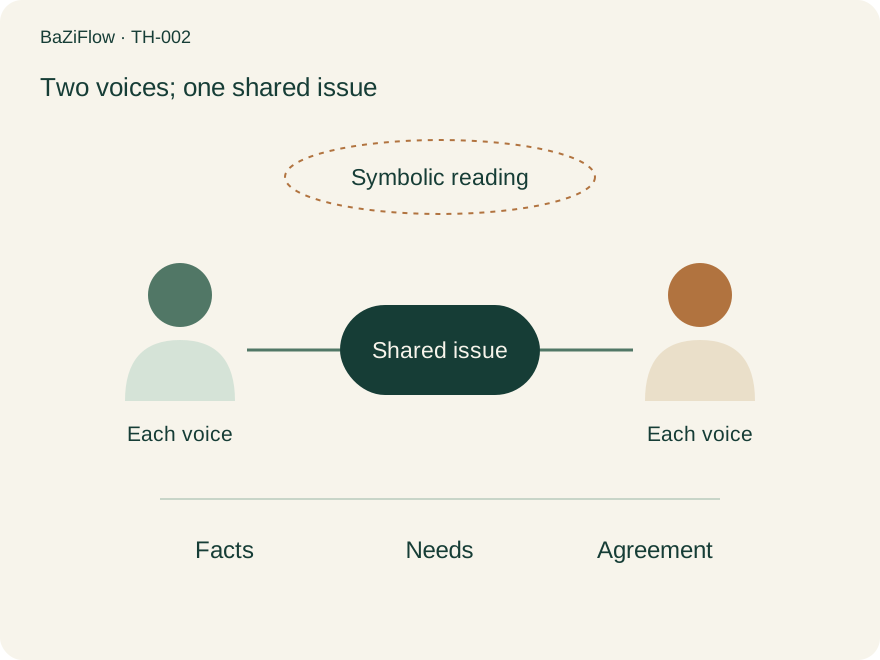
Original BaZiFlow relationship-discussion diagram. The figures are abstract and ungendered; no compatibility score is calculated.
In the diagram each person retains a voice. A shared issue sits between them; facts, needs and agreements remain explicit below. Symbolic reading is shown separately so that it can inform a question without becoming an answer spoken on someone's behalf.
Confirm by Friday
- B responds
- Reads but does not answer
- Present status
- No joint acceptance
Confirm by Friday
- B responds
- Offers Saturday instead
- Present status
- Different proposed terms
Confirm Saturday noon
- B responds
- Explicitly accepts
- Present status
- That arrangement is accepted
Review the interaction instead of retrofitting a forecast
After a discussion, record what each person said, what was agreed, what happened afterwards and what remains unresolved. One calm conversation does not settle every difficulty. One argument does not demonstrate that a zodiac pairing was doomed. Stay with the process you can describe rather than choosing a chart explanation after seeing the result.
Respect and autonomy remain practical conditions of the relationship. No compatibility reading justifies controlling a partner, overriding an explicit refusal or asking someone to endure harm. Decisions about continuing a relationship belong to the people living it and the circumstances they face, not to a label.
This route moves from simplified categories toward specific information and then toward questions both people can answer. Its useful outcome is not a more elaborate compatible-or-incompatible verdict. It is a clearer separation between a text's interpretation, your own thought, your partner's account and an agreement you have actually made together.
What was said
- Keep the two accounts
What was accepted
- Record the shared terms
What followed
- Observe action and open issues
Describe the event and effect
For example, a location changed just before departure after transport had already been booked.
Hear the different timing needs
One person may ask for Friday confirmation while the other can only confirm on Saturday. Preserve that difference.
Check the version both accepted
Record an agreement only if both accept the same confirmation time. Otherwise keep it as an unresolved proposal.
Questions readers ask next
Does a Partner Palace establish a partner’s personality?
Identify the chart owner, time layer and teaching convention first. A chart position is not the partner’s own account and cannot replace their description of their feelings.
Must someone accept a gently phrased request?
No. Specific wording can make a request easier to answer, while the person remains free to decline, revise it or propose different terms.
Are matching readings enough?
Check whether they share assumptions and concern the same people and period. Agreement between symbolic accounts does not replace actual responses from either person.
Was this article helpful?
Start reading
Compatibility beyond animal signs: keep chart fields and relationship evidence distinct ↗ · BaZi
Comparing relationship readings with an evidence ledger ↗ · Cross-system studies
Sources & references
Continue reading
Compatibility beyond animal signs: keep chart fields and relationship evidence distinct ↗