

Numbered cards and court cards
Content version · · Sources & references
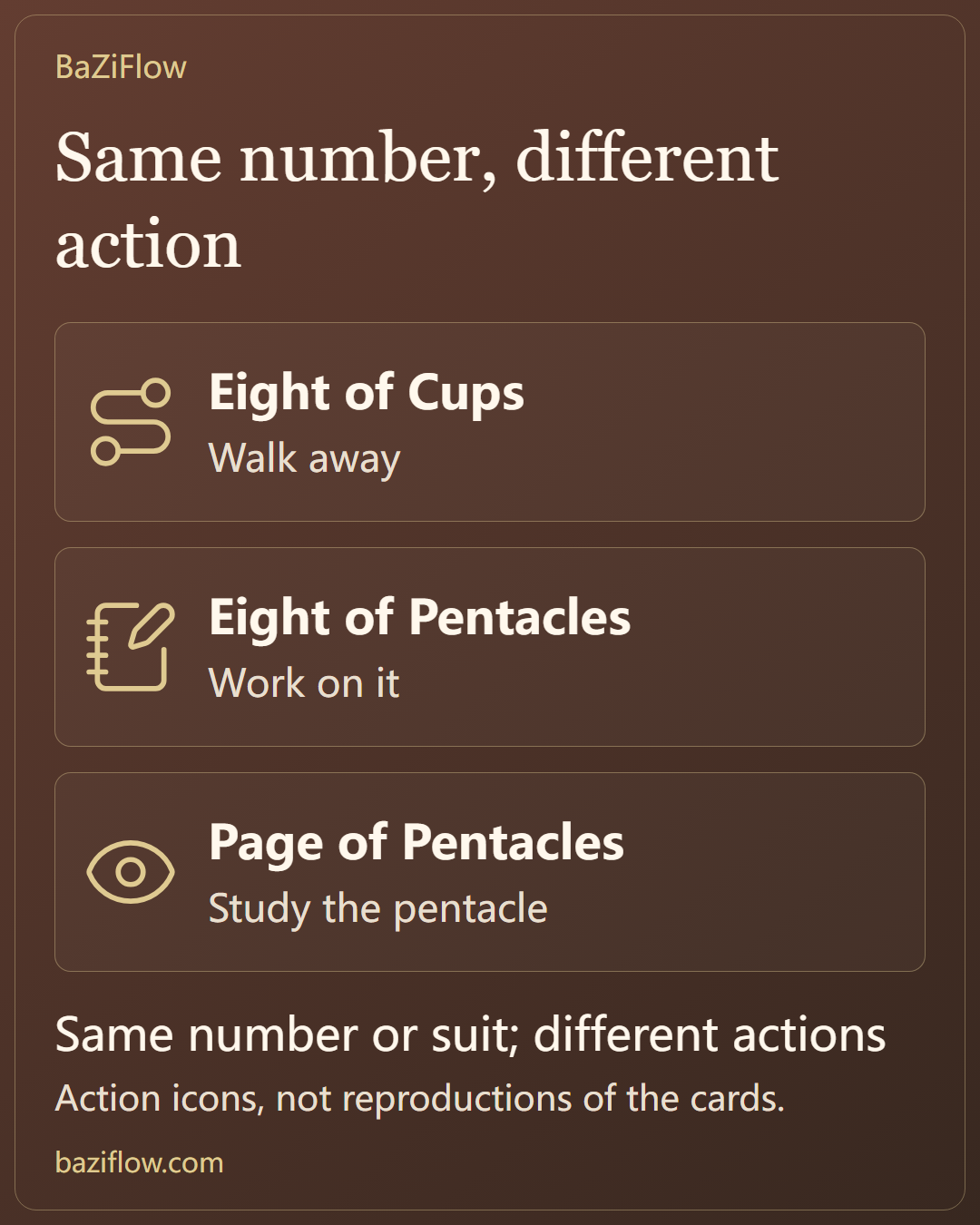
Use two Eights and two other Pentacles cards to separate number, suit, action and role. A court title does not identify a real person, and a shared number does not erase a different scene.
The short version7 min read
Numbered cards can contain people in action, while courts can invite attention to a way of observing or acting. Compare departure in the Eight of Cups, work in the Eight of Pentacles and the Page’s gaze before deciding how each scene fits a question.
- The shared number eight does not make departure and craftsmanship the same action. Number cannot replace the depicted scene.
- The Eight and Page of Pentacles share a suit but contrast making with attentive looking, giving different points of entry into a question.
- Court ranks do not establish identity or competence. A numbered card’s multi-person setting does not establish a reader’s future family.
Read first
The structure of a tarot deck: 22 cards and four suits ↗
The Four Tarot Suits: Enter Through Objects, Not Four Sealed Areas of Life ↗
Begin with the crowded scene, not the title
Suppose a catalogue exercise asks you to separate cards with people from cards without people. That sorting task would not reproduce the division between numbered and court cards. The Ten of Pentacles is a useful counterexample before any attempt to interpret a court as a real individual.
Many numbered cards in this tradition contain people and actions. The Ten of Pentacles description includes a house entrance, adults, a child, dogs and an older figure in the foreground. That gives the reader a multi-person setting to examine; it does not prove that a particular family arrangement or financial outcome awaits the querent.
Numbered
- Number and suit
- Can contain people
Court
- Rank and suit
- Read action and setting
Comparison concerns Rider–Waite–Smith scenes, not every deck
Hold the number steady and watch the action change
Compare the Eight of Cups with the Eight of Pentacles. In Waite's descriptions, one figure is leaving the cups, while the other is at work and displaying what has been made. The shared number does not make departure and workmanship the same activity. Any interpretation that gives both cards an identical paragraph about progress has probably allowed a numerical label to replace the scene.
This comparison uses the Rider–Waite–Smith tradition and the individual entries in the 1911 Pictorial Key. It does not assume that every deck's numbered cards use the same scenes. Nor does it turn eight into an unexplained forecast of eight days, eight people or age eight. Number is one organising feature; what it can support depends on a stated method and the actual material.
Waite's Eight of Cups entry also preserves conflicting readings, whereas the Eight of Pentacles entry includes work and craftsmanship. The source itself is more complicated than a single clean keyword. Read it as evidence of an author's description and interpretive choices, not as confirmation that the same events are occurring in someone's life.
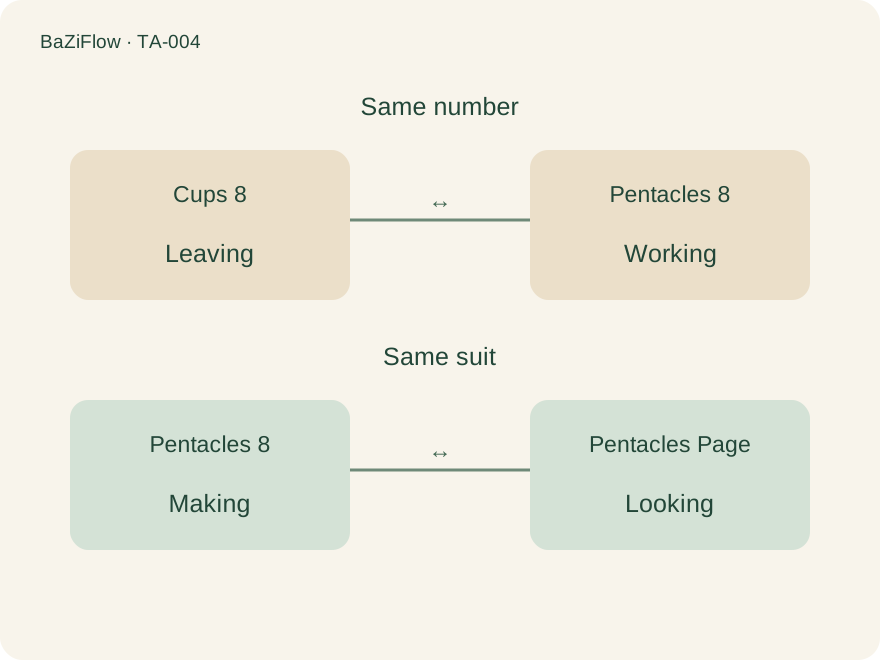
Original BaZiFlow comparison diagram. Connections indicate observations to compare, not a compulsory sequence of personal development.
Now hold the suit steady
Put the Eight of Pentacles beside the Page of Pentacles. Here the shared feature is the suit, while the activity changes. The Eight presents work in progress; the Page attends closely to the pentacle. Waite's Page entry includes study and reflection, as well as an alternative involving messages. The figure is therefore not exhausted by the description “a young person”.
Try two separate questions: what is being done, and where is attention directed? Those questions can reveal differences without assigning either card a superior value. Making something and examining something can both be useful, but they are not interchangeable actions. The four suits provides the classificatory background; the individual image supplies the further distinction.
| Comparison | Feature held constant | Difference worth retaining |
|---|---|---|
| Eight of Cups / Eight of Pentacles | Number | Leaving versus working |
| Eight of Pentacles / Page of Pentacles | Suit | Making versus attentive looking |
| Page of Pentacles / Ten of Pentacles | Suit and human presence | A concentrated focus versus a multi-person setting |
The table is an observation exercise, not a complete interpretation of any card. Its purpose is to make a claim of difference point back to a specific feature instead of relying on fresh adjectives around the same general advice.
Eight: making
Page: attention
Read the pictured role before identifying a person
Conversely, a court title does not require the reader to identify an external person. Page, Knight, Queen and King are ranks within the deck. They do not automatically map onto a person's age, gender, job or competence. Calling someone a Page need not mean that they are immature, and drawing a King does not establish that they are the most capable person involved.
Before asking “who is this?”, ask what posture, attention, objects and surroundings are visible. If the position concerns your own preparation, a court figure may be used to explore a way of attending or acting. Label that as the chosen application. If you do relate a card to someone, explain the relevant context supplied by the participants and allow for the possibility that no person is being represented.
What is visible
Page studies an object
- Useful question
- Where is attention directed?
- Not established
- A young person’s identity
People in a numbered card
- Useful question
- How are figures arranged?
- Not established
- A future family structure
A court title
- Useful question
- How is the pictured role shown?
- Not established
- A person’s competence
Turn the comparison into two different observation tasks
For an original workshop exercise, give one participant the task of describing what is being made in the Eight of Pentacles, and another the task of describing where attention is directed in the Page. Ask them to bring back observations before suggesting advice. One account should concern ongoing work; the other should make the concentrated gaze visible. If both return only “keep developing”, the assignment has not yet distinguished the pictures.
Now exchange the assignments. Can a description of attentive looking be supported by the Eight’s actual arrangement? What changes when the Page is asked to illustrate production? There may be reasonable observations in both directions, but each needs its own pictured basis. The point is to test how a claim depends on the selected material, not to decree one mandatory meaning for each card.
A learner may find either task useful at a different moment. Someone who has already made repeated attempts may need to inspect a procedure; someone who has only watched may need to try it. Their actual work determines that distinction. Putting the Page before the Eight on a table does not establish a universal route from beginner to expert.
Keep this exercise separate from the author's divinatory entries. It is a comparison activity devised here, not a report that these cards were drawn for a particular person. The court title is not a qualification, and the number is not a developmental age.
Practice
- Observe
- Try
- Inspect
- Adjust
Return to observation; Page→Eight is not a life ranking
Keep observation, source and application in separate columns
The first column records visible action or arrangement. The second records the text consulted, including any alternative interpretations the author preserves. The third gives a tentative application to the current question. If you can fill only the first column, that is a valid stopping point. An empty application is preferable to an invented character assessment.
Review whether the proposed conclusion would survive swapping the card for any other card in the exercise. If nothing substantive changes, ask which distinguishing evidence was actually used. This is not a demand to force opposite conclusions from every pair; it is a demand that a specific reading explain its dependence on specific material.
For the next step, reading cards in relation considers how different scenes contribute to one question. Numbered and court cards need not be treated as separate dictionaries of answers. They offer different combinations of scene, role and action, each of which should remain visible in the reasoning.
Describe an action
Name leaving, making or looking and its object.
Hold one feature constant
Keep number or suit fixed and identify the remaining scene difference.
Make a relevant application
Connect the observation to the actual practice record and explain the task selected.
Questions readers ask next
Can numbered and court cards be separated by whether people appear?
No. In Rider–Waite–Smith scenes, the Eight of Pentacles includes a worker, the Eight of Cups a departing figure and the Ten a multi-person setting. Rank and number classify cards; human presence describes an image.
Must the Page of Pentacles represent a young person?
No. Waite describes concentrated attention toward a pentacle and includes study, reflection and messages among readings. In a question about preparation, that gaze can prompt discussion of learning without identifying an external person.
Does putting the Page before the Eight prove progress from novice to expert?
No. It proposes a story rather than proving a universal developmental order. Experienced people return to observation and beginners also make things. Actual practice records help identify which task is useful now.
Was this article helpful?