

How six relationship groups arise
Content version · · Sources & references
Derive six reciprocal pairs from the three-nine ordering using modular offsets, while keeping reference ownership and interpretive limits explicit.
The short version6 min read
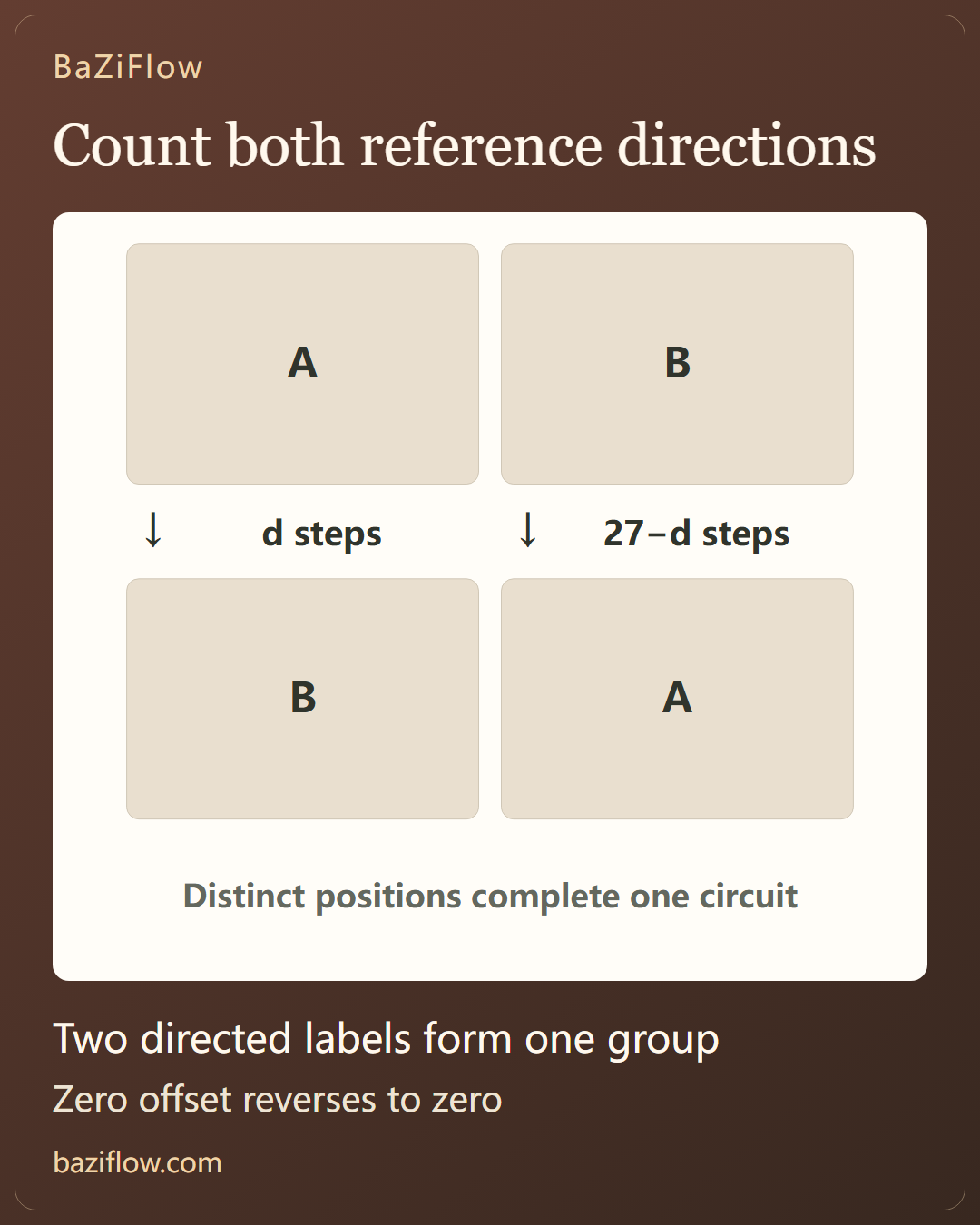
The six Sukuyō relationship groups combine two directed position labels. First locate B from A, then A from B. In the three-nine cycle, forward offset three is An and reverse offset twenty-four is Huai. Calling the pair An–Huai does not remove the two reference persons or establish an outcome for their relationship.
- The three-nine rows begin with Ming, Ye and Tai, followed by the same eight labels; a declared 27-position cycle makes the grouping reproducible.
- Offset three gives An and reverse offset twenty-four gives Huai. The pair name retains neither person’s direction unless it is also recorded.
- All 27 offsets fall into six groups: one in Ming, two in Ye–Tai and six in each of the other four groups. These counts are not population statistics.
Read first
What are Sukuyō astrology and the birth mansion? ↗
Why Sukuyō Natal Mansion Methods Differ: Tell Lookup from Zoning, Then Check the Rule ↗
Can two different offsets have the same group name?
Yes. In the three-nine ordering (defined below; an offset counts steps around a 27-name circle), a forward offset of 1 carries Rong (榮), while offset 8 carries Qin (親). Their reverse offsets are 26 and 19, carrying Qin and Rong. Both comparisons therefore belong to the unordered Rong–Qin group, even though the directional entries differ. A single group name cannot recover the original calculation.
This is a useful place to begin when comparing two reports that show the same relationship category. They may have different inputs and different directed positions. Matching category names do not establish a duplicated calculation, and they certainly do not establish matching personal experiences. First recover the two references and the direction in which each position was counted.
Reconstruct the ordering before naming people
The chapter on the Three-Nine Secret Mansions (序三九祕宿品第三; Taishō vol. 21, no. 1299, p. 391b; CBETA 2023.Q4 edition) gives three rows of nine. Ming (命), Ye (業) and Tai (胎) head the rows. Each is followed by Rong (榮), Shuai (衰), An (安), Wei (危), Cheng (成), Huai (壞), You (友) and Qin (親). The passage also calls for comparing each person's mansion from the other's reference. Those are the structural ingredients used here, not empirical evidence about a pair's behaviour.
Put that ordering on a circle of 27 positions without Niu (牛). Number the reference offset 0. A move of three steps reaches inclusive position 4, An; starting from that target, another 24 steps in the same direction returns to the reference, at Huai. Write the result with its subjects: B's position from A is An; A's position from B is Huai.
The reverse offset is (27 − d) modulo 27. The modulo retains zero as zero for coincident positions. It does not add a twenty-eighth mansion. Likewise, offset 9 reverses to 18, pairing Ye with Tai. These special entries begin rows; the remaining offsets use the repeated eight labels.
0–8
- First label
- Ming
- Following eight
- Rong · Shuai · An · Wei · Cheng · Huai · You · Qin
9–17
- First label
- Ye
- Following eight
- Rong · Shuai · An · Wei · Cheng · Huai · You · Qin
18–26
- First label
- Tai
- Following eight
- Rong · Shuai · An · Wei · Cheng · Huai · You · Qin
Count the groups, rather than assuming the list is complete
For each offset from 0 through 26, pair its label with the label at the reverse offset. Discard direction only for this grouping step. The possibilities reduce to Ming/Ming, Ye/Tai, Rong/Qin, Shuai/You, An/Huai and Wei/Cheng. This explains the six groups as a derivation from the declared sequence. Later schools may add conventions beyond this derivation; the scripture provides the stated ordering and reciprocal comparison.
| Resulting group | One forward offset | Its reverse | Directed labels for this example |
|---|---|---|---|
| Ming | 0 | 0 | Ming / Ming |
| Ye–Tai | 9 | 18 | Ye / Tai |
| Rong–Qin | 1 | 26 | Rong / Qin |
| Shuai–You | 2 | 25 | Shuai / You |
| An–Huai | 3 | 24 | An / Huai |
| Wei–Cheng | 4 | 23 | Wei / Cheng |
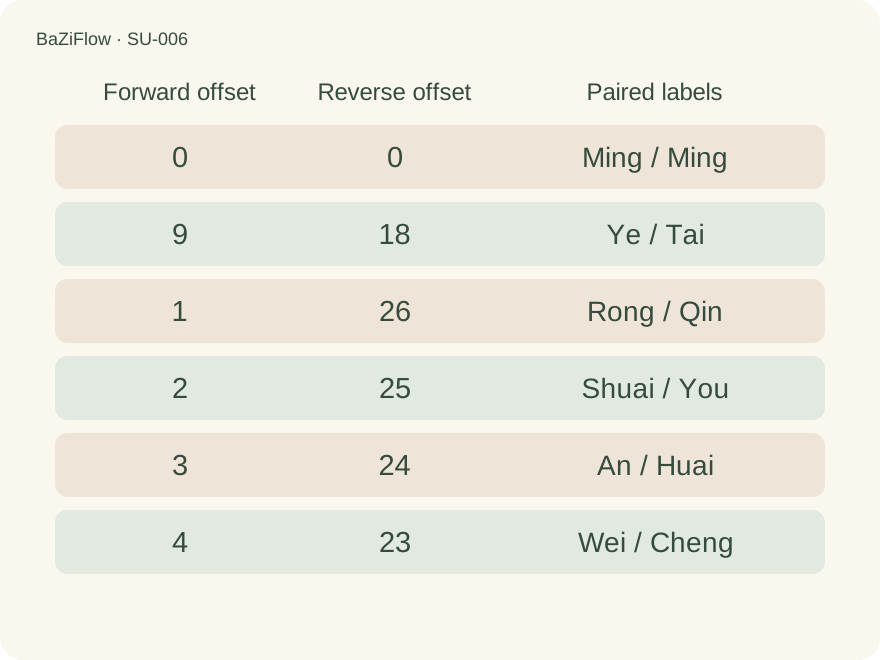
Original reciprocal-pair examples derived from the stated sequence, not relationship scores.
The figure gives one representative per group. It is not a full offset table. In particular, the opening example with 8 and 19 remains valid even though those numbers are absent from the picture. Adding near, middle or far would require another explicit naming convention; the reciprocal grouping alone has not supplied one.
To check complete coverage, sort every offset: Ming contains 0; Ye–Tai contains 9 and 18; Rong–Qin contains 1, 8, 10, 17, 19 and 26; Shuai–You contains 2, 7, 11, 16, 20 and 25; An–Huai contains 3, 6, 12, 15, 21 and 24; Wei–Cheng contains 4, 5, 13, 14, 22 and 23. Each integer from zero through twenty-six occurs exactly once.
The six categories therefore do not divide the circle into six equal pieces. Ming has one offset, Ye–Tai two, and the other four groups six each, totalling twenty-seven. This counts positions in the declared table. It neither assumes uniformly distributed birth mansions nor measures how frequently actual relationships occur.
Ming
- 1 offset
Ye–Tai
- 2 offsets
Other four groups
- 6 offsets each
What is lost when direction is discarded?
Grouping is deliberately a reduction. An–Huai retains the pair of words but no longer tells a reader which person was the reference for An. A phrase such as “A is the Huai person” can obscure that convention further. Preserve the two complete directional statements beside the abbreviated group, especially when comparing software outputs or sharing an exercise.
The word Huai is not an observation that A behaves destructively. Nor does An grant the other person authority over A. A relation between positions cannot establish consent, intentions or conduct. Even a favourable-sounding category needs the same restraint: Ming means coincident mansion positions in this calculation, not identical lives, and Ye–Tai does not demonstrate a past-life identity.
Traditional interpretations may be studied as interpretations. They should not fill missing facts about a particular interaction. The participants' accounts and observed actions are separate evidence, with their own uncertainties; neither acquires certainty by matching a symbolic word.
Check the inputs when the arithmetic agrees but reports do not
Two programs can both reverse offsets correctly and still start from different birth labels. NAOJ's explanation helps identify the 27-name convention without Niu, but it does not choose a birth-date conversion for every later system or test interpersonal predictions. Record how each person's label was obtained before comparing the final group.
If the convention is undocumented, retain that gap. Do not choose a label because its story sounds more convincing. Calculation conventions covers this earlier step. A complete practice record retains the sequence, both sourced birth labels, both offsets and both directed words, followed by the group name.
Finally, the target must really be the object being discussed. Comparing two birth references is a two-person exercise. Replacing one reference with a day's mansion makes it a person-to-date comparison, even if the modular arithmetic looks familiar. Keep that distinction visible when moving to birth mansion and daily mansion.
Offset 8: Qin
- Still grouped as Rong–Qin
Offset 19: Rong
- Still grouped as Rong–Qin
Questions readers ask next
Why do relationship groups usually contain two label names?
They combine the labels obtained in the two directions. B may occupy An from A’s reference, while A occupies Huai from B’s. An–Huai names the pair but does not, on its own, identify which directed statement belongs to each person.
Why use twenty-four rather than minus three for the reverse?
On the declared 27-position circle, minus three and twenty-four forward steps reach the same position. Using offsets from zero to twenty-six keeps the table lookup consistent: 27 minus 3 is 24. A zero offset still reverses to zero.
Do the six groups each cover one sixth of the positions?
No. Ming contains offset zero, Ye–Tai contains nine and eighteen, and the remaining four groups each contain six offsets. One plus two plus four times six equals twenty-seven. These table counts do not describe a population distribution.
Was this article helpful?