

Five of Pentacles: a lit window in snow
Content version · · Sources & references
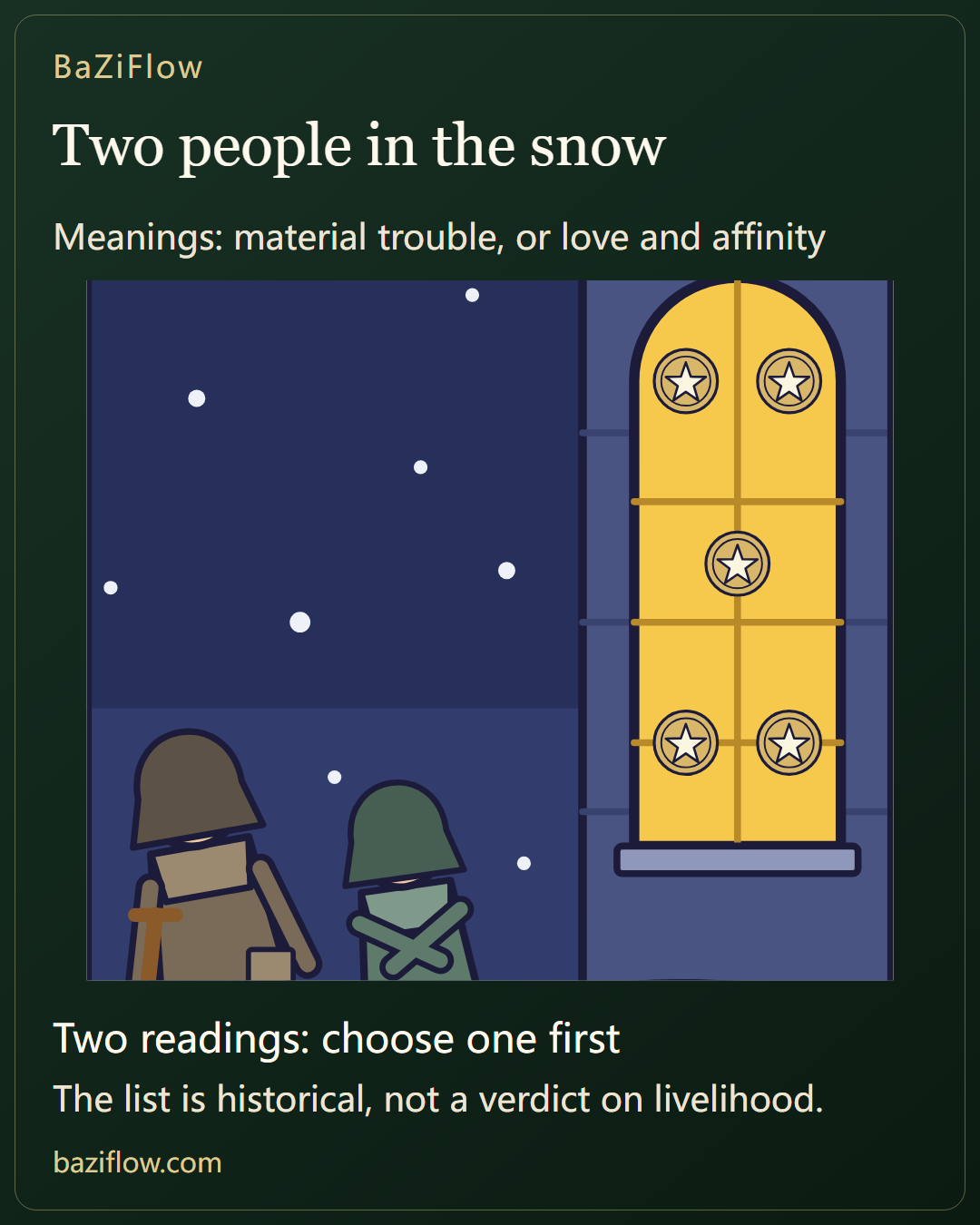
The Five of Pentacles shows two figures passing a lit window in a snow-storm. See Waite's two readings, material trouble and love, then practice choosing one with a nearly empty fridge.
The short version5 min read
The Five of Pentacles shows two figures passing a lit window in a snow-storm. Waite sets two readings side by side in its entry and says outright that they cannot be harmonized.
- Coins and people sit on opposite sides of the picture: five coins in the window, two figures passing in the snow outside.
- The list foretells material trouble above all, destitution being the form illustrated and not the only one; some cartomancists read it as love, concord and affinities, and Waite says these alternatives cannot be harmonized.
- "Conquest of fortune by reason" is a line from the extras and points the opposite way from the main entry's material trouble; the main reversed entry has five words of its own.
Read first
Two figures in the snow, one lit window
Waite's description of this card is one sentence: two mendicants in a snow-storm pass a lighted casement.
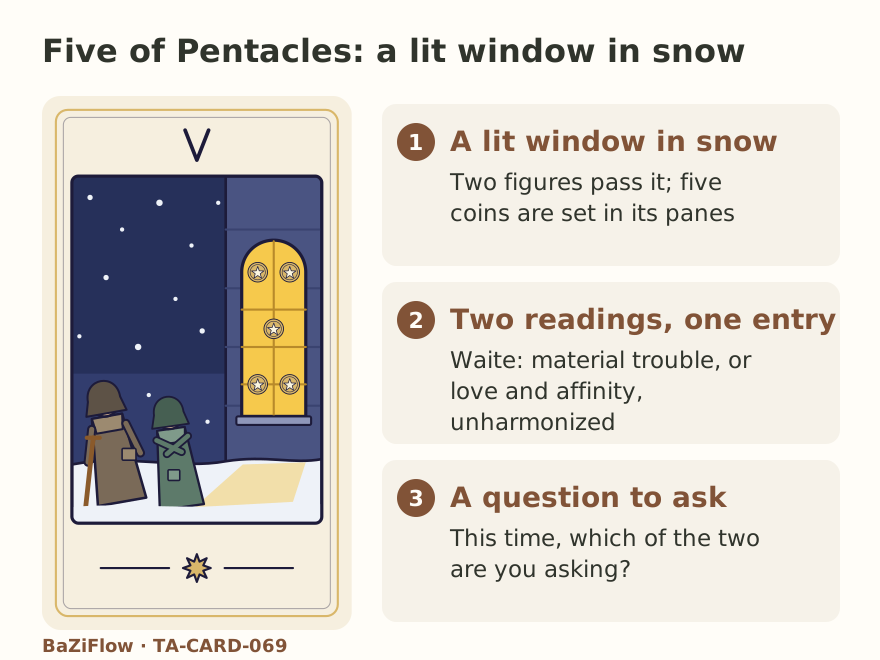
The Five of Pentacles: snow and a lit window
The Rider-Waite-Smith version has a black night and thick snow. A large window fills the upper part, with five coins set in its colored glass in a pattern of one, two and two. Below it, on the snowy ground, one figure with a bandaged head and two crutches seems to look up toward the window, while the other, in a shawl and barefoot, walks on with head bowed. In the BaZiFlow card both figures wear hoods and one leans on a wooden staff, and the window is a glowing arched one.
Enlarge diagram · scroll sideways to read
One card, two readings that will not merge
Waite's divinatory meanings begin: the card foretells material trouble above all, whether in the form illustrated, that is destitution, or otherwise. Then he turns to others: for some cartomancists it is a card of love and lovers, wife, husband, friend, mistress, also concordance and affinities. The last sentence is very short.
These alternatives cannot be harmonized.
Enlarge diagram · scroll sideways to read
The extras add one more direction: "conquest of fortune by reason", and reversed, "troubles in love". "Mistress" is 1910 wording. The reversed list in the main entry is disorder, chaos, ruin, discord, profligacy.
Window, snow and five coins: where Waite stops
The picture has a window, snow and coins. Waite's text covers only the first two, and only by name.
The lit window, the snow and the coins in it
- The lighted casement
- Waite writes "a lighted casement", and does not say what lies inside or whether the two can go in. Teaching often reads it as something close but not entered, which is a borrowing.
- The snow-storm
- Waite says only "in a snow-storm", with no time or place; in his text it is the background to their situation.
- Five coins in the panes
- The number and the layout are details of the RWS picture that Waite does not mention. All five coins are inside the window and none is near the two figures.
Enlarge diagram · scroll sideways to read
How to read it: half a bag of rice, and which reading you are using
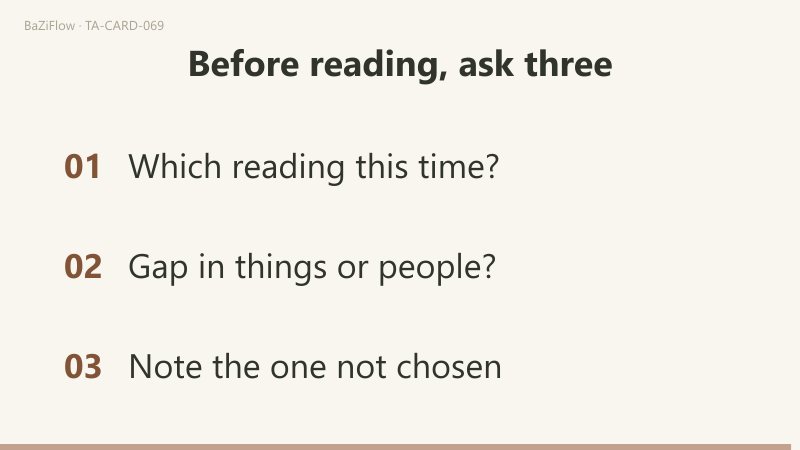
Since Waite says the two readings cannot be harmonized, the honest way to use the card is to choose first: before turning it, write down which one this question uses, and after turning it read only by that one.
Choose a reading, then look
On a Friday evening the fridge holds half a bag of rice, two eggs and a handful of scallions. Write whether the question is "is there enough for dinner" or "who am I eating with tonight".
Read it as material: count what is outside
Half a bag of rice is one meal for two, two eggs, no vegetable. Make it one line: what can be made, and what is missing.
Read it as company: see who is inside
A roommate is home tonight, so ask whether they have something in store and would cook together. This line is about a person, not an ingredient.
Enlarge diagram · scroll sideways to read
Once the reading is chosen
Visible
- Which reading is in use
- Whether the gap is in things or people
Not visible
- Whether the fridge will be empty tomorrow
- That the roommate will help
Do first
- Write the question before turning the card
- Leave the other reading for next time
Reversed and neighboring cards: disorder, ruin, discord, profligacy
The reversed Five of Pentacles is five words: disorder, chaos, ruin, discord, profligacy. The last, profligacy, means spending without restraint. The extras' reversed line, "troubles in love", connects with the second reading.
Three cards that place the coins differently
Coins held to the body
The figure there clings to what he has; in the Five the coins are in the window and the people are outside.
The next card: a merchant with scales
Waite writes a merchant weighing money and distributing it to the needy and distressed; the ones outside the window are here the ones given to.
Three down, two standing
Waite reads it as loss with something left over: three cups taken, two still upright.
Enlarge diagram · scroll sideways to read
Questions readers ask next
Is the Five of Pentacles always a card of financial loss?
Waite writes that it foretells material trouble above all, and that destitution is the form shown, not the only form. The entry also holds a reading of love and affinity, and the extras even say "conquest of fortune by reason", so reading it only as loss leaves part of the text out.
Why does Waite say the two readings "cannot be harmonized"?
In one entry he sets words of material trouble beside words of love and lovers, and admits they do not fit together. Saying which one you use before the reading is clearer than blending both into one paragraph.
What does the lit window on the card stand for?
Waite's text goes no further than "a lighted casement"; it does not say what is inside or whether the two figures can enter. The familiar idea of something close but not entered is a later teaching borrowing.
Was this article helpful?
Sources & references
Continue reading
Four of Pentacles: a coin on the head, one at the chest, two underfoot ↗
Six of Pentacles: scales in one hand, coins from the other, so ask what was weighed ↗