

Jin: light over the earth, three audiences
Content version · · Sources & references
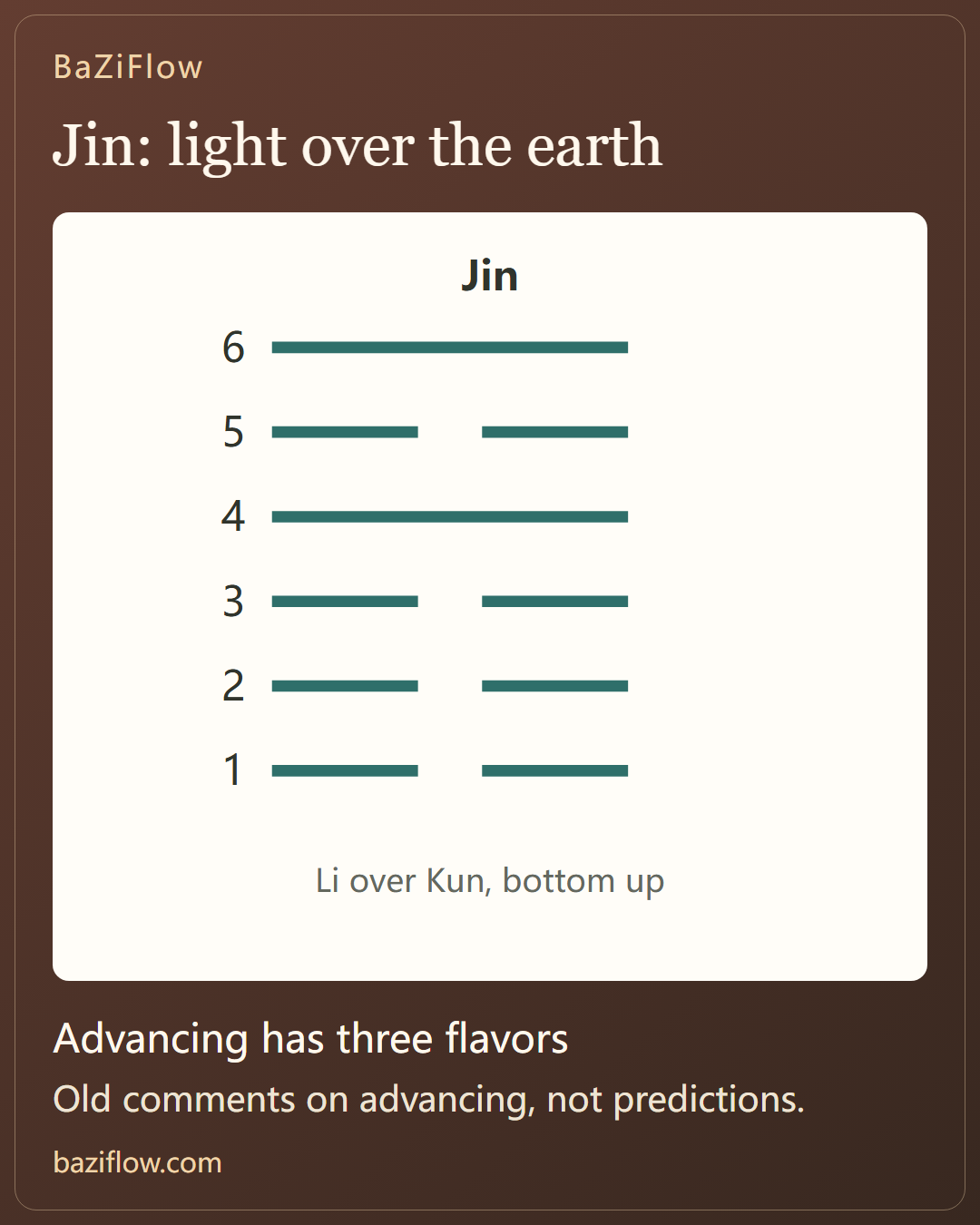
Jin is the 35th hexagram: Li (fire, the sun) above Kun (earth), light rising over the ground. Read the judgment’s gifts and audiences, the Image’s “shine your own virtue”, and the flavors of “advancing” in its lines.
The short version7 min read
Jin means “advancing”, yet the text does not promise smooth going: line 1 is thwarted, line 2 sorrowful, line 4 like a great rat. Only the lord in the judgment is received three times in a day.
- Jin stacks Li (fire, the sun) on Kun (earth). The Commentary on the Judgments says “light comes out above the earth; it yields and clings to the great light; the soft advances and moves upward”, and the Za Gua sums Jin up in one word: daytime.
- The judgment shows a lord given gifts and received in audience, while the Great Image turns the light back on oneself: make your own bright virtue shine. One light comes from outside, the other from within.
- “Advancing” opens lines 1, 2 and 4, followed by thwarted, sorrowful and great rat. Line 4, the only one that reads “staying on course is dangerous”, sits right beside the fifth place, and the Small Image says its place is not fitting.
Read first
The Sixty-Four Hexagrams: How Upper and Lower Trigrams Form One Figure ↗
Judgment and Line Statements: Whole Hexagram or Single Line? ↗
Light over the earth: Li above, Kun below
Jin (晉) is Li above and Kun below. In the Shuo Gua the one word for Li is “clinging”, and it adds that Li is brightness, the trigram in which all things see one another. Kun is “yielding”, and its image is earth. With Li above and Kun below, light rises from the ground.
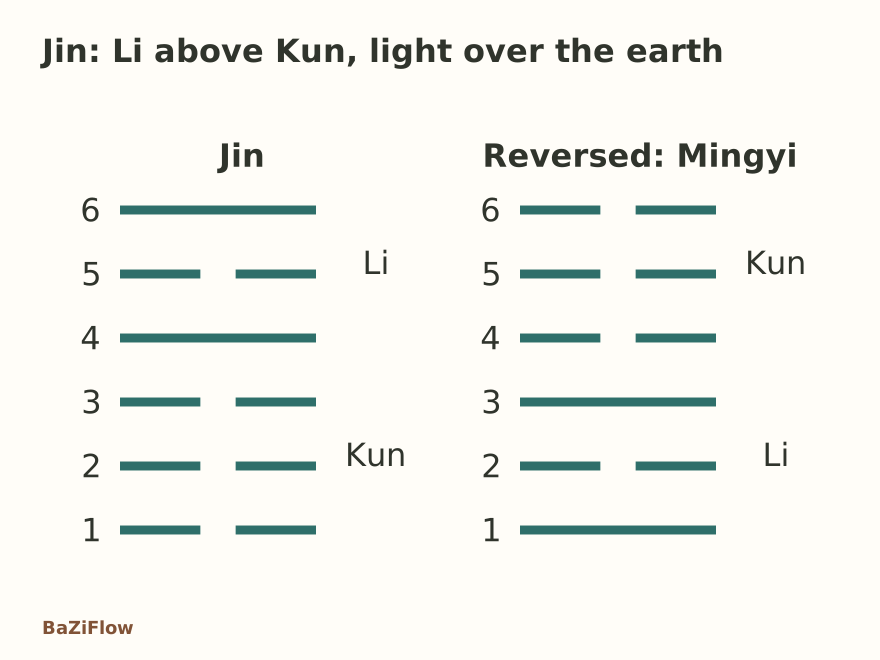
Jin and its reversed hexagram Mingyi: reversing turns the whole figure over, so the Li that sits above in Jin sits below in Mingyi.
Enlarge diagram · scroll sideways to read
Three words in Jin
- Jin
- The Commentary opens with “Jin means advancing”. The Za Gua sums it up in another word: daytime. Together they say: going forward in the daylight.
- Brightness
- The word the Shuo Gua gives to Li, adding that all things “see one another” in it; the Image of Jin is “light comes out above the earth”.
- Clinging
- To attach to something. The Commentary says it “yields and clings to the great light”: the yielding of Kun attaches itself to the great brightness.
The judgment and the Commentary: gifts, and three audiences in a day
The judgment of Jin is not a verdict in one phrase; it is a scene.
Lord Kang is granted horses in great number, and is received three times in the course of a day.
Enlarge diagram · scroll sideways to read
The word for “granted” is a variant of “bestow”, and the phrase for “great number” means both many and flourishing. “Received” is a formal reception, so the last clause means a lord has three audiences in one daytime. The Commentary joins the two halves with a “that is why”: because light comes out above the earth, because it yields and clings to the great light, because the soft advances upward, the lord receives gifts and is received three times.
“The soft advances and moves upward” can be checked on the figure. The upper trigram Li is yang, yin, yang, so its middle line, a yin line, sits exactly in the fifth place. A soft line has risen into the fifth place, which is what the Commentary calls the soft moving upward.
The Great Image: make your own virtue shine
The Great Image (大象) of Jin turns the judgment’s gift in another direction.
Light comes out above the earth: Jin. The noble person makes his own bright virtue shine.
“His own” is the key word, and “shine” means to make bright; “bright virtue” is virtue that gives light. What the noble person does is to light up his own virtue.
Enlarge diagram · scroll sideways to read
The lord in the judgment is granted things and received, while the Image speaks of “his own”: not waiting for anyone to shine on him, but giving light himself. Read side by side, Jin writes about two kinds of light. The Great Image of the next hexagram, Mingyi, shows a different way of using light, and the next article takes it up.
Six lines: three “advancing”s, three flavors
Three of the six statements begin with “advancing”, and the word after it is different each time.
Enlarge diagram · scroll sideways to read
Line 1, “advancing, then thwarted”, goes forward and is set back; “staying on course brings good fortune”, and a further clause says “not trusted; be at ease and there is no blame”. The Small Image says he walks alone and rightly, and that he has not yet received a commission. Line 2, “advancing, then sorrowful”, gets the same “good fortune” and then “he receives this great blessing from his royal grandmother”, where tradition usually reads the royal mother as a grandmother. The Small Image gives the reason: he is central and upright, a yin line in the second place, which suits yin, at the middle of the lower trigram.
Line 3, “all consent”, has everyone’s agreement, and the Small Image says their will goes upward: it is the top line of Kun, and above it is Li. Line 4, “advancing like a great rat”, is dangerous; the rat in question is a large rodent (another text has a variant for its name), and the Small Image says the place is not fitting. Line 4 is a yang line in the fourth place, a yin place, right beside the fifth place, and yet it is the one that reads “staying on course is dangerous”.
Line 5 says “regret vanishes; do not fret over loss and gain” (some texts have a variant for “loss”), and “to go on is fortunate”, which the Small Image calls cause for celebration. Line 6, “advancing to the horns”, goes forward to the very tip, fitting only for attacking a town. It reads “danger, then good fortune, no blame”, and then “staying on this course brings difficulty”. The Small Image says the Way is not yet bright.
Mingyi, Xu (Waiting) and Jian: neighbors of Jin and the hexagrams on either side
Turn Jin upside down and you get Mingyi (明夷), so Mingyi is its reversed hexagram (综卦), shown above. The inverse hexagram (错卦) is Xu (需) and the nuclear hexagram (互卦) is Jian (蹇): lines 2 to 4 of Jin are yin, yin, yang (Gen) and lines 3 to 5 are yin, yang, yin (Kan), which gives Gen below and Kan above.
Enlarge diagram · scroll sideways to read
The Xu Gua (the Sequence) places Jin after Dazhuang: strength cannot last to the end, so one has to move on, and that is Jin. After Jin comes Mingyi, for the reason that anyone who advances will be hurt along the way, and the word in Mingyi’s name means a wound. Seen like that, Jin sits between two hexagrams: the one before speaks of the limits of strength, the one after of light being pressed down.
Questions readers ask next
Does Jin say that advancing always goes well?
The text does not put it that way. Its lines contain being thwarted, sorrow, not being trusted and “dangerous”, and some of the good outcomes come with conditions set first, such as “good fortune” for those who stay on course.
What does “received three times in a day” mean?
It is one clause of the judgment: in a single daytime the lord has three audiences. The Za Gua too sums up Jin with a word for daytime.
How are Jin and Mingyi related?
They are each other’s reversed hexagram: turn Jin upside down and you have Mingyi, with Li dropping from the upper trigram to the lower and Kun rising from the lower to the upper. In one the light comes out over the ground, in the other it goes down into it.
Was this article helpful?
Sources & references
Continue reading
Dazhuang: thunder in the sky, and where strength is meant to stop ↗
Mingyi: light goes into the earth, from the drooping wing to the entering earth ↗
The Sixty-Four Hexagrams: How Upper and Lower Trigrams Form One Figure ↗
Judgment and Line Statements: Whole Hexagram or Single Line? ↗