

The Chariot: two sphinxes and a victor
Content version · · Sources & references
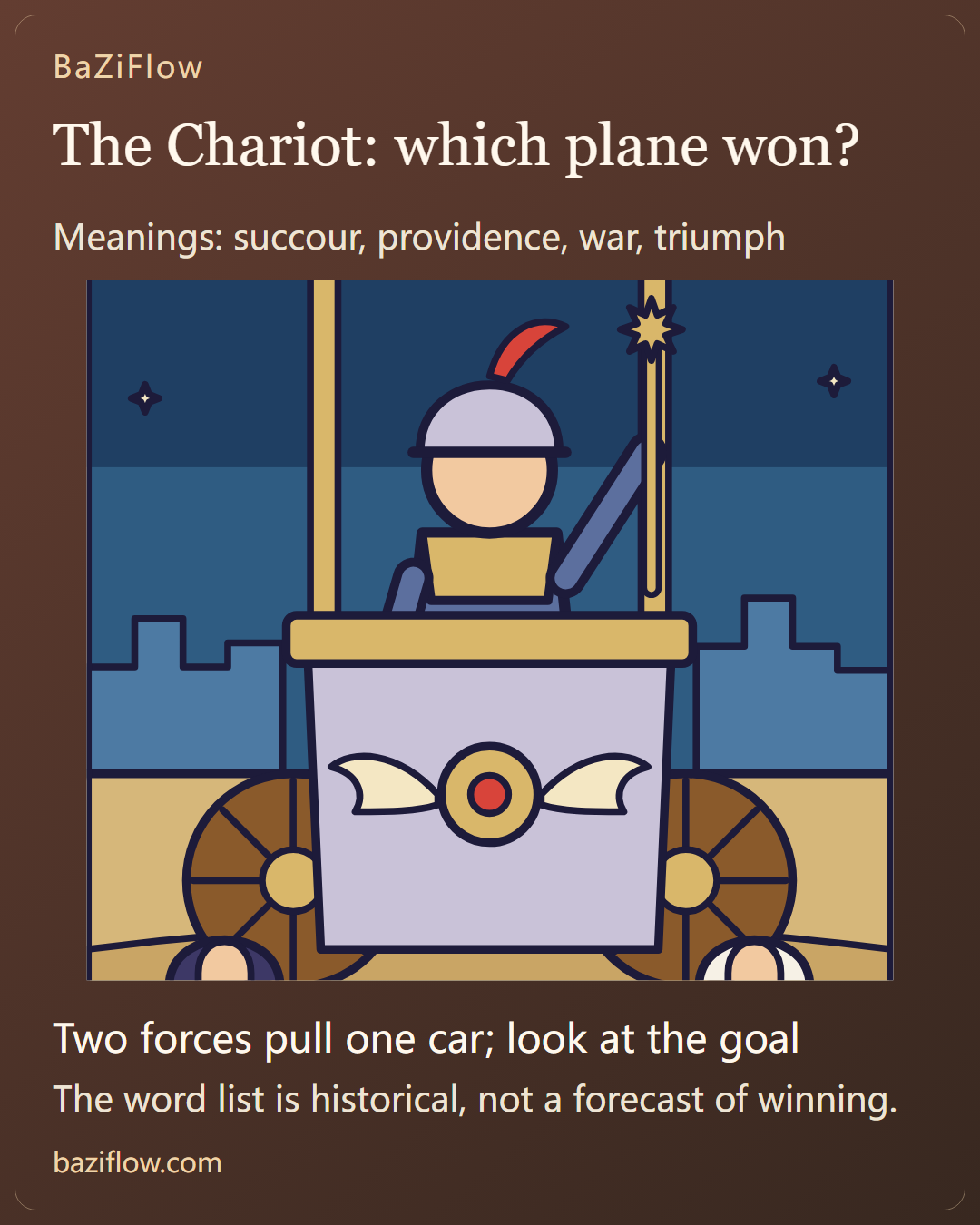
The Chariot shows an armed victor and the two sphinxes before his car. Separate the picture, the word list and the limits Waite draws himself, then use "two pulls, one destination" to plan a holiday dinner.
The short version7 min read
The Chariot shows a victor standing on a car with a black and a white sphinx lying before it. Waite writes "conquest on all planes", and also writes where it stops.
- The picture: an erect, princely figure with a drawn sword and, "supposed", the Urim and Thummim on his shoulders; he has answered the sphinx, so two sphinxes draw the car.
- The list has two halves: succour and providence first, then war, triumph, presumption, vengeance and trouble; reversed it is all disputes and outcomes: riot, quarrel, dispute, litigation, defeat.
- Waite writes that his triumph is on external and rational planes and that the charioteer cannot answer on the side of Grace. The practice here: what each side wants, where the car goes, which plane you won.
Read first
A figure on a car, a black and a white sphinx before it
Waite writes: "an erect and princely figure carrying a drawn sword"; on the shoulders of the victorious hero "are supposed to be the Urim and Thummim" (the oracle objects the Bible ties to the high priest's breastplate). He is "conquest on all planes—in the mind, in science, in progress, in certain trials of initiation", and "above all things triumph in the mind". He has replied to the sphinx, and that is why Waite accepts the variation of Éliphas Lévi: two sphinxes draw his chariot.
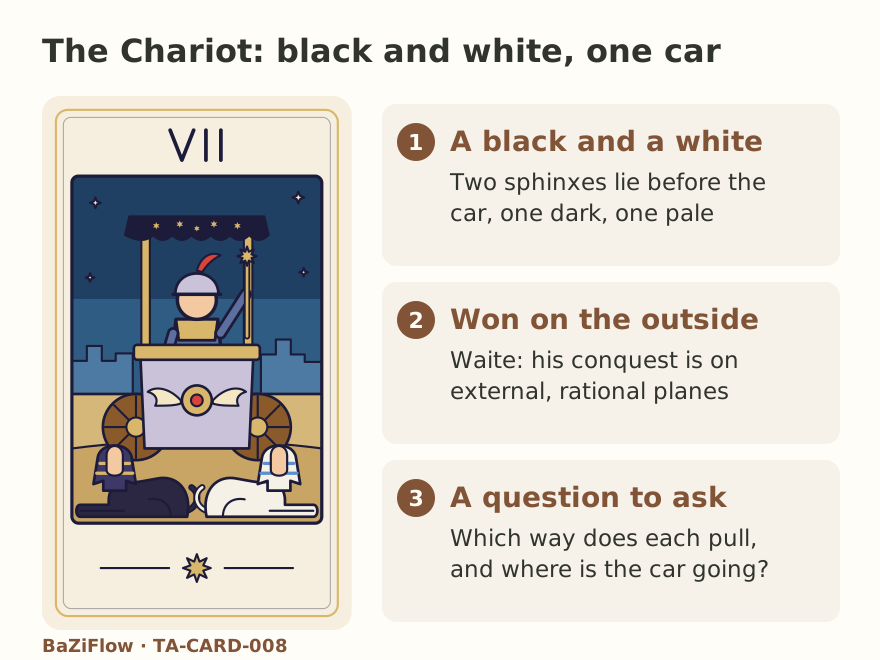
The Chariot: a black and a white sphinx lie before the car.
Look at the Rider-Waite-Smith card itself and more comes into view. Above the car is a blue canopy studded with white stars. The figure wears a crown with a gold star, metal armor and two crescent-shaped plates on the shoulders, and holds an upright staff in one hand (not the sword of Waite's text). The car is a single block of stone with a winged disc on its front; no wheels and no reins can be seen. Two sphinxes, one black and one white, lie before it, and behind are a walled city and water at both sides.
Counted from the top, there are three things here: the standing figure, the stone car with its emblem, and the two sphinxes in front. None of them is running, and the whole picture is a scene at rest.
Enlarge diagram · scroll sideways to read
What Waite lists: succour and providence first, war and vengeance after
Waite's divinatory meanings are one line: succour, providence; also war, triumph, presumption, vengeance, trouble. Reversed: riot, quarrel, dispute, litigation, defeat.
Succour, providence; also war, triumph, presumption, vengeance, trouble. Reversed: Riot, quarrel, dispute, litigation, defeat.
Enlarge diagram · scroll sideways to read
The word "also" cuts the line in two: help and Providence in the first half, then war, triumph, and presumption, vengeance and trouble. The words in first and second place are succour and providence, not triumph. The five reversed words all sit on concrete quarrels and outcomes.
Sphinxes, shoulders and hand: where the text and the picture part ways
On this card Waite's text and the Rider-Waite-Smith picture disagree in a few places, which is good practice in saying which of the two you are quoting.
Which detail comes from the text, which from the picture
- Two sphinxes
- Waite has two sphinxes draw the car because the charioteer has replied to the sphinx, in Lévi's variation. He adds that the sphinx's question concerns a mystery of Nature and not of the world of Grace, to which the charioteer could offer no answer. Black and white are not in his text.
- On the shoulders
- Waite says only that the Urim and Thummim "are supposed" to be there; in the Rider-Waite-Smith picture the shoulders carry two crescent-shaped plates.
- Sword or staff
- Waite's text says a drawn sword; the Rider-Waite-Smith card has a staff in the hand. When you quote, say whether you rely on the text or the picture.
Enlarge diagram · scroll sideways to read
Black and white as "two opposite forces" is an analogy from modern teachers; Waite never says what either sphinx stands for. The next section leans on that analogy, so its origin is flagged here.
How to read it: two forces, one car, decide where the car goes
The card brings its own structure: two sphinxes of opposite color draw one car, and the figure on it stands and does not pull. Carry that to an everyday matter: a family is planning a New Year's Eve dinner, the elders on the two sides want different things, and you are the one getting everybody to one table.
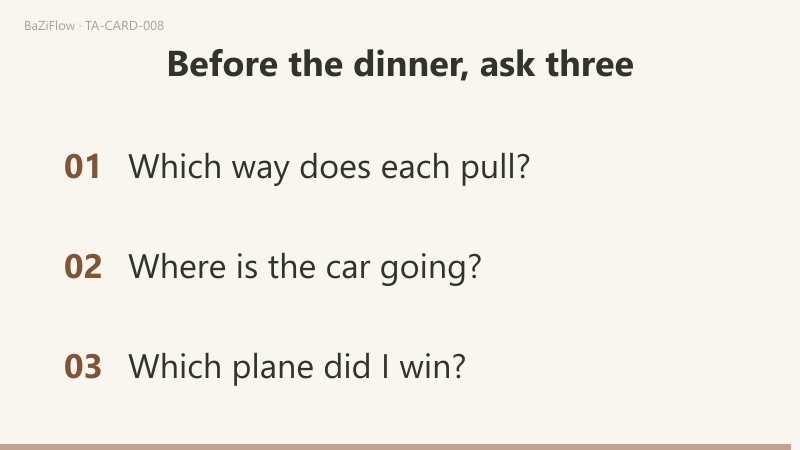
Which way does each side pull?
Write what each side actually wants: one would like thirty-first evening at the old house, the other would like noon on the first at a restaurant. Write them as concrete requests, not as "she is just picky".
Where is the car going?
The car has one destination. Write it as a question that can be answered: on which day, and in which hours, are both sides most likely to be together?
Which plane did you win?
Waite marks the charioteer's limits: won on the outside, perhaps not within. Time and place settled is the outer plane; what each side cares about most (staying up together, not cooking) not yet said is the inner one.
An example: each family's elders have a position, and you start by laying out the pulls:
Enlarge diagram · scroll sideways to read
Getting everyone to one table: what the card gives
What it hands you
- Pull apart what each side wants
- The car has one destination
What it ignores
- Whose demand is fairer
- That the dinner will go well
What talking settles
- The one thing each cares about
- Write down the time and place
Reversed and neighboring cards: disputes, outcomes, and three cards that put "winning" elsewhere
The reversed string runs: riot, quarrel, dispute, litigation, defeat. Set beside the upright words, it has lost the succour and providence that offered help, and what is left is quarrel and its result. That is an observation from comparing the two lists; Waite does not say it.
Cards that put "winning" somewhere else
The next card: the lion already subdued
A woman and a lion that has gone quiet, joined by a garland, and a list that starts from power and energy. The Chariot has a weapon and sphinxes; Strength has a hand and a garland.
The card before: two side by side
The Lovers shows two people under one light and its list begins with attraction and love; the Chariot shows one person on a car with two before it, and its list begins with succour and providence.
"Triumph" is the first word
The Ace of Swords opens with triumph, then excess and conquest, and speaks of how great the force is; in the Chariot triumph sits in the middle, with succour and providence ahead of it.
Enlarge diagram · scroll sideways to read
Questions readers ask next
Is the Chariot simply the "victory" card?
Triumph is one word in the list, with succour and providence ahead of it and presumption, vengeance and trouble after it. Waite also takes care to say that the charioteer's triumph lies on external and rational planes.
What does the Chariot mean reversed?
Waite gives the reversed card a bare string of words and no commentary, and nothing in it offers help or Providence. Say first whether you are quoting his list or another method's reversed rules.
Why are the sphinxes one black and one white?
Waite follows a variant from Éliphas Lévi: the charioteer has answered the sphinx, so two sphinxes draw him. The colors are not in his text; reading them as opposite forces is a later teaching borrowing.
Was this article helpful?
Sources & references
Continue reading
The High Priestess: seated between two pillars, her scroll half covered ↗
Reversals are not a universal minus sign ↗
Strength: a lion led by a chain of flowers, already subdued, says Waite ↗