

Black Tortoise: a northern name, a movable seat
Content version · · Sources & references
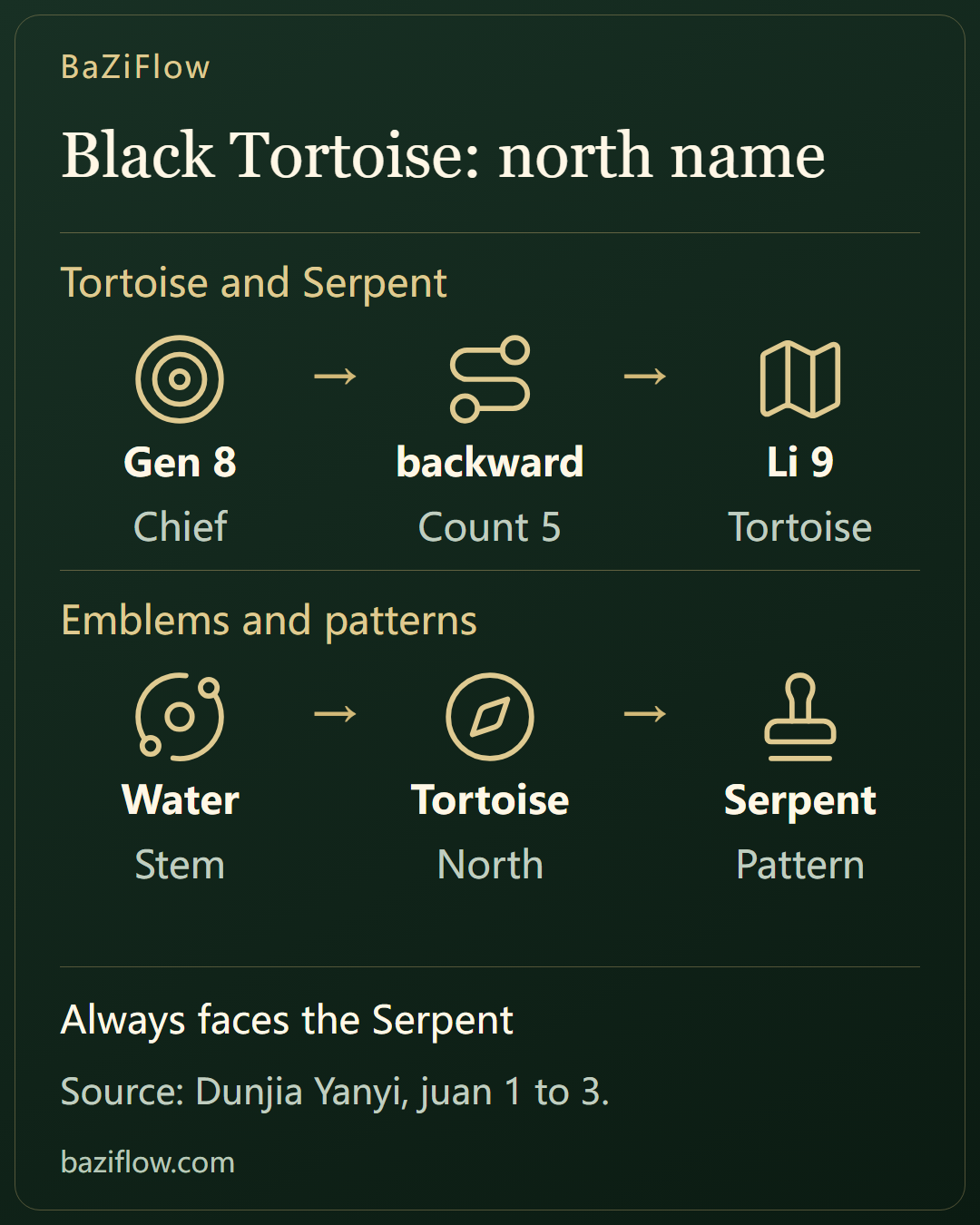
The Black Tortoise is the sixth of the eight Qimen gods and always faces the Serpent. Its three appearances in Dunjia Yanyi, the north-and-Water reasoning behind the Serpent Leaps pattern, and its three spellings.
The short version8 min read
In the Dunjia Yanyi the Black Tortoise is sometimes a petty-thief god and sometimes an escort named in a spell. On the chart it is sixth in the order, and its box depends only on the count from the Chief, not on the north in its name.
- The Black Tortoise is sixth in the order, five seats on from the Chief, and always faces the Serpent across the center. The north in its name does not decide its palace.
- Besides the "petty thief" line in juan 3 it turns up in two other roles: an escort in a spell and a northern spirit called out in a counting-rod rite. The exception clause matches the White Tiger and the Serpent.
- "Black Tortoise of the north, tortoise and snake" is the explanation juan 2 gives for naming the Serpent Leaps pattern (Yin Water over Yin Fire): the stem is Water, and Water belongs to the north.
Read first
A northern name in the southernmost box
The name points north, yet on a chart the Black Tortoise (玄武) can sit in the southernmost box. Start with one chart.
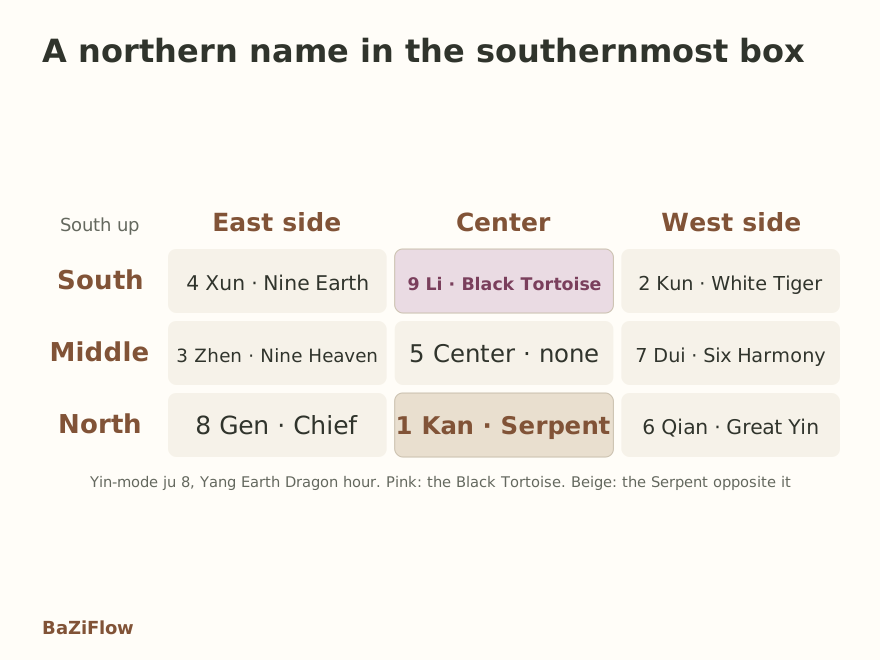
Nine-palace base, south up and east on the left. The seats follow one example in juan 2 of Dunjia Yanyi (Yin-mode ju 8, Yang Earth Dragon hour): the Chief, Nine Heaven and Life Gate the book names match the engine, and the rest are filled in by the same order. Pink is the Black Tortoise, beige the Serpent opposite it.
The chart in the picture comes from a second worked example in juan 2 of Dunjia Yanyi (遁甲演义): Yin-mode (阴遁) ju 8, Yang Earth Dragon (戊辰) hour. The text pins down only three places: the Chief (值符) in palace 8, Nine Heaven (九天) in 3 and the Life Gate in 4. Asked for the same ju and hour, the site engine agrees on all three. Counting the rest in order puts the Black Tortoise in Li Nine, the exact south, while Kan One in the far north holds the Serpent (螣蛇), directly across the center.
In the order of the eight gods the Black Tortoise is sixth, five seats on from the Chief. Yin mode lays the gods against the palace sequence, so five seats back from the Chief in Gen Eight lands on Li Nine; Yang mode counts forward and five seats lands on the other side. In the book's own terms of ahead and behind, Great Yin (太阴) is two seats ahead of the Chief, Six Harmony (六合) three ahead, Nine Heaven one behind and Nine Earth (九地) two behind. The Black Tortoise is never given such a figure, but the order supplies it: three behind the Chief in Yang mode and three ahead in Yin mode, between the White Tiger (白虎) and Nine Earth.
Enlarge diagram · scroll sideways to read
Three settings where the book names the Black Tortoise
In Dunjia Yanyi the name turns up in three kinds of text, each with its own tone. The first is the juan 3 section on the good and bad gods of the Heavenly One Chief (天乙直符吉凶神说), which gives each of the eight gods a verdict line. The Black Tortoise's line reads:
The Black Tortoise is a petty-thief god, good for watching out for spies and for prying into the army's condition.
The quotation stops at the use. As with the White Tiger and the Serpent, the original line ends with an escape route: if a wonder and a gate reach the god's bearing together, it is not to be treated as a taboo. The second setting is a spell. A line from the spell of the Yang Fire wonder (丙奇咒):
Tian Gang spreads its might, the Black Tortoise follows behind.
Here the Black Tortoise is an escort; Tian Gang (天罡) is a name the same text ties to the Big Dipper. The third is the counting-rod rite of the Jade Maiden's reverse seal (玉女反闭) in juan 3. Its "rhyme" calls out six names in turn, and one line reads "call out loudly: Black Tortoise of the north, descend", so the name is tied directly to a direction.
Enlarge diagram · scroll sideways to read
The rite calls six names in turn, each with a direction: Azure Dragon (青龙) of the east, Vermilion Bird (朱雀) of the south, Gou Chen (勾陈) of the west, White Tiger of the west, Black Tortoise of the north and Six Harmony of the east. Here the direction travels with the name, so two of the six are called "of the west" and two "of the east". The Black Tortoise is the fifth call, and its verse begins "the dragon enters the stable and stays".
Enlarge diagram · scroll sideways to read
On the plate no such tie exists: Six Harmony need not be in the east, the White Tiger need not be in the west and the Black Tortoise need not be in the north. The count from the Chief decides every seat.
Yin Water, the Black Tortoise of the north: its trace in "Serpent Leaps"
The Black Tortoise never appears in a pattern name, but it appears in the explanation of one. A short essay in juan 1, Origins of Qimen (奇门原始), pairs each of four animal-named patterns with two stems:
Enlarge diagram · scroll sideways to read
Both stems of the Water pair are Water, and Water belongs to the north, so the northern emblem lands on the Serpent Leaps pattern. Juan 2 gives the reason for the name of "Serpent Leaps" (Yin Water over Yin Fire) and there the Black Tortoise is spelled out:
Yin Water (癸) belongs to Water, the Black Tortoise of the north, tortoise and snake. Yin Fire belongs to Fire. So Yin Water over Yin Fire is Serpent Leaps.
The book goes no further than this: Yin Water is the Water where the Black Tortoise, tortoise and snake, belongs, and it presses on Yin Fire; the pattern is called Serpent Leaps. Why the snake is the part that gives the name, the text does not say.
How this pattern is found on a chart, where the book's worked example lands, and why its text is harsher than the line on the god are covered in the Serpent article. One point is enough here: the Black Tortoise appears in the explanation of the name, not in the name.
Three spellings of one god
Looking for the Black Tortoise in the original can come up empty at first: the Siku quanshu edition of Dunjia Yanyi prints a variant form (𤣥武) whose first character differs from the usual one (玄), and the site glossary records a third form (元武).
One god, three spellings
Black Tortoise (玄武)
The site's usual form and the sixth of the eight gods; the hourly experimental chart uses this name.
The printed form (𤣥武)
The form in the Siku edition of Dunjia Yanyi. Quotations here use the modern character; use the printed form when searching the original.
Yuan Wu (元武)
Another written form recorded in the site glossary for the same god.
Traditionally such missing-stroke or substituted forms are thought to be taboo avoidance, which this book does not discuss; what matters is that all three forms point to one god, so none of them is missed in the original. It is a different matter from the Gou Chen and Vermilion Bird set: the daily experimental chart writes Vermilion Bird in the same seat, and the glossary does not convert between the sets.
Before writing the Black Tortoise down
Three kinds of sentence about the Black Tortoise
Can be checked directly
- Which palace it holds: five seats on from the Chief
- The juan 3 line "petty-thief god" and its exception clause
- The juan 2 text for naming Yin Water over Yin Fire
Needs a source
- The north and Water link: juan 2 Serpent Leaps and the juan 3 rite
- Spelling: three written forms, one god
- Name set: White Tiger and Black Tortoise, or Gou Chen and Vermilion Bird
Cannot be read off
- Kan One means the name fits: seat and direction are separate lines
- A palace means theft: "petty thief" classes the god, it forecasts no event
To see how doors, stars and gods share the work, start with what doors, stars and spirits each do. Facing the Black Tortoise is the Serpent, the one before it in the order is the White Tiger, and the one after is Nine Earth.
Questions readers ask next
If the Black Tortoise lands in Kan One, does the name fit the place?
The north in the name comes from the four emblems matched to directions; the seat comes from the count from the Chief. Casting all 1,080 combinations of 18 ju and 60 hour pillars in the site engine, the Black Tortoise lands in Kan One and in Zhen Three 180 times each and in every other palace 120 times, Li Nine in the south included. The extra comes from the Chief landing in Kun Two twice as often as elsewhere.
Does the Black Tortoise mean theft?
The book classes this god as a "petty thief" and follows with a use: guarding against spies and prying into the army. The setting is military. It is the traditional classification of the god, not a forecast for one palace or one matter; reading it as a concrete event needs the focus and other layers behind it.
Are the Black Tortoise, the printed variant form and Yuan Wu the same god?
They are three written forms of one god name: the site uses the standard characters, the Siku edition of Dunjia Yanyi prints a variant of the first character, and the site glossary also records Yuan Wu. Try all three when searching the original. None of them belongs to the Gou Chen and Vermilion Bird set, which the glossary does not convert automatically.
Was this article helpful?
Sources & references
Continue reading
White Tiger in Qimen: the Seat Across from the Chief, and Three Namesakes ↗
Nine Earth in Qimen: the Second Seat Behind the Chief, Facing Great Yin ↗