

Tan Lang: landings, Water or Wood, Life Ruler
Content version · · Sources & references
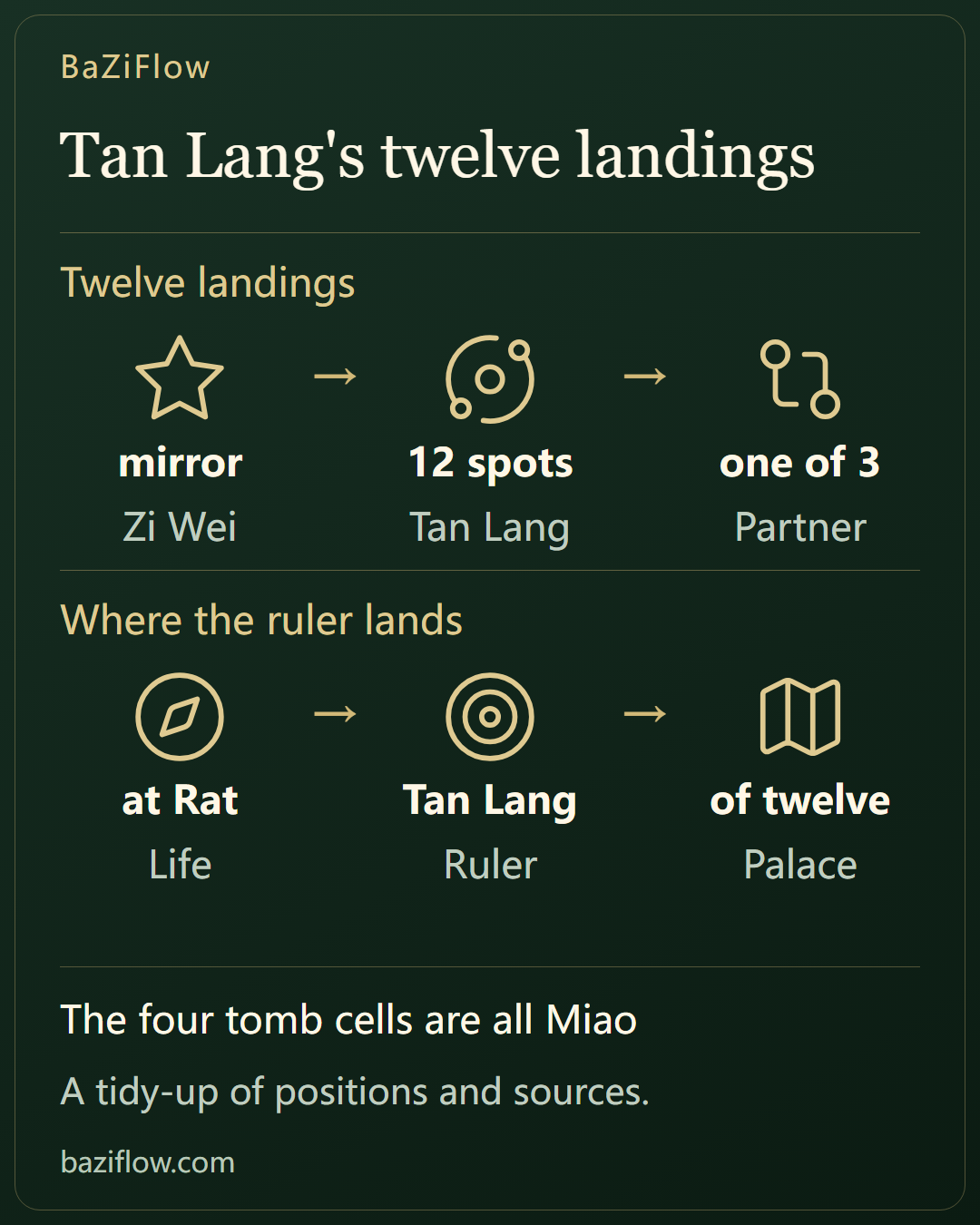
Tan Lang is third in the Tian Fu group and mirrors Zi Wei across the Rabbit-Rooster axis. Its six pairs of landings and partners, five element records, why the four tomb cells are all Miao, and the Life Ruler at Rat.
The short version8 min read
Tan Lang is third in the Tian Fu group, and each of its twelve landings shares or faces one of Zi Wei, Wu Qu and Lian Zhen; the book writes its element four ways and the engine table adds a fifth, and the Life Ruler is looked up from the Life branch.
- Tan Lang mirrors Zi Wei across the Rabbit-Rooster axis; of its six pairs of positions three share a palace and three face one, and the partner is only ever Zi Wei, Wu Qu or Lian Zhen.
- The book gives it Water, Wood, or both, Master Xiyi splits it into "qi Wood, body Water", and the engine table records Water only.
- With Life at Rat the Life Ruler is Tan Lang; Zi Wei's twelve landings send it to twelve different palaces, once each.
Read first
The fourteen major stars: learn the roster and its structure ↗
Twelve landings, and each is tied to Zi Wei, Wu Qu or Lian Zhen
Tan Lang (贪狼) is the third of the eight Tian Fu-group stars, two cells after Tian Fu. Its position can also be taken straight from Zi Wei: Tan Lang mirrors Zi Wei across the Rabbit-Rooster axis, so Zi Wei on Rat puts Tan Lang on Horse, and Zi Wei on Rabbit or Rooster puts the two in one palace.
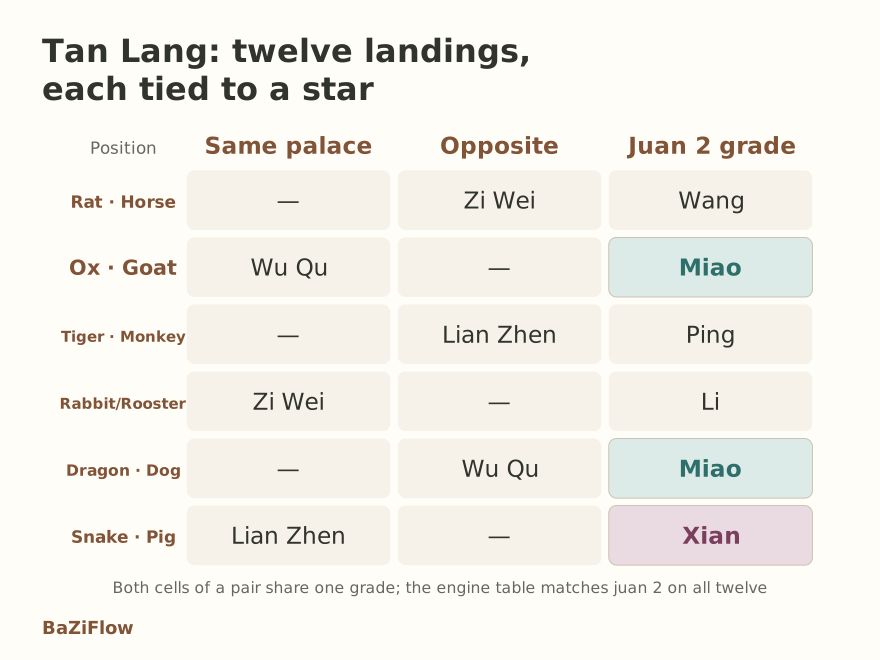
Comparison table: same-palace and opposite stars follow from the placement verse and were checked on iztro charts; grades come from the juan 2 table, and the engine star table matches it on all twelve cells.
The twelve landings fall into six pairs of opposite palaces, and every pair is tied to one of Zi Wei, Wu Qu and Lian Zhen: Zi Wei faces Tan Lang on Rat and Horse, Wu Qu shares the palace on Ox and Goat, Lian Zhen faces it on Tiger and Monkey, Zi Wei shares on Rabbit and Rooster, Wu Qu faces it on Dragon and Dog, and Lian Zhen shares on Snake and Pig. Three same-palace cases and three opposite cases, with no fourth partner anywhere.
The last part of the Tan Lang entry in juan 2 writes exactly the three same-palace lines:
Ox and Goat palaces: Miao, sharing the degree with Wu Qu.
For Rat-Horse, Tiger-Monkey and Dragon-Dog the entry gives a grade and no partner, because Tan Lang sits alone on those six cells and the partner stands in the opposite palace. This half, which the book leaves unwritten and the chart always satisfies, has to be worked out from positions. How Tian Fu and Tan Lang each mirror Zi Wei is set out in Zi Wei.
Water or Wood: five records, five wordings
The book has no single wording for Tan Lang's element. The juan 2 list assigning stars to elements, the juan 2 entry, the juan 1 reply and Master Xiyi in juan 1 each write one, and the site's engine adds another:
Enlarge diagram · scroll sideways to read
Master Xiyi splits the disagreement into two layers:
Its qi is Wood and its body is Water, so its qi becomes peach blossom.
"Qi" and "body" are two levels, Wood for the qi and Water for the body, and the qi title "peach blossom" follows from that. The book is giving the reason for the name here, not saying which level to use when counting elements; the engine table takes Water. How element attributes are used in a chart is a separate question, and this section only sets the five wordings side by side.
Dragon, Dog, Ox, Goat: the four tomb cells are all Miao
Setting Tan Lang's grades round a ring makes the pattern plain:
Enlarge diagram · scroll sideways to read
Dragon, Dog, Ox and Goat are usually called the four tombs, the storehouse branches, and Tan Lang is Miao on all four. Rat and Horse are Wang, Rabbit and Rooster Li, Tiger and Monkey Ping, and Snake and Pig Xian. A line in the juan 2 verse for male charts singles these four cells out:
Tan Lang on the four tombs is on Miao and Wang ground.
The Tai Wei Fu also gives a name to Tan Lang on Pig and Rat, "the peach blossom that crosses water". Pig and Rat are neighbors yet differ in grade: Pig is Xian and Rat is Wang. One name covers two grades, so such pattern names are taken by position, and the grade has to be looked up separately.
Life at Rat: where does the Life Ruler Tan Lang land?
The Life Ruler is the star looked up from the branch of the Life palace, and the first row of "An Ming Zhu" (安命主) in juan 2 is "Tan Lang, Rat palace". How the lookup works is in the Life palace; the question here is the next step, which the book states:
With the Life palace at Rat, find in which palace Tan Lang stands: that is the Life Ruler.
With Life at Rat, the Life Ruler is Tan Lang; then find which palace the star lands in on the chart. Tan Lang's position is set by Zi Wei, and the palace order runs backward along the branches from the Life palace. Cast all twelve Zi Wei landings and Tan Lang falls into twelve different palaces, one each:
| Zi Wei at | Tan Lang at | With Life at Rat, Tan Lang is in |
|---|---|---|
| Rat | Horse | Travel |
| Ox | Snake | Friends |
| Tiger | Dragon | Career |
| Rabbit | Rabbit | Property (shares with Zi Wei) |
| Dragon | Tiger | Wellbeing |
| Snake | Ox | Parents |
| Horse | Rat | Life |
| Goat | Pig | Siblings |
| Monkey | Dog | Partner |
| Rooster | Rooster | Children (shares with Zi Wei) |
| Dog | Monkey | Wealth |
| Pig | Goat | Health |
Enlarge diagram · scroll sideways to read
The Life Ruler lands in the Life palace itself only on the chart with Zi Wei at Horse (the Travel palace); with Life at Rat and Zi Wei also in Life, Tan Lang falls in the opposite Travel palace. The Life Ruler and the stars of the Life palace are two different things: the Life Ruler column only answers "which star is looked up", and where that star stands, who shares its palace and what grade it holds all go back to the chart.
Sha-Po-Lang: three stars that always fill one trine set
Tan Lang is two cells after Tian Fu, Qi Sha is six and Po Jun ten, so the three are four cells apart and form a trine on every chart, filling one of the four trine sets on the branch ring (Tiger-Horse-Dog, Ox-Snake-Rooster, Rat-Dragon-Monkey, Pig-Rabbit-Goat). The book calls the set Sha-Po-Lang (杀破狼, short for Qi Sha, Po Jun and Tan Lang) and mentions it in a verse on Zi Wei entering a decade:
Zi Wei entering a decade is good in itself, but beware Sha, Po and Lang on the three sides.
The question is how that set meets Zi Wei on a chart. Cast all twelve Zi Wei landings:
Enlarge diagram · scroll sideways to read
Zi Wei's four-way set always holds one of Sha-Po-Lang: in six landings all three (Zi Wei shares a palace with one of them and the other two stand on the trine), in the other six just one in the opposite palace. The book's "Sha, Po and Lang on the three sides" fits the first kind. Qi Sha and Po Jun have their own position structures, so they are not repeated here.
Two cross-check problems
Life at Rat and Tan Lang on Rabbit: where is Zi Wei, which palace is Tan Lang in, and what does the table say?
Zi Wei is on Rabbit too, sharing with Tan Lang; Rabbit is the Property palace; the table says Li.
Zi Wei on Horse: on which three branches do Sha, Po and Lang stand, and how many are in Zi Wei's four-way set?
Tan Lang on Rat, Qi Sha on Dragon, Po Jun on Monkey; Zi Wei's set is Horse, Dog, Tiger and Rat, which holds only Tan Lang on Rat, opposite.
Before Tan Lang comes Tai Yin; after it comes Ju Men.
Questions readers ask next
Is Tan Lang Water or Wood?
It depends which record you cite: the juan 2 element list gives both, the entry says Wood, the juan 1 reply says Water, Master Xiyi says "qi Wood, body Water", and the engine star table records Water. Naming the source is more accurate than picking one word.
If my Life Ruler is Tan Lang, is Tan Lang sitting in my Life palace?
Not necessarily. The Life Ruler is looked up from the branch of the Life palace alone, so Life at Rat gives Tan Lang; which star actually sits in the Life palace depends on the chart. The two coincide only on the chart with Zi Wei at Horse.
Why does Tan Lang always share a palace with, or face, one of Zi Wei, Wu Qu and Lian Zhen?
The positions are fixed: Tan Lang is the mirror image of Zi Wei, and its six pairs of positions correspond to six fixed relations. The opposite side is always one of those three stars, and so is the same-palace side; there is no fourth partner.
Was this article helpful?
Sources & references
Continue reading
Tai Yin (太陰): The Moon's Twelve Cells, Sun-Moon Pairing and Four Records Compared ↗
Ju Men (巨门): Six Entry Lines Audited, the Dragon-Dog Clash and a Fixed Chart ↗