

Twelve palaces, twelve houses: compare the questions, not the labels
Content version · · Sources & references
A method for comparing Zi Wei and Western astrology without treating Spouse as identical to the seventh house or star names as equivalent bodies.
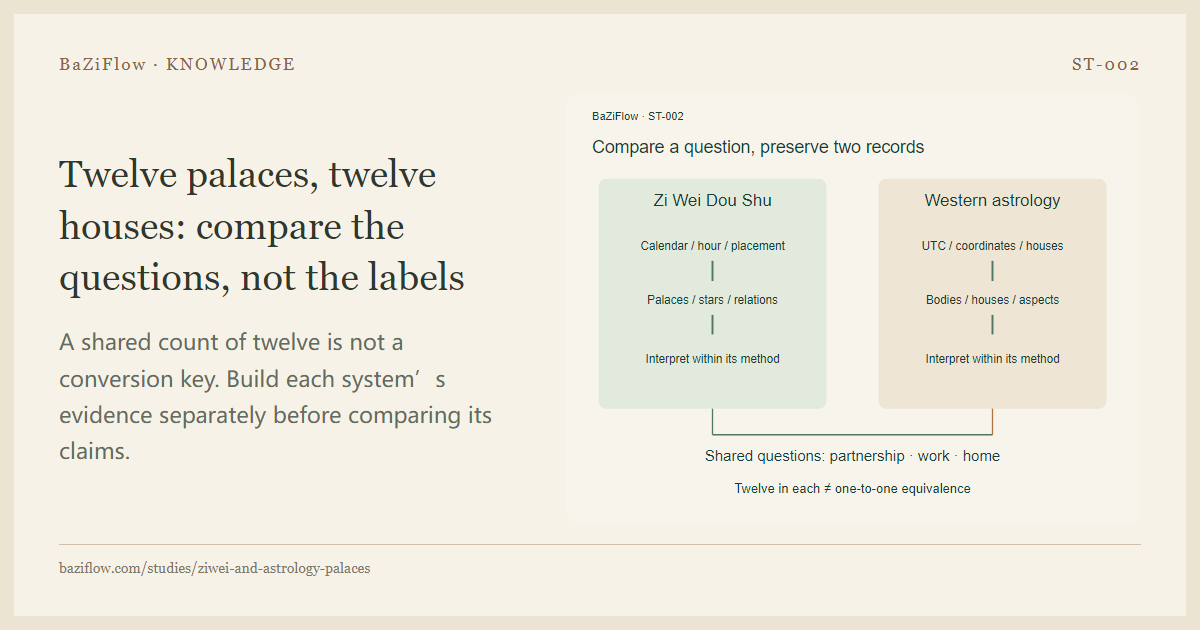
A shared count of twelve is not a conversion key. Build each system’s evidence separately before comparing its claims.
Read first
Try to translate one relationship claim
Suppose a Zi Wei reading discusses the Spouse palace and a Western reading discusses the seventh house. Both may concern partnership. Does that make the two equivalent? No: the seventh can also include contracts or open opponents in different traditions, while a Zi Wei argument depends on its palace–star arrangement and relationships. Topic overlap is narrower than structural identity.
Start with a limited question such as how cooperation and commitment are described. For each system, record the actual placements and the rule connecting them to that question. A repeated phrase like “relationships matter to you” may be broad wording rather than independent corroboration. Compare like-sized arguments, not a single palace name on one side and an entire chart on the other.
Now inspect what generated the two charts
Zi Wei arranges topic palaces from its Life-palace framework and places stars through traditional calendrical rules. Western astrology calculates celestial positions and applies a chosen house division to a birth time and place. These are not two translations of the same sky map. A Zi Wei star named Sun is not thereby the same data object as a calculated solar longitude.
Read Zi Wei's twelve palaces and the four components of a Western chart if those structures are unfamiliar. Ming Gong and Shen Gong are not alternate names for the Ascendant.
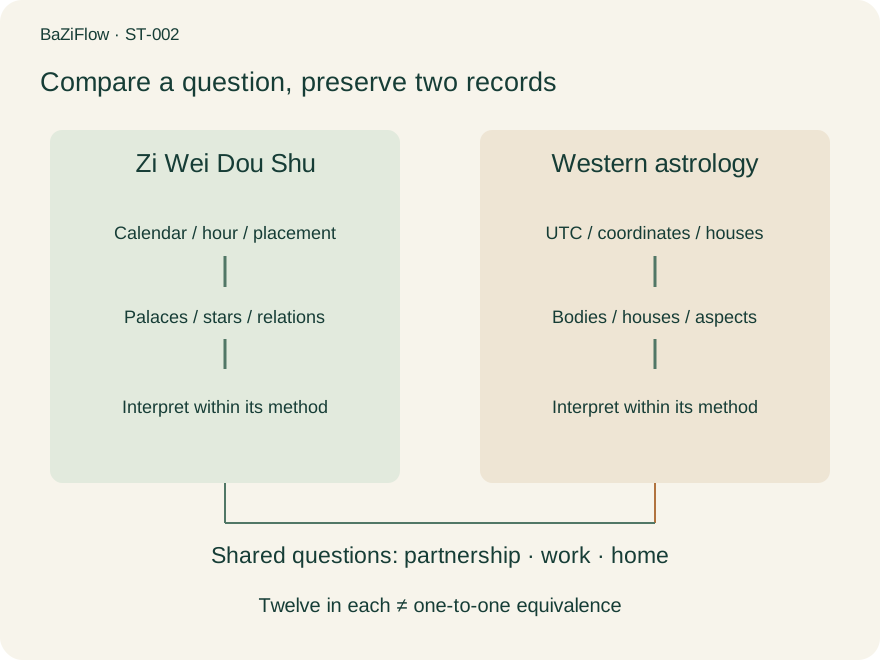
Original BaZiFlow teaching diagram; schematic, not a personal chart.
Use three comparison levels
First compare inputs and conventions: calendar and hour treatment, or UTC, coordinates, zodiac and house system, as appropriate. Then compare the objects recorded in each chart. Only then compare the scope of the question being interpreted. Skipping the middle level encourages a false dictionary of equivalent stars and palaces.
Volume two of Zi Wei Dou Shu Quan Shu documents a traditional arrangement; Swiss Ephemeris documents house-calculation definitions. They support different construction questions. The ability to reproduce either layout does not make their symbolic claims mutually validating.
Change the question and rebuild the evidence
For work, a Zi Wei approach may connect Career with Life and Wealth, while a Western approach may examine the tenth house, MC and other relevant placements. The selected method decides the detail. The MC is not the tenth-house cusp in every house system, and a Zi Wei Career star cannot be substituted for a Western planet.
For residence, Property and the fourth house can be useful topic entrances within their own traditions. Neither establishes legal ownership or family history by itself. As the question changes from partnership to work or residence, select the relevant placements and real-world information afresh.
Keep a two-column notebook
On each side record the input version, placements, convention and interpretation. Beneath them, add the shared question and the parts that cannot be converted. If conclusions agree, check whether the language is too general to discriminate. If they disagree, check scope, time layer and settings before inventing a compromise algorithm.
The notebook should preserve a real disagreement when it remains. Two uncertain interpretations do not combine into a certain prediction, and neither replaces evidence from the actual relationship, workplace or home. Continue with Life and Body palaces for a closer look at Zi Wei placement, and house systems for a closer look at Western boundaries. Return to the comparison after each column can stand on its own.
Sources & references
Continue reading
Life and Body palaces: two placements, not two lives ↗