

What is Zi Wei Dou Shu? A first guide to palaces and stars
Content version · · Sources & references
Understand the structure of a Zi Wei chart before looking up star descriptions: inputs, palaces, symbolic stars and timing layers.
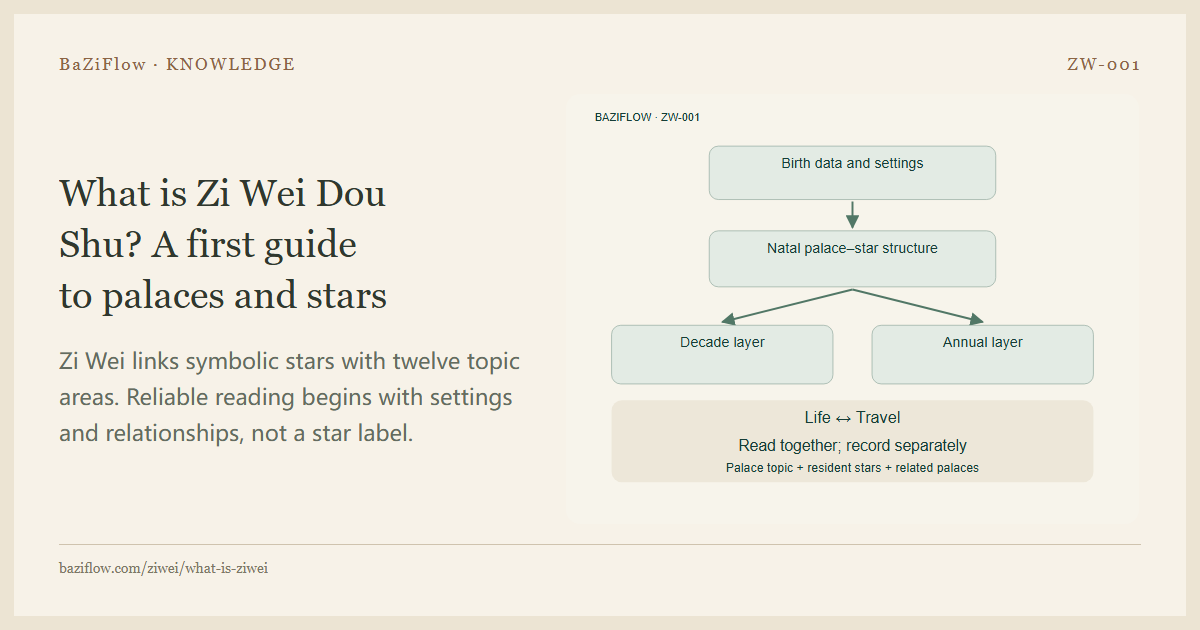
Zi Wei links symbolic stars with twelve topic areas. Reliable reading begins with settings and relationships, not a star label.
Translate “palace” and “star” before looking up a personality
Zi Wei Dou Shu is a Chinese divinatory tradition that constructs a chart from birth information and interprets symbolic stars within twelve palaces. A palace is a labelled area of inquiry, not a building. A star is part of the tradition's symbolic vocabulary. Looking up one star in isolation is therefore a limited way to understand a chart.
This is not a Chinese translation of a Western horoscope. Zi Wei placement rules do not plot the observed zodiacal longitudes of all the named bodies. A star called Sun or Moon must be read in the Zi Wei framework; matching a name across systems does not establish an identical calculation or meaning.
Separate a topic from the symbols placed there
The Career palace focuses a discussion differently from the Travel or Life palace. The same star name in each location is therefore not the same proposition. Readers also consider stars sharing a palace and relationships to other palaces, including opposite and triangular connections, according to their school.
The fourteen major stars provide a common learning scaffold, but they are not the entire chart. An “empty palace” usually means no major star is resident; it does not mean that the area of life is absent. The Body palace marker occupies one of the twelve palaces and does not create a thirteenth compartment.
A useful first exercise
Use a chart with documented settings. Locate the Life palace, copy its displayed stars, and identify its opposite palace. Then trace the relevant triangular relationship without assigning a good or bad outcome. This teaches you to distinguish what the chart contains from what an interpreter adds.
Try the exercise under three different conditions. With a reliable time, proceed to structural reading. With an uncertain time near a boundary, compare candidate charts first. With two programs using different settings, resolve the settings first. The correct next action differs; none calls for the same generic personality paragraph.
Keep natal, decade and annual layers in separate notes. A highlighted annual transformation on a software screen must not be reported as an original natal placement. The layers interact within methods of interpretation, but they do not become interchangeable evidence.
Troubleshoot the input after learning the layout
Volume two of the historical Zi Wei Dou Shu Quan Shu gives rules for placing the Life and Body markers using birth month and hour, followed by star-placement procedures. Modern software must also resolve calendar conversion, time zone, leap-month treatment and day or hour boundaries. Different conventions can produce different charts.
A family recollection such as “after dinner” is not a precise hour. Keep the uncertainty visible and compare the structures that change across plausible times. Choosing whichever description feels most flattering does not independently verify the birth time. Likewise, reconcile software settings before comparing its written interpretations.
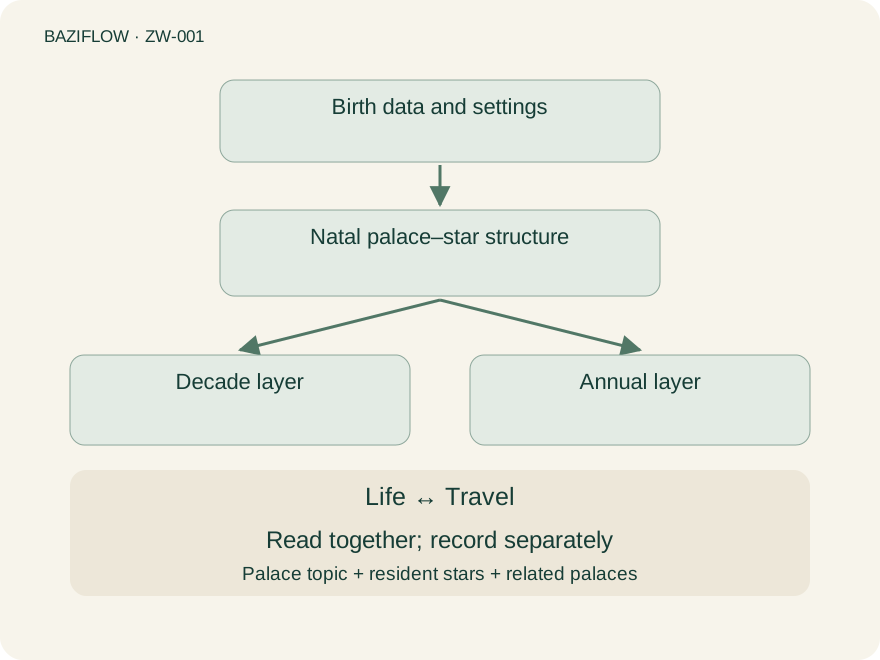
A conceptual guide, not a personal chart or a strength score.
Learn one method coherently
San He and flying-transformation approaches place different emphasis on chart relationships, and some tables have variant traditions. Record the source of a rule instead of assembling attractive fragments from incompatible methods. Historical texts are evidence for the tradition, not proof that symbolic arrangements determine health, income or relationships.
For the vocabulary of each area, continue to the twelve Zi Wei palaces. If you already know Four Pillars, the comparison of BaZi and Zi Wei methods explains what can be compared without treating the two systems as mutual validation.