

Guimei: positions out of place, and an empty basket
Content version · · Sources & references
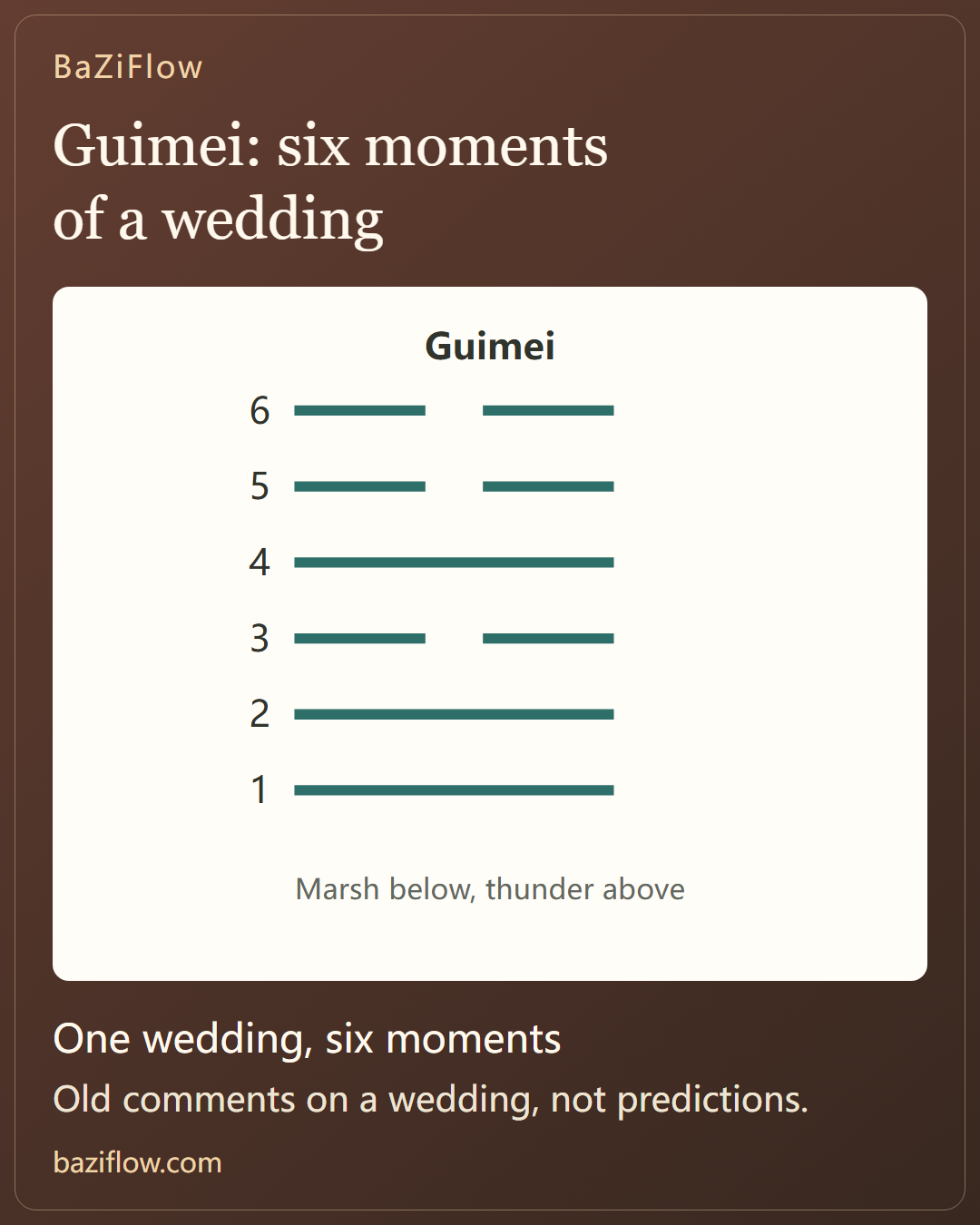
Guimei is the 54th hexagram: Dui (marsh) below Zhen (thunder). Read a Commentary that praises first and warns after, and six lines that run from the junior sister who goes with the bride to the empty basket.
The short version7 min read
The Commentary on Guimei begins with “the great principle of heaven and earth” and ends with “the positions are not fitting” and “the soft rides on the firm”. The six lines split a wedding into six moments: the junior sister, waiting, a missed date, a sleeve, a basket.
- Guimei stacks Zhen (thunder) on Dui (marsh). In the Shuo Gua Dui is “delight” and Zhen is “moving”, and the Commentary uses this: “delighting, then moving: that is how the younger sister is married off”.
- The Commentary first calls Guimei “the great principle of heaven and earth” and “the end and beginning of human life”, then says twice that something is wrong with the figure. Of lines 2 to 5, not one stands in its own place.
- The Small Image of line 1 says “they support each other”, and that of the top line says “she holds an empty basket”: the first and the last both use the word for holding up. The judgment’s closing “nothing is favorable” returns in the top line.
Read first
The Sixty-Four Hexagrams: How Upper and Lower Trigrams Form One Figure ↗
Judgment and Line Statements: Whole Hexagram or Single Line? ↗
Thunder over the marsh: the name Guimei
Guimei (歸妹) is the 54th hexagram: Dui (marsh) as the lower trigram and Zhen (thunder) as the upper. In the Shuo Gua Dui is “delight” and Zhen is “moving”; Dui is also called the youngest daughter and Zhen the eldest son. In the name, gui is for a woman to go to her husband’s home and mei is a younger woman; tradition usually reads Guimei as marrying off a young woman.
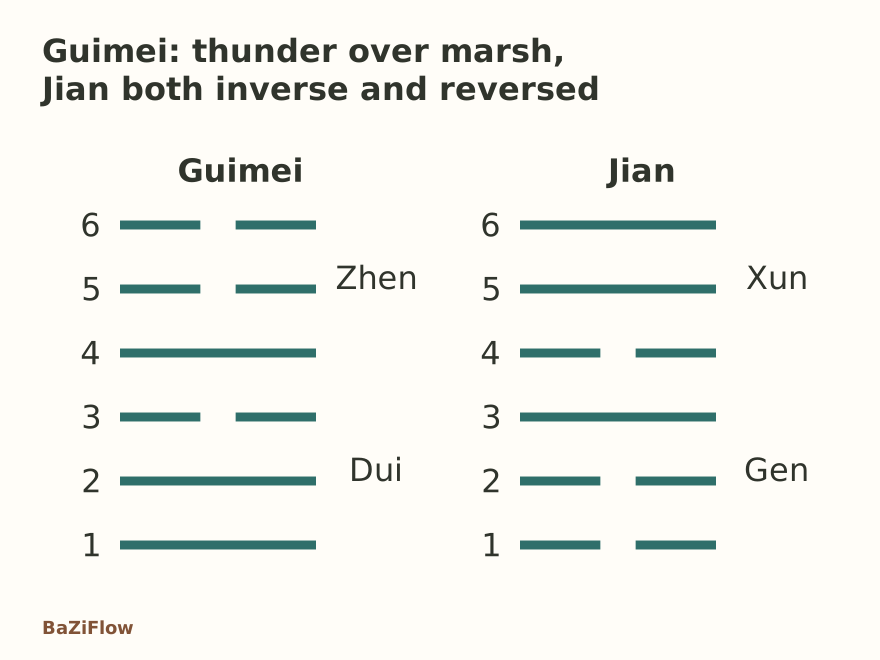
Guimei and Jian: Jian is both the inverse and the reversed hexagram of Guimei, because swapping every line and turning the figure over lead to the same hexagram.
Enlarge diagram · scroll sideways to read
Four words to know first
- Junior
- A younger woman who goes with the bride, traditionally read as an accompanying younger sister. Lines 1, 3 and 5 mention her.
- Waiting
- Line 3 says the bride is married off “as one who waits”. The word has more than one traditional reading; a common one is waiting.
- Sleeve
- The sleeve of a garment. Line 5 says the principal’s sleeve is not as fine as the junior’s.
- Basket
- A bamboo basket. In the top line a woman holds it up, and it is empty.
The Commentary: first “the great principle of heaven and earth”, then “out of place”
Guimei is the great principle of heaven and earth. If heaven and earth do not meet, the myriad things do not flourish; Guimei is the end and the beginning of human life. “Delighting, then moving” is how the younger sister is married off. “Setting out: misfortune”: the positions are not fitting. “Nothing is favorable”: the soft rides on the firm.
Enlarge diagram · scroll sideways to read
The first half is lofty. If heaven and earth do not meet, nothing flourishes, and Guimei is the “end and beginning” of human life. “Delighting, then moving”: the lower trigram Dui is delight, the upper trigram Zhen is movement, so one acts out of delight, and that is Guimei.
The second half turns cold: “setting out: misfortune; the positions are not fitting. Nothing is favorable; the soft rides on the firm.” Both statements can be checked on the lines. For “positions not fitting”, look at lines 2 to 5: line 2 is yang on a yin place, line 3 is yin on a yang place, and lines 4 and 5 are the same, so all four are off their own places and only lines 1 and 6 are where they belong. For “the soft rides on the firm”, a yin line sits directly on top of a yang line, line 3 on line 2 and line 5 on line 4. Praise and warning stand side by side in the very same passage.
The Great Image: thunder over the marsh, making an end last
Above the marsh there is thunder: Guimei. The noble person makes the ending last and knows what wears it down.
Enlarge diagram · scroll sideways to read
Tradition usually reads the first verb as making the end lasting. The second word means worn or damaged, so “knowing the wear” is seeing where something is likely to fail. Two acts, one aimed at lasting and one at the flaw.
Look closely and three texts all land on the word “end”: the Commentary says “end and beginning”, the Great Image says “make the ending last”, and the Za Gua also says of Guimei that it is “the woman’s ending”.
Six lines: six moments of a wedding
The six statements read as though the wedding were cut into six moments: going along, walking, waiting, a missed date, a sleeve, a basket.
Enlarge diagram · scroll sideways to read
Line 1: “married off with the junior; the lame can still walk; setting out: good fortune”. The bride goes with a junior, and even someone lame can walk. Line 2: “the one-eyed can still see; fitting for the constancy of a hermit”. Both are “can” lines: not whole, and yet able. Line 3 of Lü (履) has the same two phrases in the opposite order, and its Small Image says “not enough to see clearly” and “not enough to go along”; here the Small Image of line 1 says “they support each other”.
Line 3: “married off as one who waits; she returns, and goes again as a junior”. The word for “waits” has more than one traditional reading; a common one is waiting. The Small Image says only “not yet fitting”. Line 4: “the marriage is overdue; a late marriage has its time”. Overdue means the date has gone by, but the next clause says that going late also has its time, and the Small Image reads it as “waiting, then going”: the date is missed because one is waiting, and one goes when the wait is over.
Line 5: “Di Yi (帝乙) marries off his younger sister: the lady’s sleeve is not as fine as the junior’s sleeve; the moon is nearly full: good fortune”. The principal’s sleeve is less fine than the junior’s, and the moon is almost full but not yet. The Small Image says “her place is in the middle, and she acts with nobility”. The phrase “Di Yi marries off his sister” also stands in line 5 of Tai (泰).
Top line: “the woman holds up a basket with nothing in it; the man slaughters a sheep and there is no blood; nothing is favorable”. The Small Image has one remark: “she holds an empty basket”. The words “nothing is favorable” are the same as the closing words of the judgment. Back at line 1, “setting out: good fortune” differs from the judgment’s “setting out: misfortune” by one character, and the Small Image of line 1 says “support” where that of the top line says “hold up”.
Jian, Jiji and Weiji: neighbors of Guimei, and “the place one arrives at”
One hexagram serves as both the inverse and the reversal of Guimei: Jian (漸), shown in the opening figure. Guimei’s nuclear hexagram (互卦) is Jiji (既濟), which takes three lines twice from the inside: lines 2, 3, 4 are yang, yin, yang (Li, placed below) and lines 3, 4, 5 are yin, yang, yin (Kan, placed above). Jian’s nuclear hexagram is Weiji (未濟). So for this neighboring pair, the nuclear hexagrams are the last two of the sixty-four.
Enlarge diagram · scroll sideways to read
The Xu Gua puts Guimei after Jian on the ground that something that advances must have somewhere to arrive. After Guimei comes Feng, and the Xu Gua’s reason is that what has found its place of arrival must become great.
Questions readers ask next
Does Guimei simply mean marrying off a younger sister?
Literally, gui is for a woman to go to her husband’s home and mei is a younger woman, so tradition usually reads the name as marrying off a young woman. The lines have a “junior” who goes along and also a specific phrase, “Di Yi marries off his sister”; the hexagram speaks of the situations around such an occasion, and it is not one family’s story.
Do “the one-eyed can see” and “the lame can walk” appear in other hexagrams?
Line 3 of Lü has both, in the opposite order. There the Small Image says “not enough to see clearly” and “not enough to go along”, while in Guimei the Small Image says “they support each other”. The same words get a different comment.
Is “overdue” a mistake?
The word means a fault or an overrun, so “overdue” literally means the date was missed. But line 4 goes on at once: “a late marriage has its time”, and the Small Image reads it as “waiting, then going”. A missed date can also be read as a wait.
Was this article helpful?
Sources & references
Continue reading
Jian (漸): one wild goose, six landings, and what each stop brings ↗
Feng: the Dipper at midday, and why what grows “great” is a covering ↗
The Sixty-Four Hexagrams: How Upper and Lower Trigrams Form One Figure ↗
Judgment and Line Statements: Whole Hexagram or Single Line? ↗