

Heavenly Kitchen: the Eating God's Emolument
Content version · · Sources & references
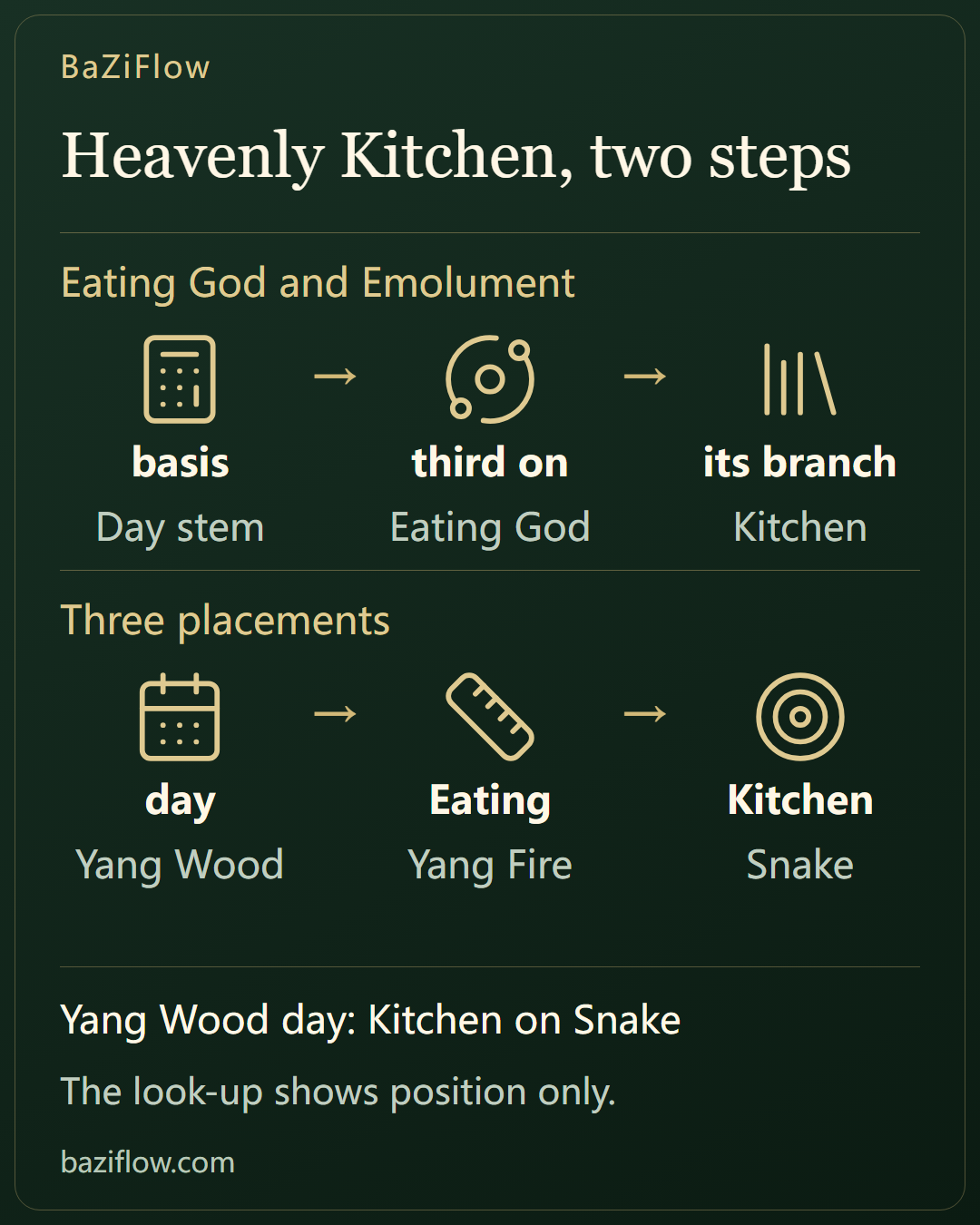
The Heavenly Kitchen is keyed to the day stem: count to its Eating God, take that stem's Emolument branch, then look for it in the pillars. A table, two sample charts and what the Yuanhai and Sanming Tonghui say.
The short version10 min read
The Heavenly Kitchen (天厨贵人) hangs on the Eating God: count from the day stem to its Eating God, then look up that stem's Emolument branch, and search for the branch in the year, month, day and hour pillars.
- The ten Kitchen branches are Snake, Horse, Snake, Horse, Monkey, Rooster, Pig, Rat, Tiger, Rabbit for Yang Wood through Yin Water. Every one is the Emolument of that stem's Eating God, with no exception.
- The name sits in three different places: on the Eating God stem in the Yuanhai Ziping, on an Eating God that meets its Emolument in juan 5 of the Sanming Tonghui, which wants stem and branch both present, and on the branch alone in the site's engine.
- The classic warns the Kitchen against the Owl, the clash and the void. The site's look-up only reports whether a branch is present, so those three belong to the whole chart.
Read first
Symbolic Stars in BaZi: Check the Reference and Rule Before the Meaning ↗
Count to the third stem, then find its Emolument
The Heavenly Kitchen (天厨贵人) hangs on the Eating God: count from the day stem to its Eating God (食神), then look up the Emolument (禄) branch of that Eating God. The branch it lands on is the Kitchen.
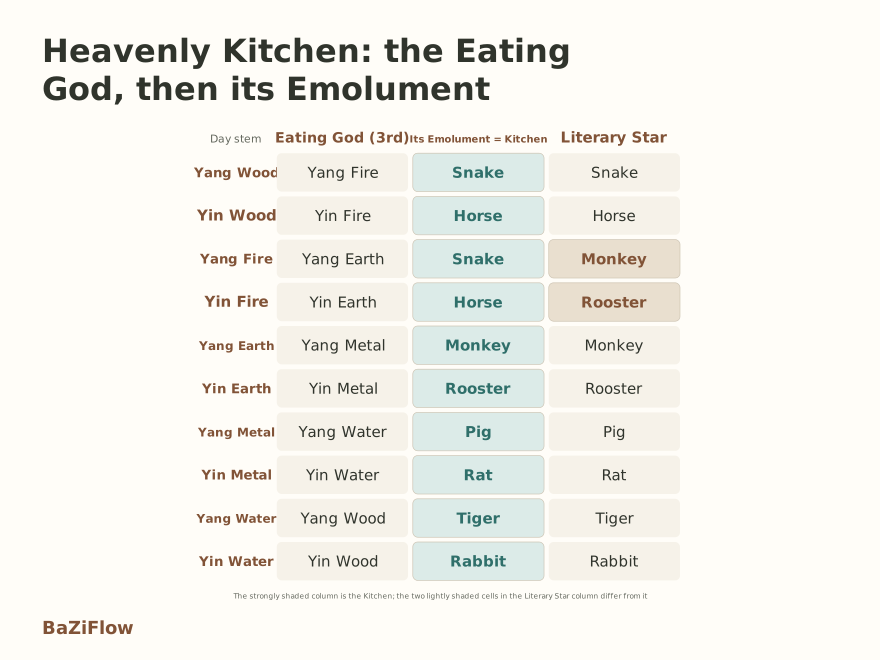
Sketch table: the Eating God and the Kitchen come from the site engine's look-up (the Eating God is the third stem counted forward and the Kitchen is its Emolument branch); the Literary Star column comes from that star's own table and is set beside it.
The first column is the Eating God, the second is that stem's Emolument, which is the Kitchen, and the third sets the Literary Star of the same day stem beside it; the two lightly shaded cells, for Yang Fire and Yin Fire, are where the two tables part. The "third place" rule comes from juan 5 of the Sanming Tonghui (三命通会), a Ming-dynasty compendium, which opens its Eating God section by fixing the Eating God as the stem that the day stem gives birth to, third in the count, and gives Yang Wood eating Yang Fire and Yin Wood eating Yin Fire as its examples.
Start counting at Yang Wood: Yang Wood, Yin Wood, Yang Fire. Yang Fire comes third, so Yang Wood eats Yang Fire. Start at Yin Water: Yin Water, Yang Wood, Yin Wood. Yin Wood comes third. Run all ten stems this way, then set each Eating God against the Emolument spot it holds in the twelve life stages, and the second column of the picture is complete.
Three sayings, three placements
Where the name "Kitchen" sits is not the same in the books and on the site. For a Yang Wood day, the Yuanhai Ziping (渊海子平), a manual of the Ziping method, lists the stems met in the chart and writes:
Meeting Yang Fire: it is the Eating God, the Kitchen, the Star of Longevity.
Here the Kitchen is one of several names for the Eating God stem itself. A Yang Wood day looks at the stem Yang Fire, and no branch or Emolument is mentioned. Juan 5 of the Sanming Tonghui opens a separate entry under the Eating God and puts the name on "an Eating God that meets its Emolument":
Yang Wood eats Yang Fire, and Yang Fire's Emolument is on Snake. Where the Eating God's own place meets its Emolument, it is called the Kitchen. The Emolument must show in both stem and branch to count: with the Yang Fire but no Snake, or the Snake but no Yang Fire, it does not. It does not matter whether this is the year, month or hour, and it is not limited to Yang Earth days, which is how it differs from the combining Emolument.
The entry has three layers. The Eating God stem (Yang Fire) and its Emolument branch (Snake) must both be seen. Any of the year, month or hour pillar will do. And it is not tied to a single day master. The "combining Emolument" it mentions is a later entry in the same juan, on a Yang Earth day with a Yang Metal and Monkey hour: Yang Earth eats Yang Metal, which has its Emolument on Monkey, so this too is an Eating God seated on its Emolument, but only for a Yang Earth day meeting that one hour pillar.
Enlarge diagram · scroll sideways to read
One Snake, two year stems
The two sample charts below share the day pillar, the hour pillar and the month branch; they differ in the year stem, and the month stem follows the year stem by the standard rule. The day master is Yang Wood in both, the month is Snake, and the Kitchen of Yang Wood is on Snake.
Enlarge diagram · scroll sideways to read
In chart one both conditions are met, the site marks the Kitchen on the month pillar, and the book's wording holds as well. In chart two the stems are Yang Metal, Yin Metal, Yang Wood and Yang Water, so there is no Yang Fire; the site still marks the Snake on the month pillar, while by the book's "the Snake but no Yang Fire does not count" it does not. A Snake always hides Yang Fire, Yang Earth and Yang Metal inside it, yet the book still wrote "the Snake but no Yang Fire", which suggests that "seen" means showing as a stem, not as a hidden stem.
The day pillar is also searched. Wu Shen (戊申), Ji You (己酉), Ren Yin (壬寅) and Gui Mao (癸卯) are four day pillars that stand on their own Kitchen. Take a Wu Shen day: Yang Earth counts on to Yang Metal, and Yang Metal draws its Emolument on Monkey, so the Monkey of the day pillar hits itself. For the other six stems (Yang Wood, Yin Wood, Yang Fire, Yin Fire, Yang Metal and Yin Metal) the Kitchen branch has the opposite polarity to the stem, so no such day pillar exists.
The book's cautions: the Owl and the clash
The section on the Eating God in juan 5 collects several old verses, and two of them name the Kitchen:
An Eating God meeting its Emolument is called the Kitchen; no clash, no restraint, no void, no officer or killing star.
An Eating God on the month is called the Kitchen, and whoever meets it is rich with surplus. Beware above all the Owl, which cuts blessings in the open; most of all dread the clash, which wears them away unseen.
The "Owl" (枭) is the Indirect Resource, and the book has a separate section for it under its other name, Toppled Food (倒食). For a Yang Wood day the Eating God is Yang Fire, and Yang Water is the Indirect Resource of Yang Wood. When Yang Water is strong it puts Yang Fire out, so the Eating God is robbed. Juan 10 has an even shorter line on the same thing: "the Kitchen meeting the Owl, food and salary wax and wane". The clash is a relation between branches:
Enlarge diagram · scroll sideways to read
How the book reads the Kitchen, and how far the site goes
What the book wants
- Eating God stem and Emolument branch seen together
- The verse speaks of the month, so place matters too
- No clash, restraint, void or officer-killing star
What the book warns of
- The Owl comes: blessings visibly shrink
- The clash comes: blessings wear away unseen
- "Kitchen meets Owl, food and salary wax and wane"
The site's look-up
- Answers whether a branch is in the pillars
- Owl, clash and void are judged separately
- Found does not mean conditions are met
The site's line and the book's "food"
The site describes the Kitchen as a place for food, clothing and the pleasures of the table, and also as a channel of output in expression and craft. The first half matches the book. When the Sanming Tonghui rates this pattern in its section on the Eating God, it says:
For this pattern the day master and the Eating God must both be strong, with no clash or break; the person has thick wealth and plentiful food, and a generous measure of fortune.
"Plentiful food" is the side the site calls the pleasures of the table. The second half, a channel of output in expression and craft, comes from the later habit of reading the Eating God as what the day master gives birth to and sends outward; see the Eating God and the day master. The passage above does not mention it.
Two to try yourself
Yang Fire day master, pillars Gui You, Wu Wu, Bing Shen, Gui Si from year to hour: where are the Kitchen and the Literary Star?
Yang Fire counts on to Yang Earth, and Yang Earth draws its Emolument on Snake, so the Snake of the hour pillar is the Kitchen. The Literary Star of Yang Fire is on Monkey, which is the day pillar. The month stem is Yang Earth too, so the book's "stem and branch both seen" is also met.
Yang Water day master, pillars Jia Yin, Ding Mao, Ren Zi, Ren Yin: in which pillars is the Kitchen?
Yang Water counts on to Yang Wood, which draws its Emolument on Tiger, so the Tiger of the year pillar and of the hour pillar are both the Kitchen. The year pillar Jia Yin is itself an Eating God seated on its Emolument.
Questions readers ask next
Is the Heavenly Kitchen the same thing as the Eating God?
The Eating God is one of the ten gods and is fixed by how the day stem relates to another stem. The Kitchen is a shensha, and it asks which branch holds that other stem's Emolument. The Yuanhai Ziping lists the two names side by side, which is why they are often spoken of together. On the site the Kitchen is always a single branch.
My day stem is Yang Wood and my chart has a Snake. Do I have the Kitchen?
By the site's table, yes: a Snake in any pillar is marked. The Sanming Tonghui is stricter and also wants the Eating God, Yang Fire, to show in the chart. So the site marking a Snake does not mean the book would accept it.
Does the Kitchen mean eating well?
The site's line about food and clothing matches what the book says of the Eating God, "wealth thick and food plentiful". In the classic the Kitchen is the name of the pattern in which the Eating God meets its Emolument, and what it describes is position and conditions.
Was this article helpful?