

Zhongfu: a hollow center and where voices go
Content version · · Sources & references
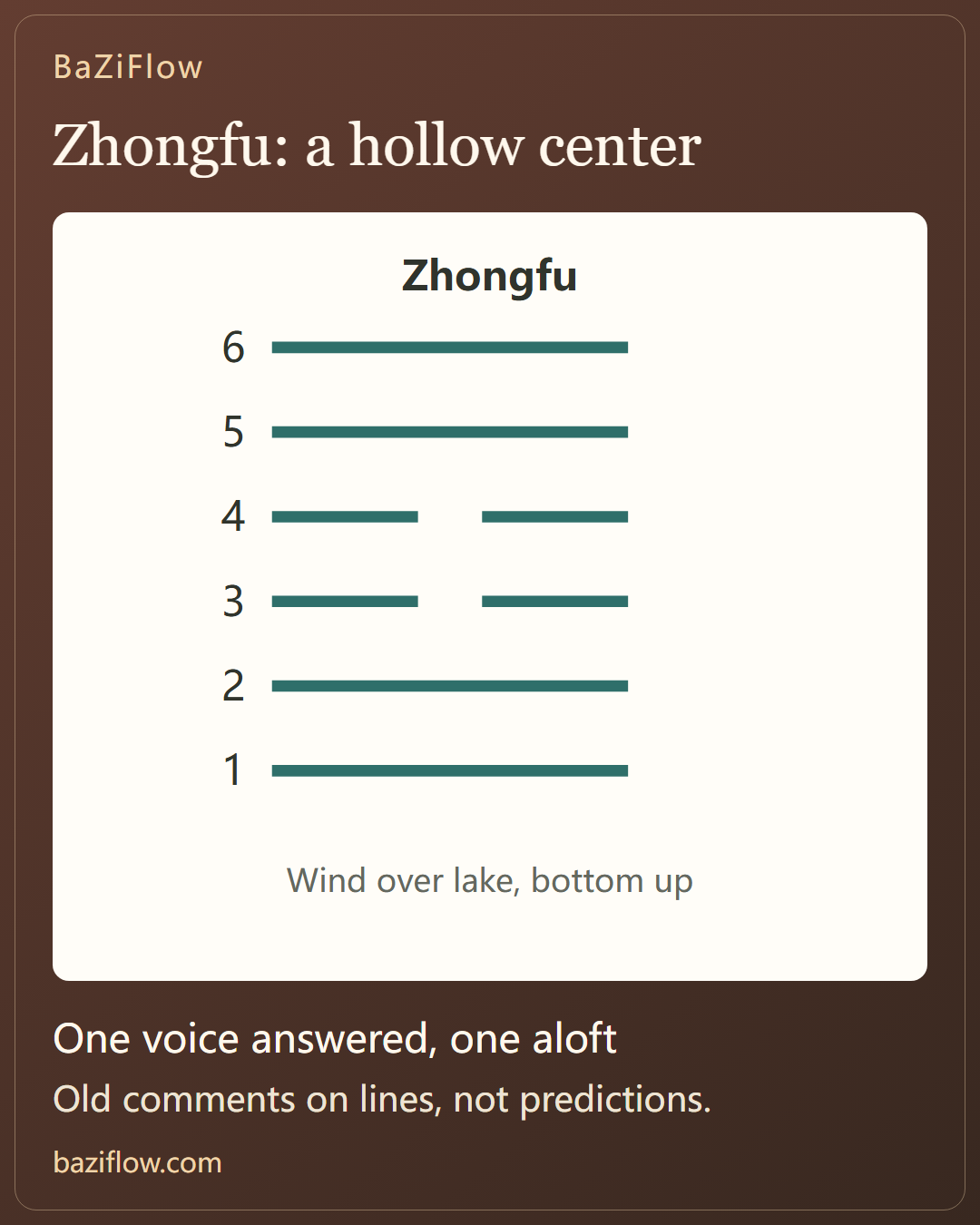
Zhongfu (中孚) is the 61st hexagram: Xun (wind) over Dui (lake). Read “the yielding is inside”, the hollow boat, the Great Image on deliberating cases, and six lines of voices from a crane to a feathered voice.
The short version8 min read
The figure of Zhongfu is hollow in the middle: two yin lines at the center and four yang lines around them. Three of the six lines make a sound: a crane calling and being answered, drum and song, and at the end a feathered voice that climbs to heaven.
- Zhongfu stacks Xun (wind) on Dui (lake), and its figure is four yang lines around two yin. The Commentary says “the yielding is inside, the firm holds the center”, and also “riding a wooden boat that is hollow”.
- The judgment says “pigs and fish: good fortune”, and the Commentary explains it as trust reaching even pigs and fish. The Great Image, on deliberating cases and putting off executions, is the other side of Lü’s image on prison.
- Two voices stand out in the lines: on line 2 a crane calls from the shade and its young answer; on the top line a feathered voice climbs to heaven. The Small Images say “from the heart” and “how can it last?”.
Read first
The Sixty-Four Hexagrams: How Upper and Lower Trigrams Form One Figure ↗
Judgment and Line Statements: Whole Hexagram or Single Line? ↗
Wind over a lake: a figure hollow in the middle
Zhongfu (中孚) is Xun (wind) above and Dui (lake) below. From the bottom the lines run yang, yang, yin, then yin, yang, yang. Set side by side, the two broken lines sit in the exact middle, with two unbroken lines above and two below, and the center of the figure is empty.
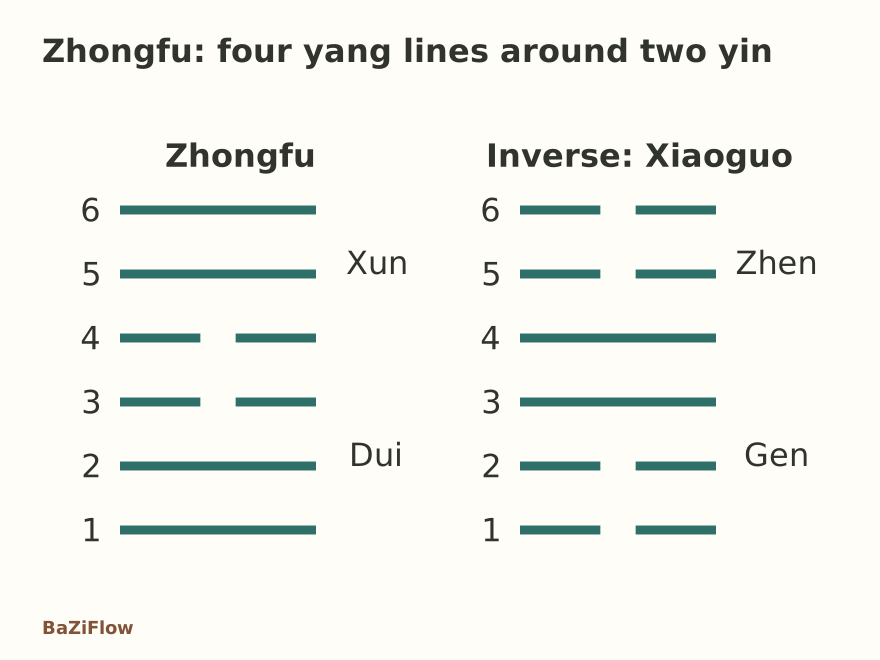
Zhongfu and its inverse Xiaoguo: one is four yang around two yin, the other four yin around two yang.
Enlarge diagram · scroll sideways to read
Three words before reading
- Trust
- The Za Gua glosses the name with a single word: “Zhongfu is trust.”
- Center
- The “center” of the name can be read against the figure: the two yin lines are in the exact middle, inside, and the Commentary also says “the yielding is inside”.
- Pigs and fish
- In the judgment, “pigs and fish: good fortune”: small pigs and fish, neither of which can speak.
The judgment and the Commentary: the yielding inside, a hollow boat
The judgment of Zhongfu reads: pigs and fish, good fortune; a good time to cross the great river; steadfastness is fitting. The Commentary on the Judgments describes the figure first and then explains each sentence.
In Zhongfu the yielding is inside and the firm holds the center. Delighting and yielding, with trust: this transforms a state. “Pigs and fish: good fortune” means that trust reaches even pigs and fish. “A good time to cross the great river” means riding a wooden boat that is hollow. Zhongfu, with steadfastness fitting, answers to heaven.
Enlarge diagram · scroll sideways to read
“The yielding is inside” can be counted straight off: lines 3 and 4 are the two yin lines in the middle. “The firm holds the center” is lines 2 and 5, each the middle line of its own trigram. “Delighting and yielding” sets the trigrams side by side: Dui below delights, Xun above yields. Then “pigs and fish: good fortune” is explained as trust reaching even small things that cannot speak. The last sentence is “riding a wooden boat that is hollow”: Xun is wood, and the boat is empty. The Commentary never says that the figure looks like a boat, but “hollow boat” set beside “the yielding is inside” fits the empty middle of the figure.
The Great Image: deliberate cases, put off executions
The Great Image of Zhongfu reads:
Wind over the lake: Zhongfu. The noble person deliberates on prison cases and puts off executions.
Wind passes over the lake. From it the noble person takes two actions: to deliberate on prison cases, and to put off executions. Deliberating cases means discussing them; putting off executions means slowing a death sentence down.
Enlarge diagram · scroll sideways to read
This Image is in the same territory as the Image of Lü, which asks for punishment that is clear and careful with no case left waiting in prison. There the watchwords are clarity, care and no delay; here they are deliberation and slowing down. One says that cases should not sit waiting, the other that death should not be hurried, and each hexagram writes one side of the matter.
Six lines: three that sound
In the six statements of Zhongfu voices sound several times.
Enlarge diagram · scroll sideways to read
Line 1 reads “peace of mind: good fortune; another concern: no ease”. Tradition usually takes the first word as holding to one’s place, so another concern disturbs it. The Small Image: his aim is unchanged. Line 2: “a crane calls from the shade, and its young answer it”. The crane cries in a shaded place and its young reply. “I have a fine cup, I will share it with you”: the cup can be read as a drinking vessel or as a good rank, and tradition usually reads the last word as to share. The Small Image says it comes from the heart.
Line 3: “he meets an opponent: now he beats the drum, now he stops; now he weeps, now he sings.” Four actions swing back and forth, and the Small Image says the position is not proper. Line 4: “the moon is just past full” (some copies read “almost full”), “the horse’s mate is lost: no blame”. Tradition usually reads the horse as losing its partner, and the Small Image says it cuts itself off from its kind and goes up. Line 5: “he has trust that binds: no blame”, where binding means being tied to others, and the Small Image says its position is right and fitting.
At the top, line 6: “the feathered voice climbs to heaven; steadfastness brings misfortune”. Tradition usually takes the feathered voice as a rooster’s crow, going up to heaven. The Small Image has one question: how can it last? It can be read against the Shuo Gua: Dui is the mouth, and the three lower lines hold a call, a drum and a song; Xun is the rooster, and the topmost line of Xun is the “feathered voice”.
Enlarge diagram · scroll sideways to read
Put the two voices together: one is in the shade, is answered, and shares a fine cup; the other climbs to heaven, and the Small Image asks how it can last.
Xiaoguo and Yi: neighbors of Zhongfu and its place after Jie
Turn Zhongfu upside down and it is still Zhongfu: lines 1 and 6, 2 and 5, 3 and 4 each pair up as the same kind of line, so its reversed hexagram is itself. The inverse hexagram is Xiaoguo, in the figure above, four yin around two yang. The nuclear hexagram is Yi (頤): lines 2 to 5 split into a Zhen trigram below and a Gen trigram above. Huan, Jie and Zhongfu all share Yi as their nuclear hexagram.
Enlarge diagram · scroll sideways to read
The Xu Gua puts Zhongfu after Jie:
With limits kept, one can be believed, so what follows is Zhongfu.
Limits first, and then people believe. After Zhongfu the Xu Gua says that those who have trust are sure to act on it, and so Xiaoguo (小過) follows.
Questions readers ask next
What does “pigs and fish: good fortune” mean?
Literally small pigs and fish, which the judgment calls fortunate. The Commentary explains: trust reaches even pigs and fish. Neither can speak, and tradition usually takes them as the least noticed of beings.
Why is the reversed hexagram of Zhongfu Zhongfu itself?
Turn the figure upside down and lines 1 and 6, 2 and 5, 3 and 4 swap places. Each pair holds the same kind of line, yang for the first two pairs and yin for the third, so the figure does not change and its reversed hexagram is itself.
How are Zhongfu and Xiaoguo related?
They are each other’s inverse, with every line changed to the opposite polarity: Zhongfu is four yang around two yin, Xiaoguo is four yin around two yang. The Xu Gua says that those who have trust are sure to act on it, and so Xiaoguo comes after Zhongfu.
Was this article helpful?
Sources & references
Continue reading
Jie: water over a lake, from “does not go out” to the bitter limit ↗
Xiaoguo: thunder above the mountain, and passing and meeting trade places ↗
The Sixty-Four Hexagrams: How Upper and Lower Trigrams Form One Figure ↗
Judgment and Line Statements: Whole Hexagram or Single Line? ↗