

Why natal mansion methods differ
Content version · · Sources & references
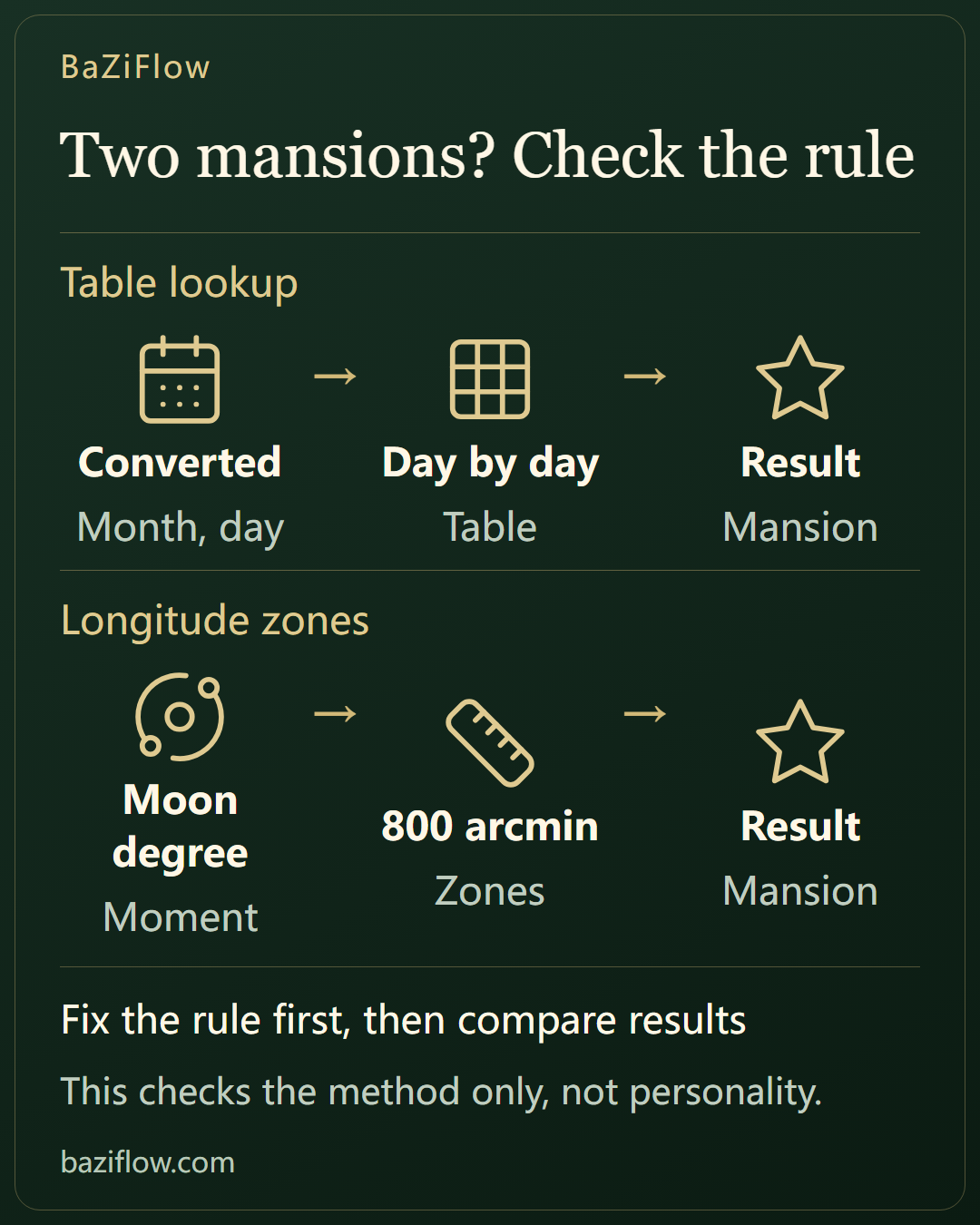
When two websites give different natal mansions, first see whether each uses a month-and-day table or Moon-longitude zones. A 799/800 arcminute exercise, two sources and a check sheet find the first step that differs.
The short version6 min read
When two websites give different mansions, first tell whether they answer "look up the month-and-day table" or "zone the Moon's longitude". They are different questions with different inputs.
- A table lookup needs a calendar conversion, a month-and-day index and one table; zoning needs a definite instant, the Moon's longitude and a declared coordinate origin.
- The NAOJ 27-way division gives each zone 13 degrees 20 arcminutes, which is 800 arcminutes: 799 falls in zone 1 and 800 enters zone 2.
- "Both follow the scripture" is not enough: the first-month, first-day cells in two sources are Shitsu (室) and Kyo (虛). Record the first step that differs, and write "unconfirmed" where information is missing.
Read first
Why one birthday can give two mansion names
Site A says Shitsu (室), site B says Kyo (虛). The natural reaction is to read both personality descriptions and keep the one that sounds like you. That selects the interpretation you prefer, not an algorithm you have checked.
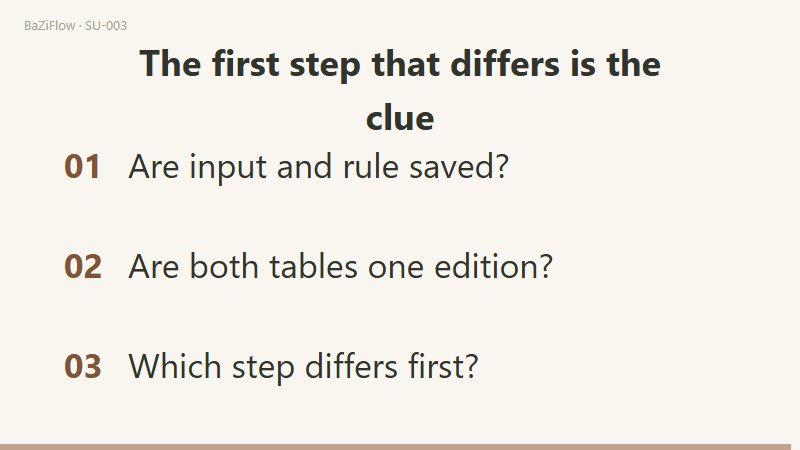
To investigate, begin by saving the inputs and the rule: which calendar the birthday was entered in, how the date was converted, which table was used, or whether the result came from the Moon's position. Label the results "method A" and "method B" for now; that finds a reproducible cause sooner than deciding early which one is the real you.
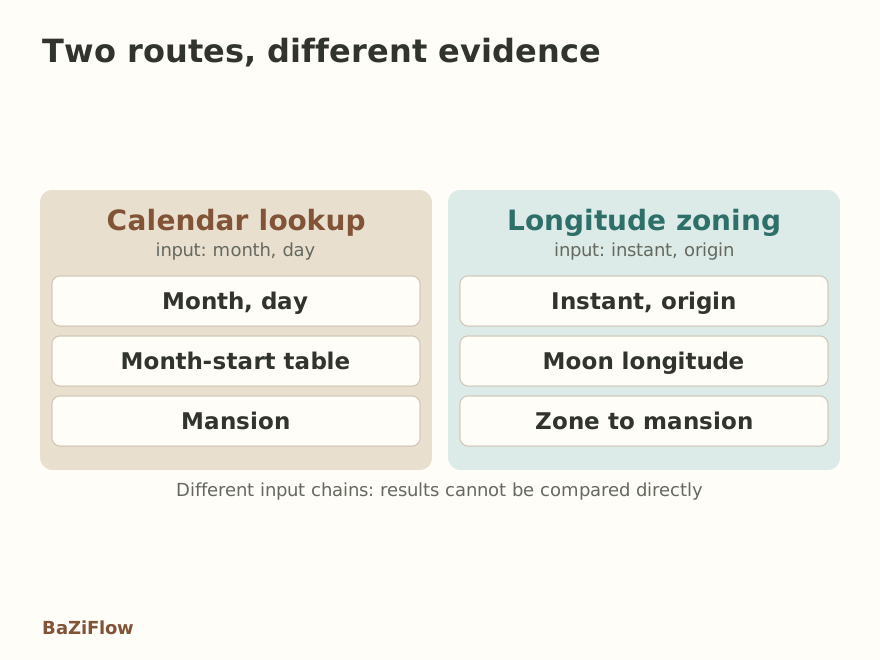
Comparison of input routes, not a ranking: the two routes need different evidence, so their results cannot be compared directly.
"Both say 27 mansions" is not the same calculation
The name list
Which mansions take part in the sequence.
Month-start mansion
Which mansion each month begins with.
Date conversion
How a birthday becomes a month and day in the calendar used.
Zone origin
Where longitude starts being measured.
Two routes need different evidence
A calendar lookup first obtains the month and day count in the chosen calendar, then applies a month-start table and a progression rule to get a label. A positional method needs the Moon's longitude at a specified instant, a declared coordinate origin, and a decision about which interval contains it.
Enlarge diagram · scroll sideways to read
A lookup needs a calendar conversion, a month-and-day index and the relevant table; a positional method needs an instant, a lunar longitude and a stated coordinate convention.
Work one boundary through: 799 and 800 arcminutes
The National Astronomical Observatory of Japan describes a nakṣatra scheme with 27 equal divisions: 360 degrees, each division 13 degrees 20 arcminutes wide. In arcminutes that is 360 × 60 ÷ 27 = 800, so every division is exactly 800 arcminutes.
Enlarge diagram · scroll sideways to read
Here is a purely arithmetic exercise. Assume the longitude is already in the coordinate system the scheme requires, call the first division zone 1, and let each zone include its start and exclude its end.
Enlarge diagram · scroll sideways to read
A source title does not identify one table
Even within calendar-based work, "from the Sukuyō scripture" is not a complete specification. Here are two identified cells in two identified sources.
Enlarge diagram · scroll sideways to read
What a tool's claim needs in order to be reproduced
To reproduce, you need
The table and its edition, or a documented adaptation.
To reproduce, you need
The input calendar and the converted month and day.
To reproduce, you need
The adopted instant, coordinate settings and interval scheme.
To reproduce, you need
The stated leap-month rule, not a guessed default.
A check sheet that stops at the first divergence
When you meet a real disagreement, keep four lines in order; wherever information is missing, write "unconfirmed" on that line.
Enlarge diagram · scroll sideways to read
If two tools both say they use a table but one publishes none, its output alone cannot tell you which source it used. Saving each step lets a different date conversion, a different table and a program error be located separately, and the same clock reading can point to a different moment if the time-zone assumption differs.
Reproducing a mansion name does not show that a personality or relationship claim is true. To keep the daily mansion apart from the natal one, read natal and daily mansions; for the calendar cells see reading a Sukuyō calendar.
Questions readers ask next
Why can two websites give different natal mansions?
The commonest reason is that they take different routes: one looks up a month-and-day table, the other zones the Moon's longitude. Even two table lookups can differ in calendar conversion, the month-start mansion and leap-month handling.
If both sites cite the scripture, can the results still differ?
Yes. One title can sit behind different tables and editions: the NAOJ calendar page assigns Shitsu (室) to the first day of the first month, while the monthly table in the CBETA edition starts that month at Kyo (虛). A title alone does not show that two sites used one table.
Can I read two personality descriptions and keep the one that sounds like me?
No. That selects an interpretation you like, not an algorithm you have checked. Even a correctly reproduced mansion name does not show that the personality or relationship claims that follow are true; that is a separate question.
Was this article helpful?
Part of a learning path
Sukuyō: from the birth mansion to relationship limits · Step 3 of 3 available
Sources & references
Continue reading
Tropical and Sidereal Zodiacs: Two Readings of One Direction ↗