

Evidence-based personal readings
Content version · · Sources & references
Use a small geometric contrast to separate accurate fields from supported explanations. Check what survives when names are removed and when structurally different inputs are compared.
The short version6 min read
If two readings remain interchangeable after hiding the names, inspect their evidence. A changed field must change an argument for a reason; neither synonyms nor invented opposites establish individuality.
- Trace the current source and reproducible field before judging its interpretive link.
- Substantive differences need evidence, not name replacement, altered decimals or synonym changes.
- Personalization, source accuracy and predictive support require separate conclusions.
Read first
Combination, clash and star in BaZi, Ziwei and astrology: different rules ↗
Specific detail can still be unsupported
A paragraph can contain many names, coordinates and specialist terms while offering no clear reason for its personal conclusion. Specificity of vocabulary is not the same as specificity of inference. The missing step is often the connection between the cited field and the advice that follows it.
Select one claim that purports to describe the current input. Work backwards: what interpretation rule connects it to a field, and where did that field come from? Preserve the subject and time layer at each step. A value from a partner's chart, a previous result or an illustrative example does not become current evidence simply because it appears beside the person's name.
| Level | What should be traceable? | Common failure |
|---|---|---|
| Fact | Current source, field and scope | A stale or foreign value is reused |
| Interpretation | Rule and relevance to the question | A term is followed by an unexplained leap |
| Conclusion | Limits supported by the first two levels | Detail exceeds the available evidence |
This is an editorial inspection, not a new divination algorithm. It can reveal a weak connection even before a reader decides what they think of the tradition's broader claims.
What do 120° and 180° actually establish?
- Source identity
- Whose field it is, its time layer and its version.
- Discriminating evidence
- A fact that explains why this conclusion differs from the one for another input.
Contrast two inputs that cannot share the same calculation
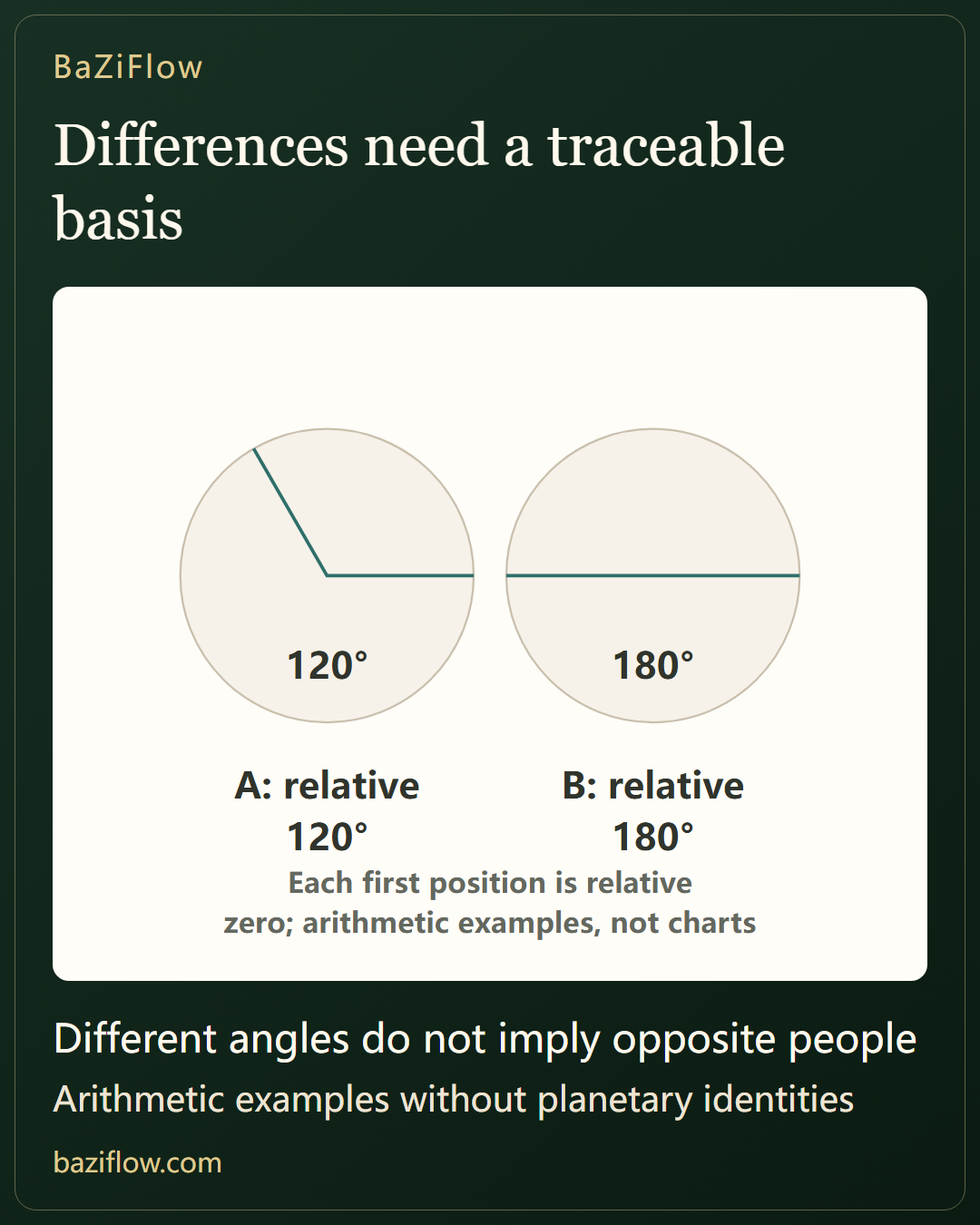
Use two abstract longitude pairs with no birth records. Pair A is 10 and 130 degrees. Pair B is 10 and 190 degrees. Their absolute differences are 120 and 180 degrees. Taking the smaller of each difference and 360 degrees minus that difference leaves shortest separations of 120 and 180 degrees respectively.
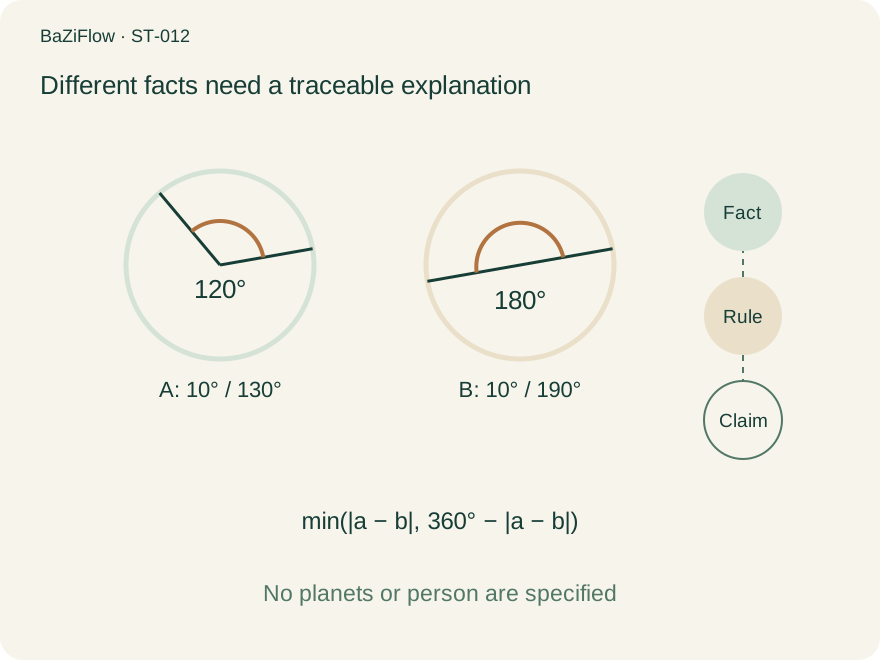
Original BaZiFlow teaching diagram. Coordinates are arithmetic examples with no planetary identities, birth records or personality claims.
These are author-created arithmetic examples, not ephemeris results for a real sky. No planet, house or interpretive orb has been supplied. The supported conclusion is a geometric difference. Neither pair licenses a personality description or a prediction about a person's life.
If both outputs append the same advice about finding balance without further support, changing the number has not completed the explanation. Yet forcing opposing personality claims on A and B merely to make the texts different would be another error. The evidence determines the allowable difference; novelty is not an independent reason to assert one.
Swiss Ephemeris documentation distinguishes positional outputs and their input parameters. It is a technical reference for keeping calculated fields explicit, not a source for assigning life meanings to this example. Accurate calculation and warranted interpretation are separate checks.
A: relative 120°
B: relative 180°
Each first position is relative zero; arithmetic examples, not charts
Compare the parts that claim to be personal
Take several structurally different teaching inputs and place their complete readings side by side. Remove names temporarily and ask which substantive conclusions could be swapped without changing anything else. This is a warning test, not proof that every shared sentence is wrong.
Inspect argument order, selected facts, priorities and recommendations as well as repeated wording. A synonym rewrite can preserve the same template underneath. Likewise, scores clustered near the same high value may reveal an uninformative scoring rule; changing the last decimal does not establish meaningful discrimination.
Shared definitions are allowed to remain shared. Inputs can also support genuinely common observations. The task is to identify whether a supposedly individual conclusion has sufficiently discriminating evidence. If removing its cited fact leaves the entire argument intact, the author should explain why that fact was presented as its basis.
This comparison models an ordinary reader's behavior. People share results, compare their own alternative inputs and read friends' summaries. A text that seems fluent in isolation can expose shallow personalization in that setting. Quality assessment should include that side-by-side experience, rather than assuming one reader sees only one output.
Input A
- Its fields and priorities
- Keep the whole reading
Input B
- Its different evidence
- Keep the whole reading
Close gaps instead of filling every heading
An explanation should not infer canonical facts by scanning ordinary prose for familiar characters or fragments. A domain-like character inside a normal word is not a chart field. Nor can a generated paragraph or an old cached interpretation serve as an authoritative replacement for the current structured input.
When the evidence supports only a small conclusion, keep it small. A page layout with headings for work, relationships and resources does not require unsupported content under all three. Omitting an individual claim can be more useful than completing the shape of a report with general encouragement.
If a source field is corrected later, the dependent conclusions need an identifiable revision. A share summary that retains the old claim and a reading page that shows the new one are no longer presenting the same version. Personalization includes this ongoing correspondence, not only the initial drafting step.
Stale or foreign field
- Required response
- Return to current input
Insufficient evidence
- Required response
- Keep the claim limited
Corrected source field
- Required response
- Revise dependent summaries
Name the scope of a successful check
NIST's guidance on selecting an experimental design ties the design to the objective being investigated. Applied cautiously here, that means deciding whether the exercise concerns input discrimination, source accuracy or prediction before declaring success. This article's comparison is about evidence-based variation in writing; it is not a formal test of predictive validity.
A reading may accurately cite its input and still make an unsupported claim about reality. Conversely, an emotionally resonant sentence may be too general to establish personalization. These distinctions let readers value a reflection without overstating what has been verified.
After reading, try to identify one conclusion that depends on a particular condition, its supporting field and the rule connecting them. If that path is absent, mark the individual claim as unconfirmed rather than improving its rhetoric. Facts, symbols, inferences and advice expands this layered approach, while agreement is not proof addresses comparisons between several similar readings.
Calculation check
- What passing means
- The arithmetic is correct
Input-discrimination check
- What passing means
- Differences follow evidence
Outcome evaluation
- What passing means
- Needs its own design
Recompute A
|130−10|=120; the other way around the circle is 240. The smaller separation is 120.
Recompute B
|190−10|=180; the other way around the circle is also 180. The shortest separation is 180.
Stop at the supported boundary
Only a geometric difference is established. No planetary identity, house or interpretive rule has been supplied.
Questions readers ask next
Does an interchangeable sentence have to be false?
No. It is a signal to inspect the purported individual basis. Shared definitions or genuinely shared conditions can support common explanations.
Does citing many fields establish personalization?
The author still needs to connect the current fields through relevant rules to the claim. Terminology cannot replace that argument.
Does correct arithmetic validate a forecast?
No. It validates the field calculation. A claim about reality requires a separate evidential path and an appropriate evaluation.
Was this article helpful?
Theme: Understanding yourselfParenting