

Choose the position, then change its state
Content version · · Sources & references
Separate a moving line’s index from its yin–yang change, using a six-position remainder table and two independent changes to the Qian figure.
The short version6 min read
Selecting a moving line has two steps: map a supplied total to one of six positions counted upward, then change only that line between yin and yang. Separate bottom-line and top-line exercises starting from Qian make both the indexing and the change visible.
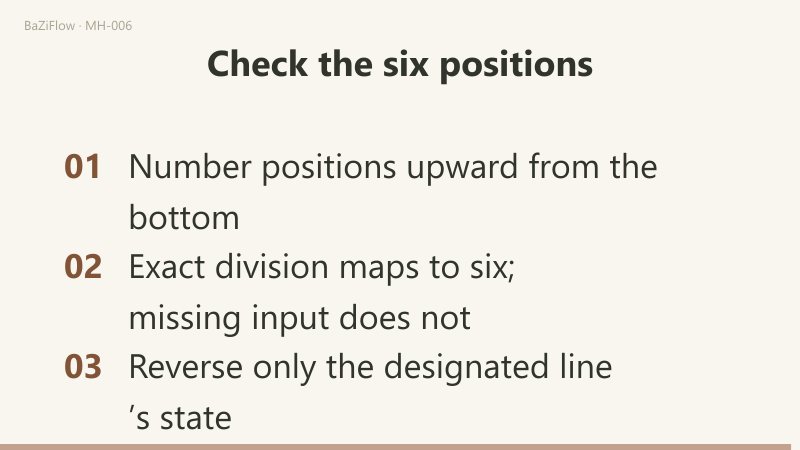
- Positions run upward from the bottom. Nine in the second position denotes yang at position two; Use of Nines is not a seventh line.
- In the stated positive-integer cycle, 17 selects five, 18 selects six and 19 returns to one. Missing input is not exact division.
- Change one specified position per exercise: Qian becomes Gou at the bottom or Guai at the top. Restart from Qian for each example.
Read first
A moving line is first a position
Number six horizontal lines from the bottom upward. The bottom is line 1 and the top is line 6. In classical line labels, nine denotes a yang line and six denotes a yin line; “nine in the second position” is therefore a yang line at position 2, not a ninth line. The Qian chapter of the Zhou Yi runs from its initial nine to its upper nine and provides a clear check on that naming convention.
In the division-by-six procedure described in volume 1 of Meihua Yi Shu, a previously obtained total selects the moving position. The line at that position then changes from yang to yin or from yin to yang. Selecting the position and changing its state are separate operations. A reader should not choose a favourite line statement first and work backwards to a convenient moving line.
Qian also includes a separate Use of Nines statement. It is not a seventh line. A web page may display it as a seventh list item, but an editorial list number does not change the six-position structure.
Qian
Decide the total before taking the remainder
Time, object-based and measurement procedures do not necessarily construct their totals in the same way. This article begins after the selected procedure has supplied its total. It does not invent a universal formula for every kind of input. Number sources in casting explains why the earlier step must remain visible.
The common six-position cyclic convention maps remainders 1 through 5 to those positions and maps exact division to position 6. There is no line 0. A record should say “exact division maps to six” rather than leaving a software remainder of zero unexplained. The classical passage describes selecting a line by division; this explicit notation is a modern way to state the indexing convention, not a quotation of programming syntax from the text.
| Supplied total for a position exercise | Division by six | Selected position |
|---|---|---|
| 17 | 6 × 2 + 5 | Line 5 |
| 18 | 6 × 3 + 0 | Line 6, under the exact-division convention |
| 19 | 6 × 3 + 1 | Line 1 |
These are three independent indexing exercises, not three results from one real casting record. Moving from 18 to 19 wraps from the top to the bottom of the six-position cycle. It does not add a seventh line above the drawing.
17
- Remainder
- 5
- Position
- 5
18
- Remainder
- 0
- Position
- 6
19
- Remainder
- 1
- Position
- 1
Change the top and bottom of Qian in separate exercises
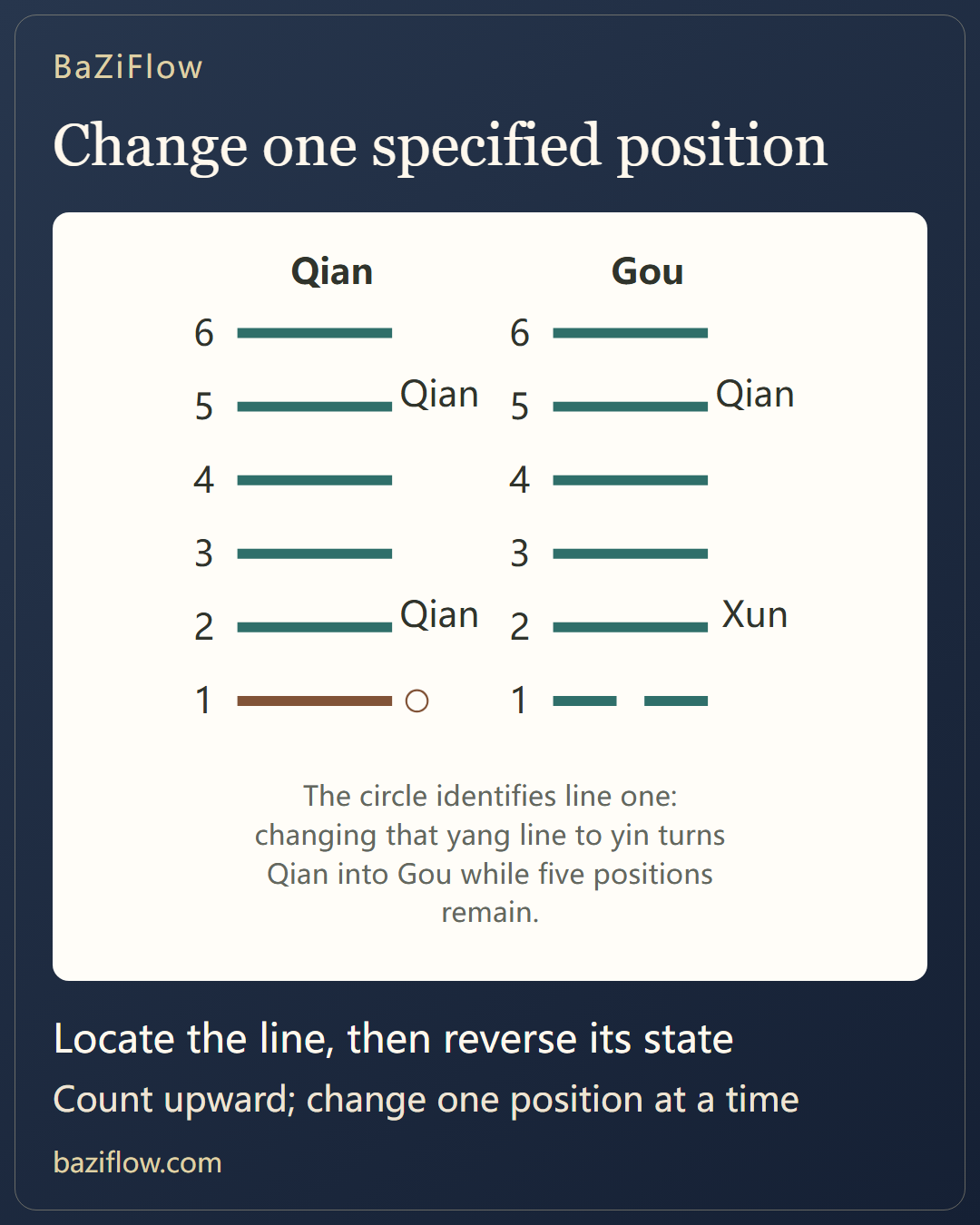
Now use Qian's six unbroken yang lines for two separate line-change demonstrations. In the first, change only the top line to yin. The upper trigram becomes Dui while lower Qian remains unchanged, producing Guai, Lake over Heaven. In the second, start again with Qian and change only the bottom line to yin. The lower trigram becomes Xun while upper Qian remains, producing Gou, Heaven over Wind.
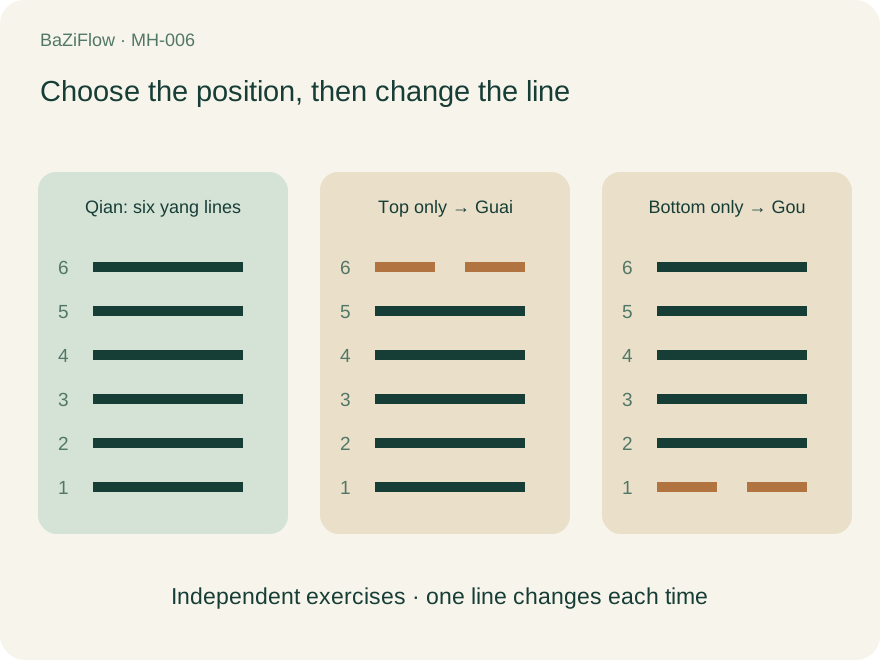
Original BaZiFlow teaching diagram of two independent line-change exercises; not a complete casting or a personal prediction.
The Zhou Yi chapters identify Guai as Qian below Dui and Gou as Xun below Qian, allowing the resulting structures to be checked against the text. Compare all six positions before and after each exercise: exactly the selected position changes, and the other five remain identical. Reversing every line's yin–yang state or turning the entire picture upside down would be a different operation.
The two examples do not assign two moving lines to one Meihua cast. They isolate two possible positions so that a bottom-to-top indexing error becomes visible. Nor are the supplied totals in the previous table claimed as complete inputs that generated Qian; the table and the line-change drawings test distinct steps.
Qian
Gou
The circle identifies line one: changing that yang line to yin turns Qian into Gou while five positions remain.
Separate the marker, the changed line and the quoted text
A moving line belongs to the original figure as the position designated for change. The resulting state at that position belongs to the changed figure. If a yang line in position 2 becomes yin, the original figure's line statement does not retroactively acquire a new label. A quotation still needs its own figure name and position.
Diagrams may mark movement with a circle, cross, colour or arrow. Read the legend used by that diagram. A circle on an interface can be a button or ornament rather than a yang-moving marker. Its appearance alone is not line data.
Coin-cast Na Jia Liu Yao can produce multiple moving lines. That is different from the Meihua procedure discussed here, which selects one position from one remainder. Both use six-line drawings, but a rule for interpreting multiple changes cannot silently be imported to add changes to a single-position calculation.
Qian
Guai
Restart from Qian and change only the circled top line to obtain Guai; this is independent of the previous exercise.
Check the edge cases without inventing an ancient rule
The indexing exercise assumes a positive integer total. Zero, negative numbers, fractions or missing values should send the reader back to the input source and selected procedure. Mechanically taking a remainder does not show that the classical method defines those cases. A contemporary exercise may declare a normalization rule, but it should identify that rule as its own convention.
Likewise, exact division is not a licence to treat every invalid input as line 6. Distinguish a valid positive total divisible by six from a missing value that software happens to store as zero. The first follows the stated cycle; the second lacks evidence.
Obtaining a moving position has not yet established Body and Use, element relationships or a reading of the line text. For the next structural distinction, continue with primary, nuclear and changed hexagrams, where changing one line is separated from extracting an inner configuration.
Valid total 18
- Exact ÷6 → line 6
Missing total
- Check the source rule
Questions readers ask next
Do nine in the second place and six in the second place occupy different positions?
Both occupy the second position counted from the bottom. Nine denotes yang and six denotes yin. A line quotation also needs its figure name; the changed state does not rewrite the original figure’s line statement.
Why does remainder zero still select a moving position?
The stated six-position convention maps exact division of a positive total to line six. Eighteen therefore selects the top line, not line zero. A missing value or an original total of zero must instead be checked against the input procedure.
Can both exercises be combined into one changed Qian figure?
They each restart from Qian. Changing the bottom line alone yields Gou; changing the top line alone yields Guai. Flipping both ends in one figure would be a different operation, not either of these single-line examples.
Was this article helpful?
Part of a learning path
Sources & references
Continue reading
Primary, nuclear and changed hexagrams: trace each operation ↗