

Jie: from the courtyards to sweet and bitter limits
Content version · · Sources & references
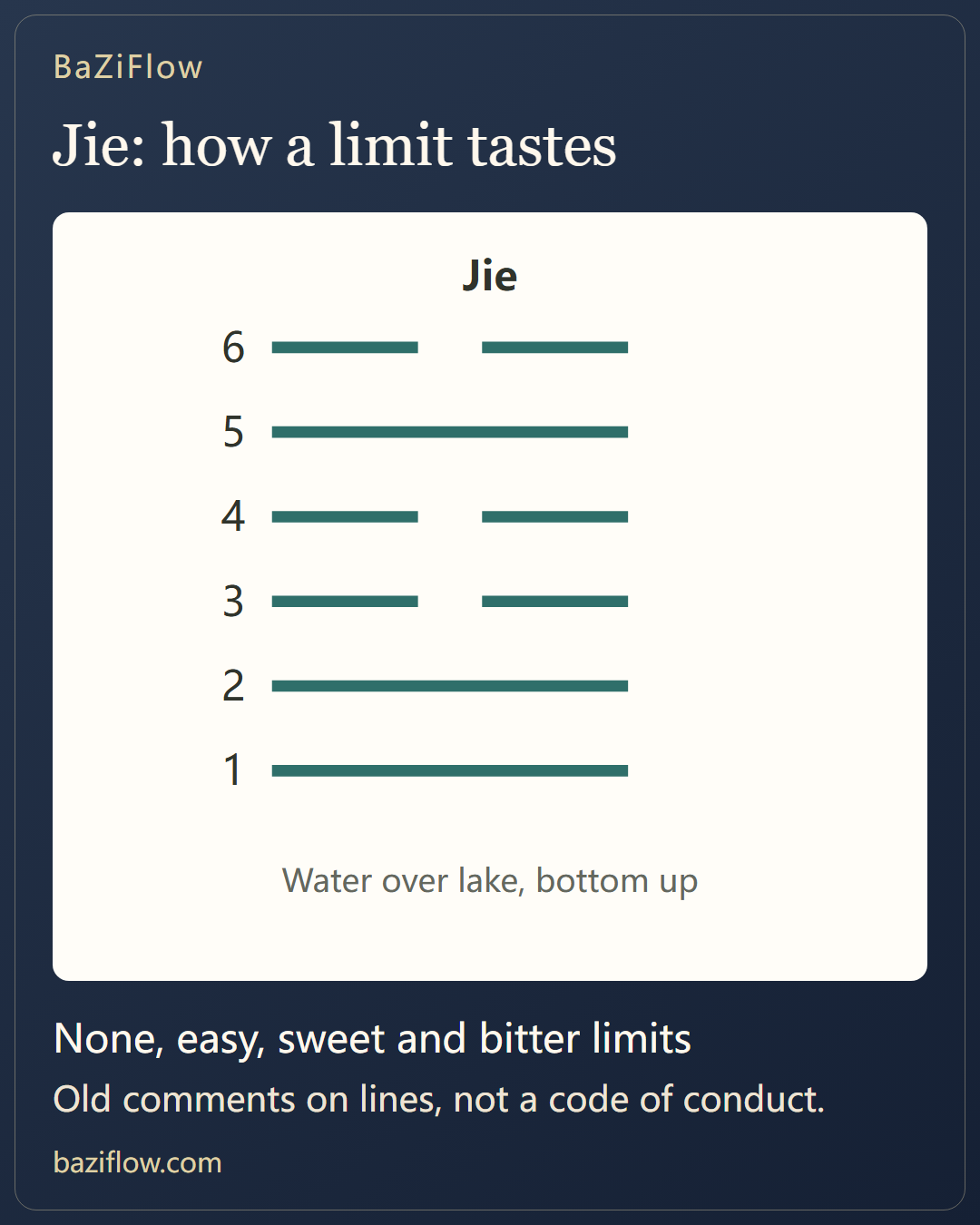
Jie (節) is the 60th hexagram: Kan (water) above Dui (lake). Read “fixing numbers and measures” and six lines that run from staying in the courtyard to easy, sweet and bitter limits.
The short version7 min read
Jie means limit. Its six lines begin with two courtyards a person does or does not leave, and then grade the limit itself by taste: none, easy, sweet, bitter.
- Jie stacks Kan (water) on Dui (lake). The Commentary on the Judgments calls it “delighting in order to pass through danger”: delight below, danger above.
- The Commentary’s “a bitter limit cannot be kept; its way has run out” returns almost word for word as the Small Image of the top line. The Great Image turns the hexagram into “fixing numbers and measures”.
- Line 1 keeps to the courtyard of the house: no blame; line 2 keeps to the courtyard of the gate: misfortune. After them come no limit, easy, sweet and bitter limits, and the Small Image gives a reason for each line.
Read first
The Sixty-Four Hexagrams: How Upper and Lower Trigrams Form One Figure ↗
Judgment and Line Statements: Whole Hexagram or Single Line? ↗
Water over a lake: Dui below, Kan above
Jie (節) is Kan (water) above and Dui (lake) below. The Shuo Gua gives Kan the word “sinking in” and Dui the word “delight”. From the bottom the lines are yang, yang, yin, then yin, yang, yin: three yang lines (1, 2, 5) and three yin lines (3, 4, 6), exactly three of each.
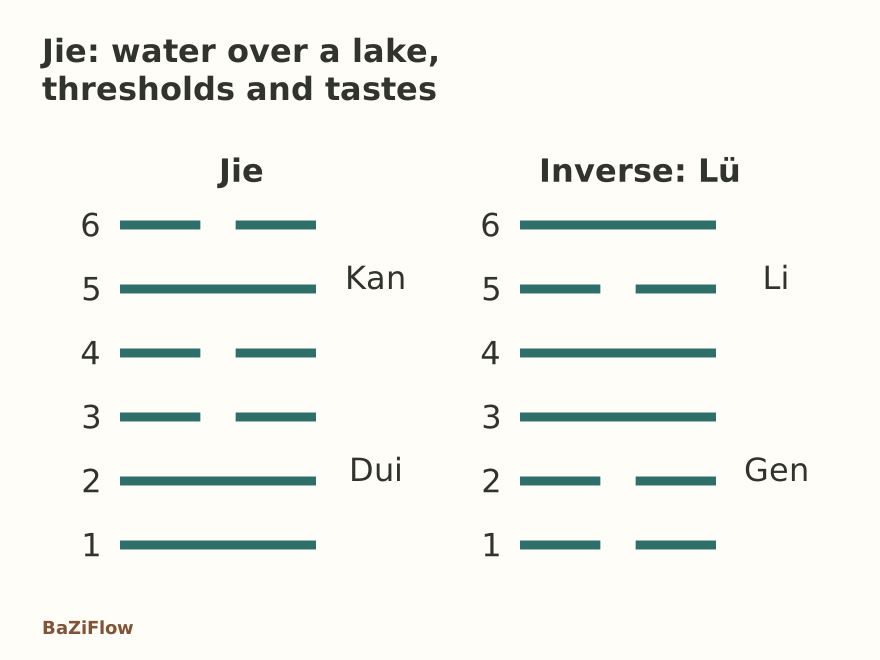
Jie and its inverse Lü: the inverse hexagram changes every line to the opposite polarity.
Enlarge diagram · scroll sideways to read
Three words to know first
- Jie
- The character first meant a joint of bamboo, one stretch set off from the next, and from that a limit, restraint. The Xu Gua says “after limits, trust”, putting Jie before Zhongfu.
- Numbers and measures
- In the Great Image the noble person “fixes numbers and measures”: numbers are how much, measures are how large or long.
- Bitter limit
- It appears in the judgment and on the top line: restraint that has become too harsh. The judgment says it “cannot be kept”, the top line says it brings misfortune.
The judgment and the Commentary: a limit that passes, a limit that is bitter
The judgment of Jie has two sentences: success; a bitter limit cannot be kept. The first says it passes through, the second that a limit pushed too far cannot be held. The Commentary on the Judgments explains both ends.
Jie, success: the firm and the yielding are divided, and the firm holds the center. “A bitter limit cannot be kept”: its way has run out. Delighting in order to pass through danger, standing in its place to set limits, central and correct and so getting through. Heaven and earth have their limits and the four seasons are completed. Limits set by measure do not injure wealth or harm the people.
Enlarge diagram · scroll sideways to read
The first half can be read off the figure. “The firm and the yielding are divided”: three yang lines and three yin lines hold three places each, as neatly separated as can be. “The firm holds the center”: lines 2 and 5 are the yang lines in the middle of their trigrams. “Delighting in order to pass through danger” reads the two trigrams together: Dui below is delight, Kan above is danger, and delight carries one through. “Standing in its place to set limits, central and correct” is traditionally read as line 5: a yang line sitting where yang belongs, in the fifth place, at the middle of the upper trigram. Then the Commentary lifts limits to heaven and earth and brings them back to human affairs: limits by measure do not injure wealth or harm the people. The final clause, “a bitter limit cannot be kept”, returns to the judgment: a limit can be sweet or bitter, and when the bitterness is complete the way no longer goes through.
The Great Image: fix numbers and measures, deliberate on conduct
The Great Image of Jie reads:
Water over the lake: Jie. The noble person fixes numbers and measures, and deliberates on virtue and conduct.
Water stands above the lake. Tradition usually reads it this way: a lake holds only so much, and once water stands on top of it there has to be a limit. From this the noble person takes two tasks: to fix numbers and measures, and to deliberate on virtue and conduct.
Enlarge diagram · scroll sideways to read
Numbers and measures are limits of quantity: how much, how long, how large. “Deliberate on virtue and conduct” is a different kind: virtue and conduct are things to be discussed and judged. Under the one word Jie, one hand sets amounts and the other considers character.
Six lines: first thresholds, then tastes
The six statements fall into two parts: the first two are thresholds, and the last four are the taste of a limit.
Enlarge diagram · scroll sideways to read
Line 1 says he stays inside the yard of the house, and there is no blame. Tradition usually takes this as the yard just within the door. The Small Image (小象) says he knows what is open and what is blocked. Line 2 says he stays inside the yard of the gate, and there is misfortune; this is the yard within the outer gate. One word differs and the result is the opposite; the Small Image says he has missed the time, and utterly.
Line 3: “if there is no limit, then sighing; no blame.” The Small Image adds: for one who sighs for want of a limit, whom else is there to blame? Line 4, “limits taken in ease: success”; the Small Image says he takes up the way of the one above, and line 4 stands right below line 5. Line 5, “limits that are sweet: good fortune; going has something to be valued”; the Small Image says he stands in the central position. Line 6, “bitter limits: persisting brings misfortune; regret vanishes”; the Small Image says its way has run out.
That sentence has already appeared in the Commentary: “a bitter limit cannot be kept; its way has run out”. The Small Image of line 6 writes it again almost word for word, one speaking of the whole figure and the other of this one line.
Before “limit”, the words run: none, easy, sweet, bitter. Without a limit there is sighing, with ease there is success, with sweetness good fortune, with bitterness misfortune: the text writes one word in four tastes.
Huan, Lü and Yi: neighbors of Jie and its place after Huan
Turn Jie upside down and you get Huan, its reversed hexagram. The inverse hexagram is Lü, already in the figure above. Its nuclear hexagram is Yi (頤), built from the inner lines: Zhen (yang, yin, yin) below, Gen (yin, yin, yang) above. Huan has the same nuclear hexagram.
Enlarge diagram · scroll sideways to read
The Xu Gua says:
Things cannot stay scattered to the end, so what follows is Jie.
What has scattered cannot stay scattered, and so a limit is set. After Jie the Xu Gua says “limits, then trust”, and Zhongfu (中孚) follows. The Za Gua also puts Huan and Jie in one line:
Huan is separating; Jie is stopping.
One separates and one stops. Set against the inverse hexagram Lü, the traveler is outside while the first two lines of Jie stay inside the courtyards.
Questions readers ask next
Does “bitter limit” mean that restraint is bad?
No. The Commentary begins with “Jie, success” and says that heaven and earth have their limits and so the four seasons are completed: limits are what makes things work. A bitter limit is restraint carried too far, which is why it “cannot be kept”. Line 5, the sweet limit, is the same thing done in due measure.
Why is staying in the courtyard of the house blameless and staying in the courtyard of the gate unlucky?
The two sentences differ by one word and end opposite ways. The Small Images give the reasons: line 1 “knows what is open and what is blocked”; line 2 “has missed the time, completely”.
How are Jie and Lü related?
They are each other’s inverse, every line changed to the opposite polarity. Lü is about someone away from home, while the first two lines of Jie are about not going out of the courtyards: one outside, one kept within.
Was this article helpful?
Sources & references
Continue reading
Huan: wind over water, and what “scatter” takes as its object ↗
Zhongfu: solid outside, hollow within, from the calling crane to the feathered voice ↗
The Sixty-Four Hexagrams: How Upper and Lower Trigrams Form One Figure ↗
Judgment and Line Statements: Whole Hexagram or Single Line? ↗