

Semisextile: 30° and one sign's distance
Content version · · Sources & references
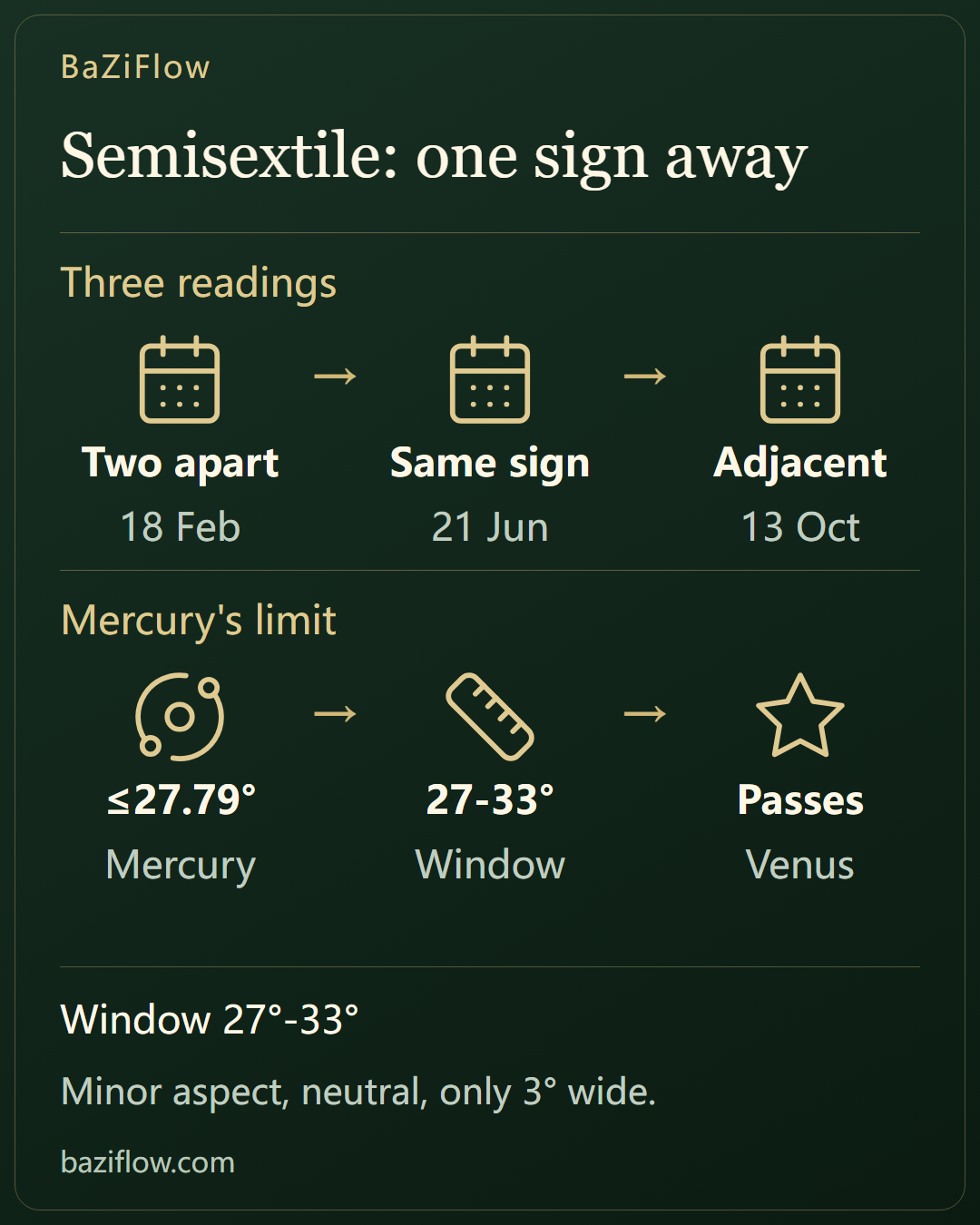
A semisextile is a minor aspect at 30° with a 3° orb. Three 2026 readings, Ptolemy's "averted" signs and Mercury's "face", Mercury's 27.79° limit and the Sun and Moon around a new moon show how it works.
The short version6 min read
A semisextile puts two points 30° apart, exactly one sign away, as a minor aspect with a 3° orb that counts degrees only and ignores which signs the two points sit in.
- The 27°-33° window compares degrees alone: two points 28° apart in one sign qualify, and so do two points with a whole sign between them. The site labels it "neutral".
- Ptolemy files signs one apart under "averted"; Ashmand's footnote then uses the same distance for Mercury's "face", one sign after the Sun or before the Moon, and the site's ruler table confirms it.
- Of 1,266 greatest elongations of Mercury in 1900-2100 only 13.6% reach 27°, and the largest is 27.79°. Venus sits in the 27°-33° band on about 11.1% of days.
Read first
Aspects and orbs in astrology: how to calculate the angle between two planets ↗
Three 30° readings: adjacent, same sign, two apart
In plain words first: a semisextile is one sign of distance on the ecliptic, 30°, one twelfth of the circle.
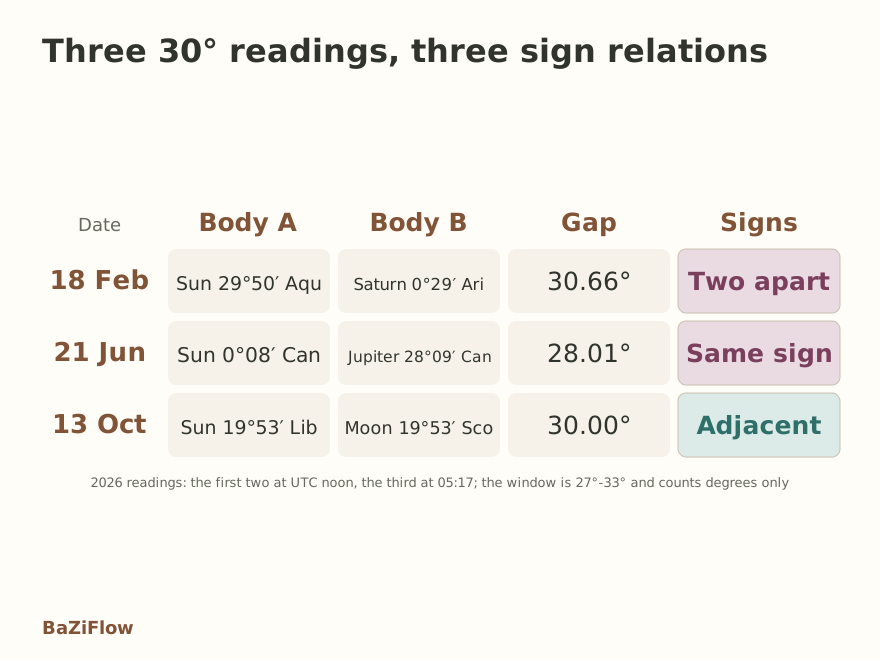
Table of readings: the gap is the engine's longitude difference; the sign relation is only a description, and the 27°-33° window decides whether the aspect holds.
The table has three readings from 2026. All fall within 3° of 30°, and the sign relations differ. The Sun and Moon on 13 October at 05:17 UTC look like the textbook case: 19°53′ Libra and 19°53′ Scorpio, adjacent signs at the same degree. On 18 February the Sun was at 29°50′ Aquarius and Saturn at 0°29′ Aries, with the whole of Pisces between them, and the gap was 30.66°. On 21 June the Sun was at 0°08′ Cancer and Jupiter at 28°09′ of the same sign, 28.01° apart.
The 27°-33° window compares degrees only and ignores sign boundaries. Two points 28° apart in one sign qualify, and two points with a sign between them qualify when they come to about 30°.
One sign apart: averted, and Mercury's "face"
Ptolemy puts signs one apart into his chapter on signs without a tie, and says two things about them:
Parts one sign apart are, as it were, turned away from each other; and though the space between them may stretch into two signs, the whole angle is only that of one sign.
Ptolemy is speaking of whole signs, but the point carries over to degrees: the angle is the size of one sign, while the two points can share a sign, sit in two neighbors, or have a whole sign between them, which is exactly the three readings above.
The same distance turns up in the chapter on a planet's "face" (Book I chapter 23). A planet is in its own face when its aspect to the Sun or Moon matches the aspect its home makes to their homes. Ashmand's footnote spells the positions out: Mercury one sign after the Sun or before the Moon, Venus sextile, Mars quartile, Jupiter trine, Saturn five signs. Checking the site's table of rulers shows the footnote is right:
Enlarge diagram · scroll sideways to read
The two ends of this ladder land on the rungs Ptolemy leaves unconnected: one sign belongs to Mercury and five to Saturn. The footnote calls five signs a quintile, a word that today means 72°; five signs make 150°, covered in the quincunx article.
Mercury only reaches the edge of the window: 27.79°
Mercury orbits inside Earth's orbit and never leaves the Sun's neighborhood. Sampling every day from 1900 to 2100 at UTC noon turns up 1,266 greatest elongations, and the largest is 27.79°. Only 172 of them, 13.6%, reach the 27° lower edge of the window.
3 April 2026 is one of those: Mercury at 15°58′ Pisces, the Sun at 13°44′ Aries, a gap of 27.77°, which is 2.23° from 30° and inside the window. The window stayed open across twelve daily readings, from 29 March to 9 April:
Enlarge diagram · scroll sideways to read
Once on each side of a new moon: Sun and Moon
The Moon takes a little over 29 days to catch the Sun again, and each month the separation passes 30° twice: before the new moon the Moon trails the Sun by 30°, and after it the Moon leads by 30°. October 2026 went like this:
Enlarge diagram · scroll sideways to read
Both times the Moon and Sun share a degree in adjacent signs. When Lilly explains how to read an ephemeris in his 1647 book, he marks the semisextile with the symbol SS and says it is made of 30°; his own example has a day on which Mars and Mercury "are in semisextile".
Two exercises and three checks
Two exercises
On 10 April 2026 at UTC noon Mercury is at 23°49′ Pisces and the Sun at 20°37′ Aries. A semisextile?
The gap is 26.81°, which is 3.19° from 30° and outside the 3° window, so no. Mercury left the window after 9 April.
On 18 February at UTC noon the Sun is at 29°50′ Aquarius and Neptune at 0°40′ Aries. And now?
The gap is 30.84°, 0.84° from 30° and inside the window, so yes; with Pisces between them, the signs are two apart.
Measure degrees, do not count signs
The signs of the two points do not decide it; whether the longitude difference falls inside 27°-33° does.
Allow same-sign and two-apart cases
The window opens by degrees, so two points 28° apart in one sign, or across a sign boundary, qualify equally.
Check Mercury and Venus by their limits
Mercury cannot reach 30° and enters the window only for a few days above 27°; Venus passes through 30°.
Only after all three are settled does the aspect go into the whole chart. For measuring windows see aspect angles and orbs; for where Mercury and Venus sit see Mercury by sign and house and Venus by sign and house; the 0° rung at the other end of the ladder is the conjunction.
Questions readers ask next
Is a semisextile just the relation between adjacent signs?
No. Two points in adjacent signs can be anywhere from nearly 0° to nearly 60° apart, and only a difference of about one sign qualifies. Two points 28° apart inside one sign qualify as well.
Can the Sun and Mercury ever make a semisextile?
They can, but rarely. Mercury is never more than 27.79° from the Sun and the window starts at 27°; in 1900-2100 only about 13.6% of its greatest elongations reach 27°, and even then it stays inside for only about ten days.
How many times a month do the Sun and Moon form a semisextile?
Twice, one on each side of the new moon: once with the Moon 30° behind the Sun and once 30° ahead. Each window lasts only about twelve hours.
Was this article helpful?
Sources & references
- Ptolemy, Tetrabiblos Book I (F. E. Robbins text on Perseus/LacusCurtius): signs without familiarity (I.16) and planetary conditions (I.23) ↗
- Deborah Houlding, Traditional Sign Rulerships (2003) ↗
- NASA Science, About the Planets ↗
- William Lilly, Christian Astrology (1647), Of the Twelve Houses (cited for the passages named in the text; chapter and page cross-check pending) ↗
- Ptolemy, Tetrabiblos (J. M. Ashmand translation, 1822), chapter numbering as cited in the text ↗
Continue reading
Quincunx (150°): The Five-Sign Distance, Read From Two Sun-Saturn Passes in 2026 ↗
Conjunction, opposition and square aspects: measure the angle before judging good or bad ↗