

Two of Pentacles: two coins, one cord
Content version · · Sources & references
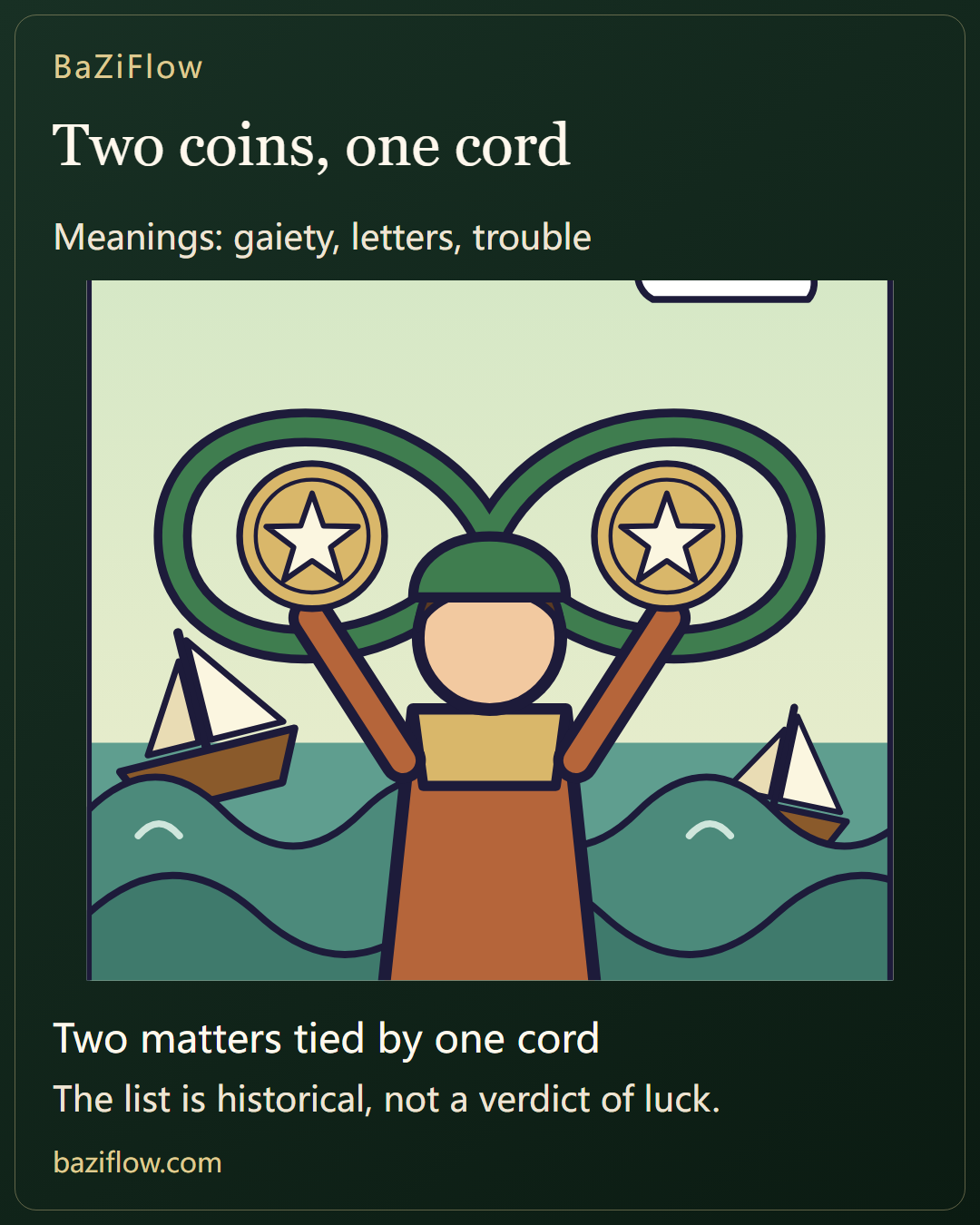
The Two of Pentacles shows a dancing youth with a coin in each hand, joined by a cord shaped like an 8. Separate the gaiety end and the trouble end of Waite's list, then draw a cord between two pots on a stove.
The short version6 min read
The Two of Pentacles shows one figure holding two coins, tied by a cord in the shape of an 8. Waite's list has words for gaiety and for trouble at once.
- Waite's description: a youth in the act of dancing, a pentacle in either hand, the two joined by an endless cord "like the number 8 reversed".
- One end of the list is gaiety and recreation, which he calls the subject of the design; the other is news and messages in writing, obstacles, agitation, trouble, embroilment.
- The extras say troubles are "more imaginary than real"; reversed they give a bad omen, ignorance and injustice.
Read first
Two coins in the hands, and a cord like an 8 turned over
Waite describes the card in one sentence: a young man in the act of dancing has a pentacle in either hand, and the two are joined by that endless cord which is like the number 8 reversed.
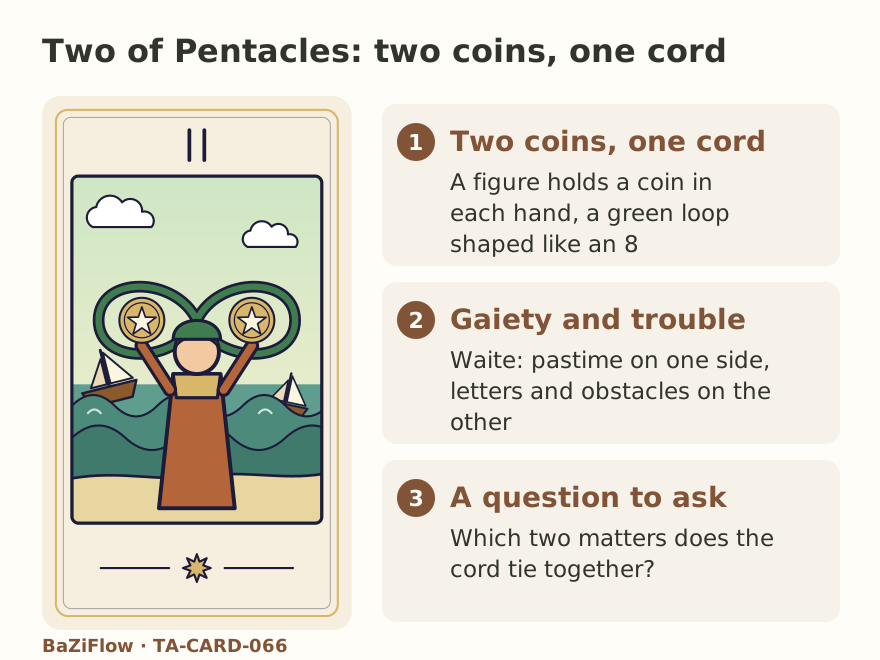
The Two of Pentacles: two coins, one cord
The Rider-Waite-Smith picture adds a few things. The youth wears a tall red hat and red stockings, and the coin on the left of the picture is held a little higher than the one on the right. The green cord loops between the coins into an 8 lying on its side. Behind him are rolling waves with two ships on them, the one at the right tilting with the swell. Waite does not mention the sea or the ships. In the BaZiFlow card both coins are held at the same height and the boats are two small sailboats.
Enlarge diagram · scroll sideways to read
"Gaiety on one end, trouble on the other": Waite writes both readings side by side
Waite's divinatory meaning is one long sentence: on the one hand it is represented as a card of gaiety, recreation and its connexions, which is the subject of the design; but it is read also as news and messages in writing, as obstacles, agitation, trouble, embroilment.
...a card of gaiety, recreation and its connexions, which is the subject of the design; but it is read also as news and messages in writing, as obstacles, agitation, trouble, embroilment.
There is an order inside that sentence. Gaiety is "the subject of the design"; the trouble end is "read also". The two ends stand side by side, but Waite says plainly which one the picture itself draws.
Enlarge diagram · scroll sideways to read
The reversed list reads like both ends turned over. "Enforced gaiety" and "simulated enjoyment" are the false side of gaiety; "literal sense, handwriting, composition" connect to the upright "messages in writing"; "letters of exchange" is a 1910 commercial term for written instruments used in exchange. The extras speak differently again: upright, "troubles are more imaginary than real"; reversed, "bad omen, ignorance, injustice". That runs nearly opposite to the main entry's "obstacles, trouble".
The cord, the dance and the waves: three details, three origins
Take the figure-eight cord, the dancer's posture and the sea behind him one at a time, and ask who gave each of them a meaning.
Where the cord, the dance and the waves come from
- The figure-eight cord
- Waite writes "that endless cord which is like the number 8 reversed" and does not explain it. An 8 on its side is commonly linked with endlessness or cycles, which is general tradition; modern teaching often reads it as a continuing back-and-forth between two matters.
- The dancer
- Waite writes "in the act of dancing" and says gaiety is the subject of the design. Reading the dance as "keeping balance while moving" is a teaching borrowing.
- Waves and ships
- The painter added the sea; Waite's text is silent about it. Reading it as "ups and downs in your situation" is a teaching metaphor.
Enlarge diagram · scroll sideways to read
How to read it: draw a cord between two matters
The card comes with its own shape: two coins, one cord, and a person in motion. In daily life that becomes three questions: which two matters, what they share, and how attention moves between them.
A small case: on a Friday evening two things are on the stove at once, a pot of radish and pork-rib soup that simmers for forty minutes, and a plate of greens stir-fried to order.
Name the two coins
Write the two simultaneous matters in one line each: the soup, about forty minutes, mostly simmering on its own; the greens, two or three minutes, standing at the pan.
Find the cord
What joins the two: the same pair of hands, the same evening, the same stove. The cord is not on either coin; it runs between them.
See how attention is set
The soup needs a glance every few minutes, the stir-fry needs everything you have. The dancer's move is to swing between the two ends: put the end that matters right now in your palm first.
Enlarge diagram · scroll sideways to read
What drawing the cord helps you see
Visible
- What the two matters share
- Where attention sits right now
Not visible
- Whether it will go smoothly
- Which end will go wrong
Before acting
- Write down the shared thing
- Mark the end that can wait
Reversed and neighboring cards: enforced gaiety, simulated enjoyment
In the reversed Two of Pentacles the first two words speak of the false side of gaiety: forced, put on. The following words lean toward the written: literal sense, handwriting, composition, letters of exchange. When you read it reversed, first decide whether you follow the main entry's run or the extras' "bad omen, ignorance, injustice".
Three Twos, and how each holds two things
Two people, one cup each
The cups meet in the middle and the subject is "both sides"; in the Two of Pentacles one person holds two coins and the subject is the cord between them.
Two readings that cannot be married
Waite says no marriage is possible between the alternatives, riches and magnificence on one hand, suffering and sadness on the other; the Two of Pentacles puts its two ends in one sentence.
Two swords held still on the shoulders
The list is conformity and equipoise, courage, friendship; the Two of Pentacles holds its balance while dancing.
Enlarge diagram · scroll sideways to read
Questions readers ask next
Is the Two of Pentacles lucky or unlucky?
Waite's list has two ends: gaiety and recreation at one, obstacles, trouble and embroilment at the other, and he says the first is the subject of the design. You do not need to pick a side first; look at what each end would mean in the matter you ask about.
What does the Two of Pentacles mean reversed?
Waite's reversed line is a run of nouns: enforced gaiety, simulated enjoyment, literal sense, handwriting, composition, letters of exchange. The extras give a different line: bad omen, ignorance, injustice. Say which one you follow.
What is the "8" on the card?
Waite writes "like the number 8 reversed", meaning an 8 lying on its side, and he does not explain it. The familiar readings of infinity or cycles come from tradition and later teaching.
Was this article helpful?
Sources & references
Continue reading
Ace of Pentacles: a hand holds up a coin, and Waite keeps having and benefiting apart ↗
Three of Pentacles: one works on a platform, two look on, and the list slides toward glory ↗