

Sun: two bowls, three travelers, and adding
Content version · · Sources & references
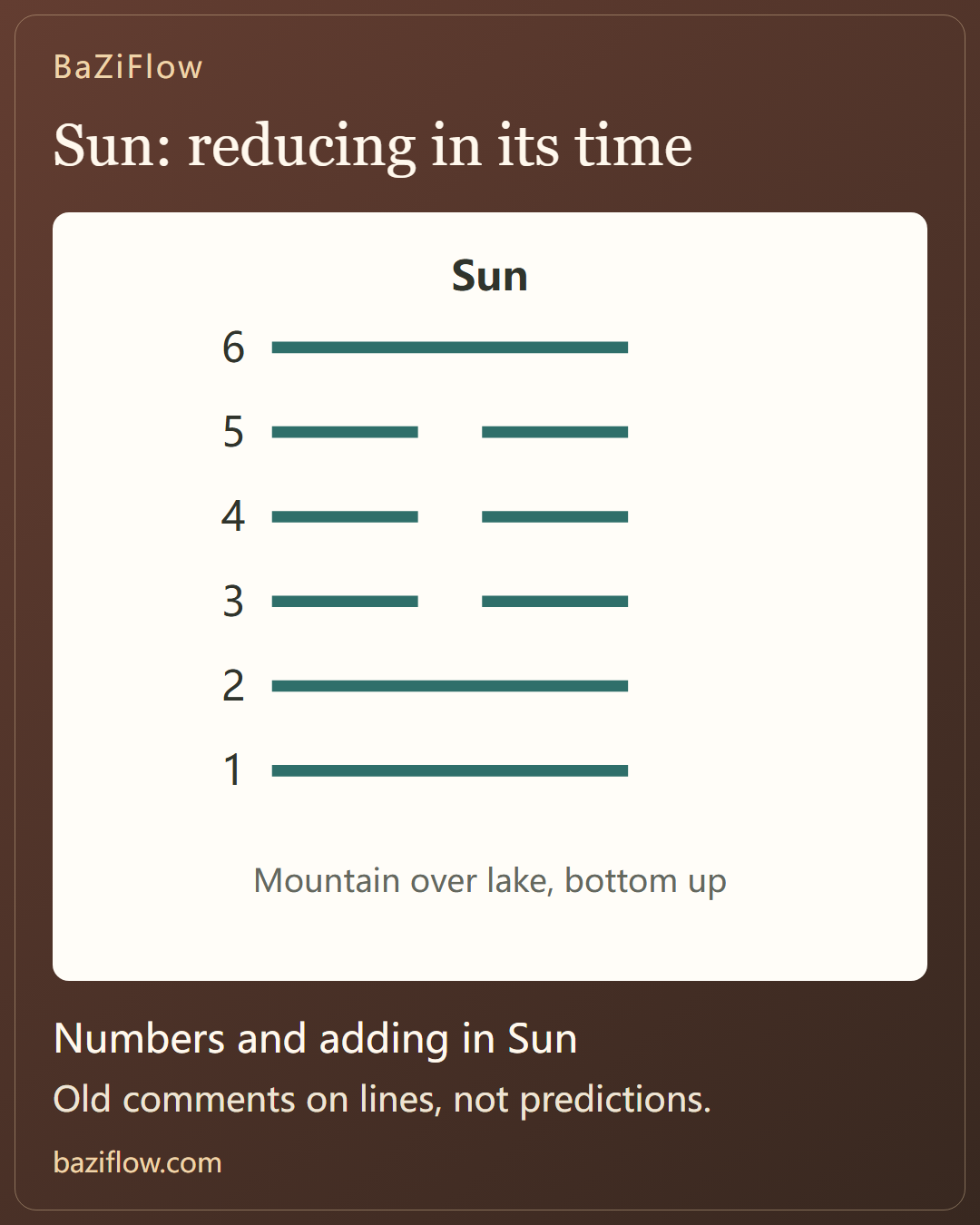
Sun (損) is the 41st hexagram: Gen (mountain) above Dui (lake). Read the judgment’s two bowls, “reduce the lower, add to the upper”, the counting in its lines, and the three lines that say “add”.
The short version6 min read
Sun keeps counting: two bowls, three people traveling, one person traveling, ten peng of tortoise shell. Along the way three of the six lines turn out to say “add”, and the last one reads: without reducing, he adds.
- Sun stacks Gen (mountain) on Dui (lake). Against Tai only lines 3 and 6 change polarity, so the lower trigram loses a yang line and the upper gains one, which fits the Commentary’s “reduce the lower to add to the upper”.
- The judgment asks and answers: “What is to be used? Two bowls may be used for the offering.” The Commentary adds that the bowls answer to the time. The Image has two verbs with two objects: curb anger, block desire.
- Line 3 says “three travel and one is lost; one travels and finds a friend”. Lines 2, 5 and 6 each mention adding, and the top line ends: without reducing, he adds.
Read first
The Sixty-Four Hexagrams: How Upper and Lower Trigrams Form One Figure ↗
Judgment and Line Statements: Whole Hexagram or Single Line? ↗
A lake under a mountain: stopping above, pleasure below
The upper trigram of Sun (損) is Gen (mountain) and the lower is Dui (lake). In the Shuo Gua Gen stands for stopping and Dui for being pleased. From the bottom the lines are yang, yang, yin, yin, yin, yang: yang in the two lowest places and in the topmost, with three yin lines running between.
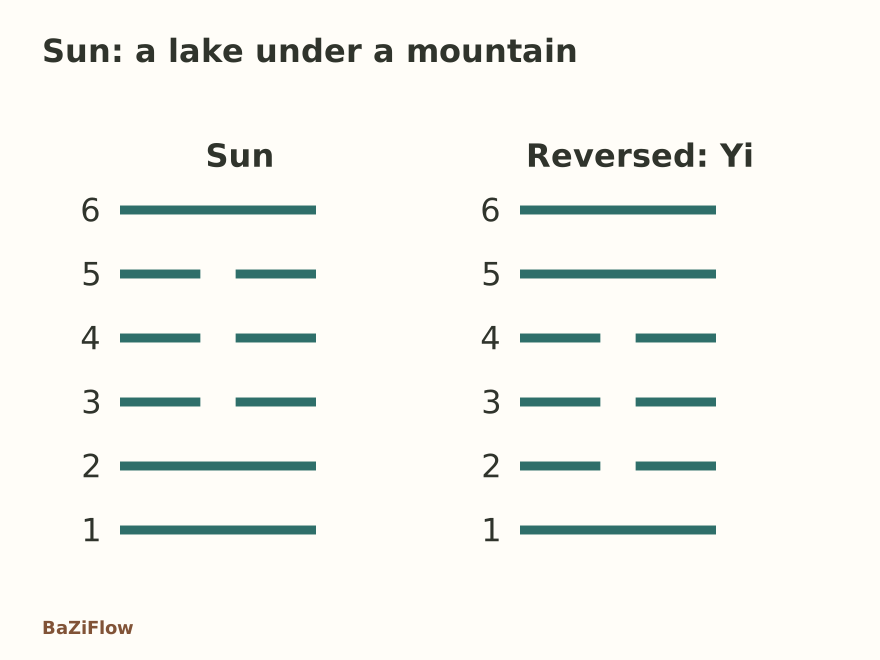
Sun and its reversed hexagram Yi: turned upside down, the Gen above Sun becomes the Zhen below Yi, and the Dui below Sun becomes the Xun above Yi.
Enlarge diagram · scroll sideways to read
Three words: reducing, bowl, sincerity
- Sun
- Literally, to reduce or to lose. In the order of the sixty-four it stands right after Xie and right before Yi.
- Bowl
- The gui, an old vessel for millet, used at offerings. The two bowls of the judgment are two such vessels.
- Sincerity
- The “having sincerity” that opens the judgment. “Supreme good fortune” and “no blame” follow after it.
The judgment and the Commentary: two bowls, and reducing in its time
The judgment of Sun asks and answers: sincerity, supreme good fortune; no blame, it can be held to, fitting to have somewhere to go. What is to be used? Two bowls may be used for the offering. The question is what to use, and the answer is that two vessels will do.
Sun means reducing the lower to add to the upper, and its way goes upward. … The two bowls answer to the time. Reducing the firm and adding to the soft has its time. Reduction and increase, fullness and emptiness, move together with the time.
“Reducing the lower to add to the upper” can be counted on the figure. Set Sun beside Tai (Qian below, Kun above) and only the third and top lines differ: line 3 is yang in Tai and yin in Sun, and the top line is yin in Tai and yang in Sun. The lower trigram has lost a yang line and the upper has gained one.
Enlarge diagram · scroll sideways to read
The second half of the Commentary puts the weight on timing. “The two bowls answer to the time”: even two vessels depend on the moment. “Reducing the firm and adding to the soft has its time”: both reducing and adding have a time. The last clause sets reduction beside increase and fullness beside emptiness, and says they all move with the time.
The Great Image: curb anger, block desire
The Great Image (大象) of Sun reads:
Beneath the mountain there is a lake: Sun. The noble person curbs anger and blocks desire.
“Beneath the mountain there is a lake” follows the figure. The noble person’s conduct falls into two pairs: curbing goes with anger, blocking with desire. To curb is to hold in check and to block is to stop up; anger is wrath and desire is craving.
Enlarge diagram · scroll sideways to read
Gen’s “stopping” and Dui’s “pleasing” can be set beside these two verbs: the upper trigram is about stopping, the lower about pleasing, and “curb” and “block” are both ways of stopping, with wrath and craving as what is stopped.
Six lines: the numbers, and the “adding” inside Sun
Numbers turn up in several places in the text of Sun: the “two bowls” of the judgment, the “three people” and “one person” of line 3, the “ten peng” of line 5.
Enlarge diagram · scroll sideways to read
Line 1 reads “weigh it and reduce it”: to weigh is to measure before cutting. Some versions read the line’s “sacrificial business” as “once the business is done”, and the Small Image has exactly that: “once the matter is done, going quickly”. Line 2 says “not reducing, he adds to it”: no cutting, and the Small Image says the middle is his aim.
Line 3 is the plainest count: “when three people travel, one is lost; when one travels, he finds a companion.” The Small Image has one comment: “when one travels, three would breed doubt.” Count it out and three minus one is two, and one plus a companion is two, the same number as the two bowls of the judgment.
Line 4 reads “he reduces his ailment”, what goes is an illness, “and brings joy quickly”, and the Small Image agrees: it is a joy. It is the only reduction in the six lines that the text plainly calls cause for joy.
The second thread is “add”. Three of the six statements mention it: line 2 “not reducing, he adds”, line 5 “someone adds”, line 6 “not reducing, he adds”. For a hexagram named reduction, the last statement is about not reducing but adding, and the Small Image says he “greatly gains his aim”. Its closing words “he gains retainers and has no household” are read in different ways.
Xian, Fu and Yi: neighbors of Sun
Turn Sun upside down and you get Yi, so Yi is the reversed hexagram (综卦) of Sun (see the figure above). In the Xu Gua’s account, Sun follows Xie because loosening costs something, and Yi follows Sun because reduction that never stops can only turn into increase. The Za Gua has a single line for the pair: they are the beginning of flourishing and decline.
The inverse hexagram (错卦) is Xian (咸), and it uses the same two trigrams as Sun, Gen and Dui, with their places exchanged: Sun is Gen above Dui, Xian is Dui above Gen. The nuclear hexagram (互卦) takes the inner lines in two groups: the lower group, lines 2 to 4, is yang, yin, yin, which makes Zhen, and the upper group, lines 3 to 5, is all yin, which makes Kun. Zhen under Kun is Fu (复).
Enlarge diagram · scroll sideways to read
Questions readers ask next
Is Sun saying that taking a loss is better?
The judgment opens with “sincerity: supreme good fortune” and does not rate reducing itself as good or bad. The Commentary puts the weight on timing: the two bowls answer to the time, and reduction and increase, fullness and emptiness, move with it.
What is a “bowl”, and why two?
The word is gui, an old vessel for offering millet at a sacrifice. The text only says that two bowls may be used for the offering; it does not say why two, and the Commentary adds only that they answer to the time.
Does the line “someone adds to it; ten peng of tortoise shell could not refuse” occur elsewhere?
Yes. The same sentence appears again in line 2 of Yi, one in Sun and one in Yi, and the two hexagrams are each other’s reversed hexagram. A peng is an old unit for counting cowries, the shell currency.
Was this article helpful?
Sources & references
Continue reading
Xie: thunder and rain arise, from “coming back is fortunate” to “the duke shoots a hawk” ↗
Yi (益): wind over thunder, from “from above to below” to “no one adds; someone strikes” ↗
The Sixty-Four Hexagrams: How Upper and Lower Trigrams Form One Figure ↗
Judgment and Line Statements: Whole Hexagram or Single Line? ↗