

Keep hidden entries at their sourced positions
Content version · · Sources & references
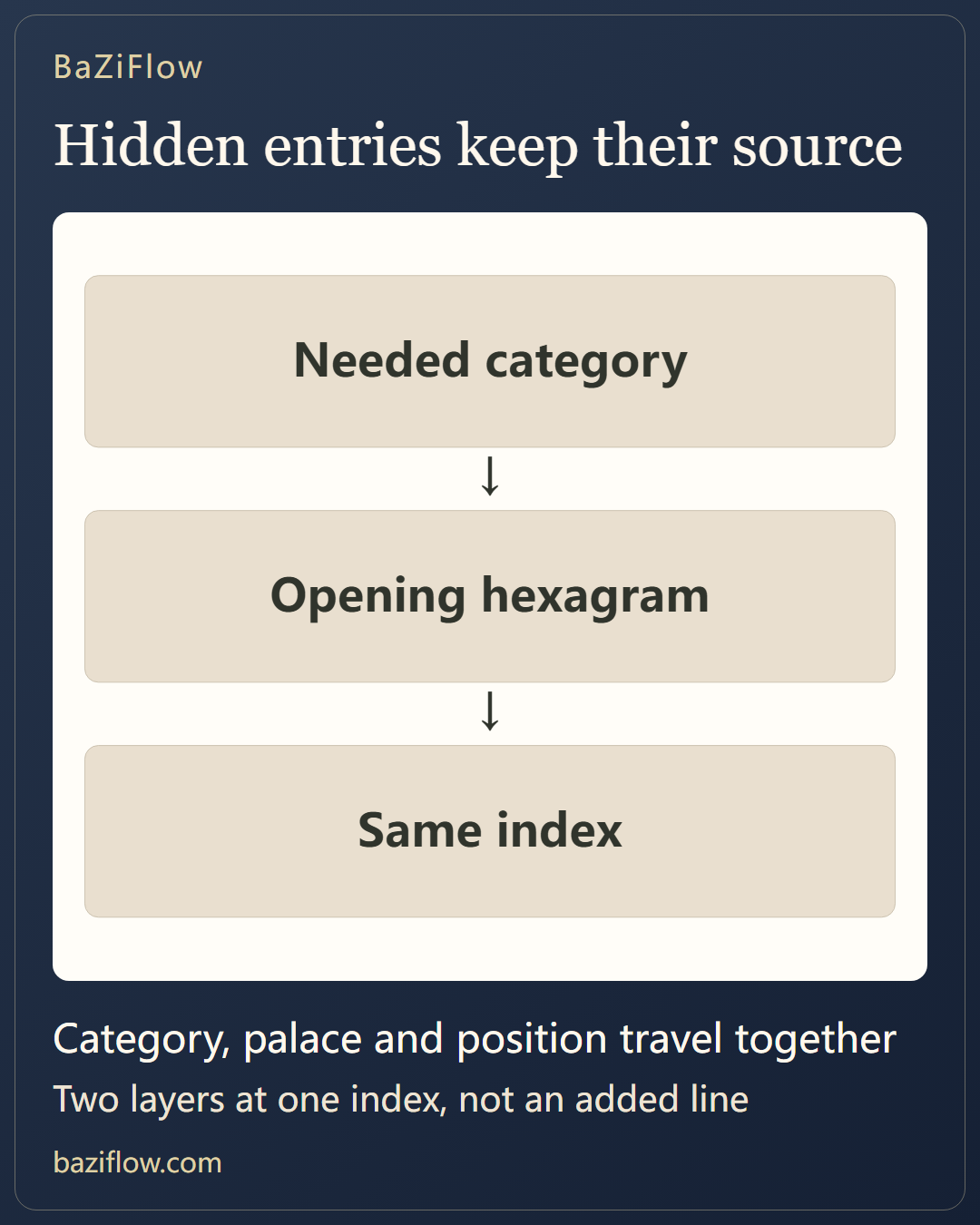
Use Gou and Dun in the Qian palace to locate two hidden entries, compare generating and controlling pairs, and preserve the texts’ different methods.
The short version6 min read
Gou’s missing Wealth points to Tiger Wood at Qian’s second line; Dun’s missing Descendants points to Rat Water at its first. Visible Pig Water generates the former, while visible Dragon Earth controls the latter. One palace can supply different targets and positions.
- Check the needed category and visible absence before consulting the opening hexagram under the chosen method.
- Flying and hidden entries share one index; Gou’s second and Dun’s first position remain distinct and add no seventh line.
- Separate provenance, phase relation and effective conditions while retaining the texts’ differing wider practices.
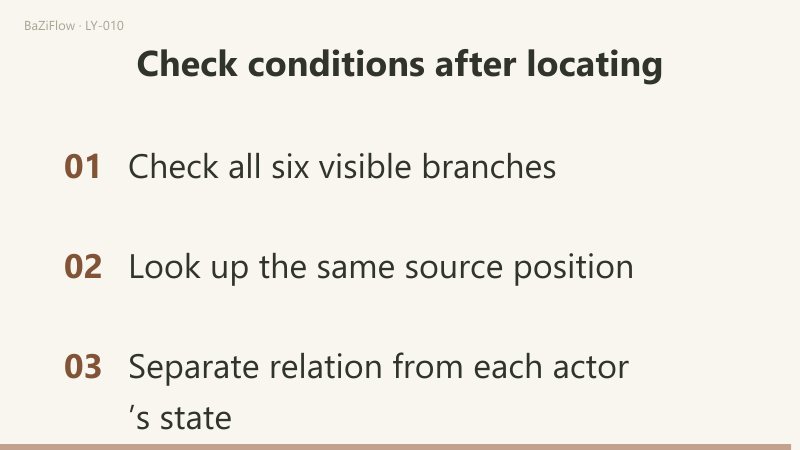
Read first
Najia, Six Relatives, and Six Spirits: three chart layers ↗
Choosing the useful god: define the subject and retain candidates ↗
Record where a hidden entry came from
A hidden spirit in the Liuyao method discussed here is a derived chart entry, not an invitation to invent an unseen person or object. The derivation needs a named method, a palace reference, and a line position. Without those, the word “hidden” explains very little.
Under the home-palace method, a needed relative category is absent from the visible lines and the relevant preliminary checks have been made. The reader consults the palace's opening, pure hexagram to locate that category. Its entry is placed beneath the same position in the original chart. The visible line at that position is called the flying spirit; the derived entry beneath it is the hidden spirit.
“Beneath” is a notation layer, not an extra seventh line or the next lower position. It also does not mean that the visible line changed into the hidden one. Najia and the six relatives supplies the palace-based reference used in the examples below.
Gou: a missing Wealth category leads to position two
Heaven over Wind, Gou, belongs to the Qian Metal palace. Its visible branches from bottom to top are Ox (丑) Earth, Pig (亥) Water, Rooster (酉) Metal, Horse (午) Fire, Monkey (申) Metal, and Dog (戌) Earth. Relative to Metal, Wood is the controlled phase and therefore the Wealth category. No Wood branch appears among these six visible entries.
The missing category is a property of this chart, not proof that real-world money or a person does not exist. The selected object must first be justified by the question; see choosing the useful line. A reader cannot choose an absent category merely to obtain a more dramatic hidden story.
Zengshan Buyi's flying-and-hidden chapter first considers the day and month when the useful category is not visible. It turns to the palace's opening hexagram when those do not supply the required object under its approach. Our exercise gives no day or month, so it demonstrates the lookup itself rather than claiming that this entire selection process has already been completed.
The opening hexagram of Gou's palace is pure Qian. Its second line is Tiger (寅) Wood, classified as Wealth against the Metal palace. Place that entry beneath Gou's second line, Pig Water. Pig Water is the flying spirit, Tiger Wood the hidden spirit, and Water generates Wood. The relationship is flying generating hidden.
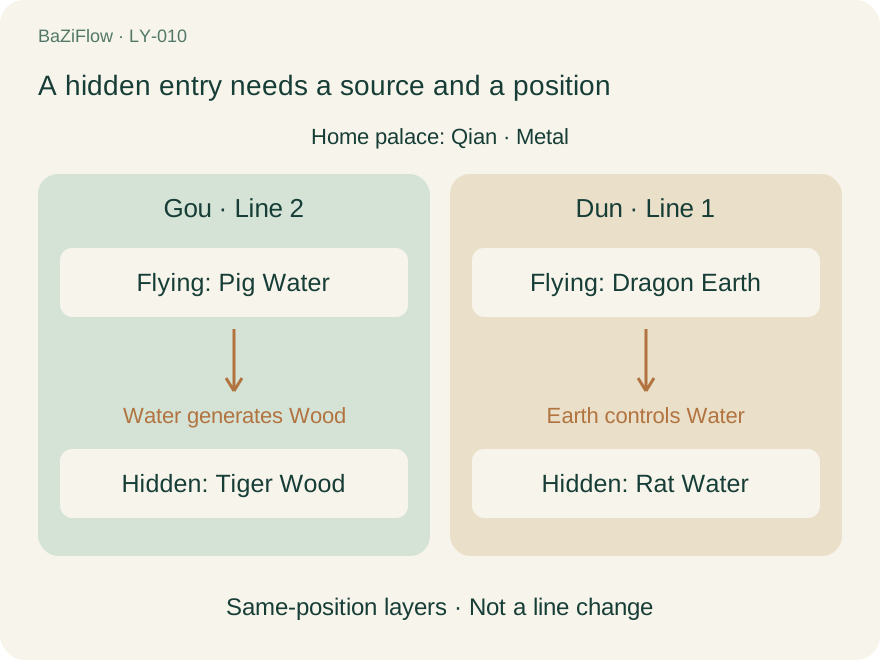
BaZiFlow same-position layer diagram. The lower box is a palace-derived reference, not an added line or a changed counterpart.
Position 2
Dun: the same palace produces a different hidden pair
Heaven over Mountain, Dun, also belongs to the Qian Metal palace. Its visible branches are Dragon (辰) Earth, Horse Fire, Monkey Metal, Horse Fire, Monkey Metal, and Dog Earth. None is Water. Because Metal generates Water, the missing category in this exercise is Descendants.
Pure Qian supplies Rat (子) Water at its first line. Place that Rat Water entry beneath Dun's first line, Dragon Earth. Dragon Earth is now the flying spirit and Rat Water the hidden spirit. Earth controls Water, so the relation is flying controlling hidden.
| Original chart and needed category | Source in pure Qian | Visible covering entry | Phase relation |
|---|---|---|---|
| Gou, Wealth | Line 2: Tiger Wood | Line 2: Pig Water | Water generates Wood |
| Dun, Descendants | Line 1: Rat Water | Line 1: Dragon Earth | Earth controls Water |
Both examples retain the Metal palace reference, but they seek different categories at different positions. Remembering that Qian contains Tiger Wood is not enough: adding that same branch whenever any category is missing would erase the reason for the lookup.
The comparison also prevents a misleading metaphor. A flying spirit is not automatically an obstacle merely because it is drawn above the hidden entry. In Gou it generates the hidden Wood; in Dun it controls the hidden Water. The relation must be calculated, not inferred from the page layout.
Position 1
Locating a hidden entry does not establish its effectiveness
The source chapter discusses support from the day, month, moving lines, or the flying spirit, as well as the hidden entry's own strength. It also discusses conditions of the flying line that may allow the hidden one to become usable. Conversely, weakness or injury of the hidden line and control from a strong flying line can limit it.
Those are conditions on distinct actors. A flying line being void does not make the hidden line void; a weakened flying line does not itself prove that the hidden line has adequate support. A record should preserve both states and the relationship between them.
Our examples determine two positions and two phase relations. Without calendar and movement details, they do not establish a successful or unsuccessful real-world result. Cycle void and month break explains why later state labels also need separate evidence. A phrase such as “the hidden line will emerge” is incomplete unless it identifies the conditions and the object under discussion.
Flying entry
- Its own calendar state
Hidden entry
- Its own calendar state
The texts agree on a lookup but differ over wider practice
The Bushi Quanshu passage preserved in the imperial encyclopedia likewise places Qian's inner branches beneath Gou's corresponding inner positions. That supports the same-position lookup used here. The passage also records an exchange method in which pure Qian seeks hidden entries in Kun and pure Kun in Qian.
Zengshan Buyi reports and rejects such cross-palace searching. Later in the same chapter, its author explains a preference for additional casts and even says that he does not directly use hidden spirits when the useful object fails to appear. An honest account must retain that reservation alongside the chapter's earlier teaching examples.
This article therefore does not merge every passage into a supposed unanimous rule. It teaches the explicit Gou and Dun lookups, identifies the wider exchange method as a different approach, and does not convert the author's repeated-casting practice into advice to cast until a pleasing answer appears.
Finally, keep hidden and changed entries separate. A hidden entry is located through a palace reference; a changed counterpart is calculated from an actual moving position. The source itself criticizes an example that calls a changed Officials/Ghosts line hidden. Even if the resulting branch and category happen to match, their provenance differs. Neither a shared name nor a second column licenses rewriting the original six-line record.
Hidden
- Palace reference
Changed
- Actual movement
Questions readers ask next
Does beneath line two mean at the bottom line?
No. Beneath describes an annotation layer, not a lower index. Put the visible and hidden entries in separate columns of one row to check this. Changing the position from two to one would alter the lookup rather than merely its display.
Can two Qian-palace charts reuse one hidden target?
Only after checking the requested category and source position. A common palace supplies the phase reference, not the missing object automatically. Inserting familiar Tiger Wood into every gap would confuse a Descendants lookup with a Wealth lookup.
Can identical hidden and changed branch names be merged?
Identical names do not establish identical derivation. A palace lookup and an actual line transformation require different evidence. Record any textual match while preserving both paths, so a hidden annotation cannot manufacture movement in a still line.
Was this article helpful?
Sources & references
Continue reading
Moving lines and changed counterparts: auditing Xu to Song ↗
Cycle void versus month break: two independent calendar tests ↗