

Images, numbers and meaning
Content version · · Sources & references
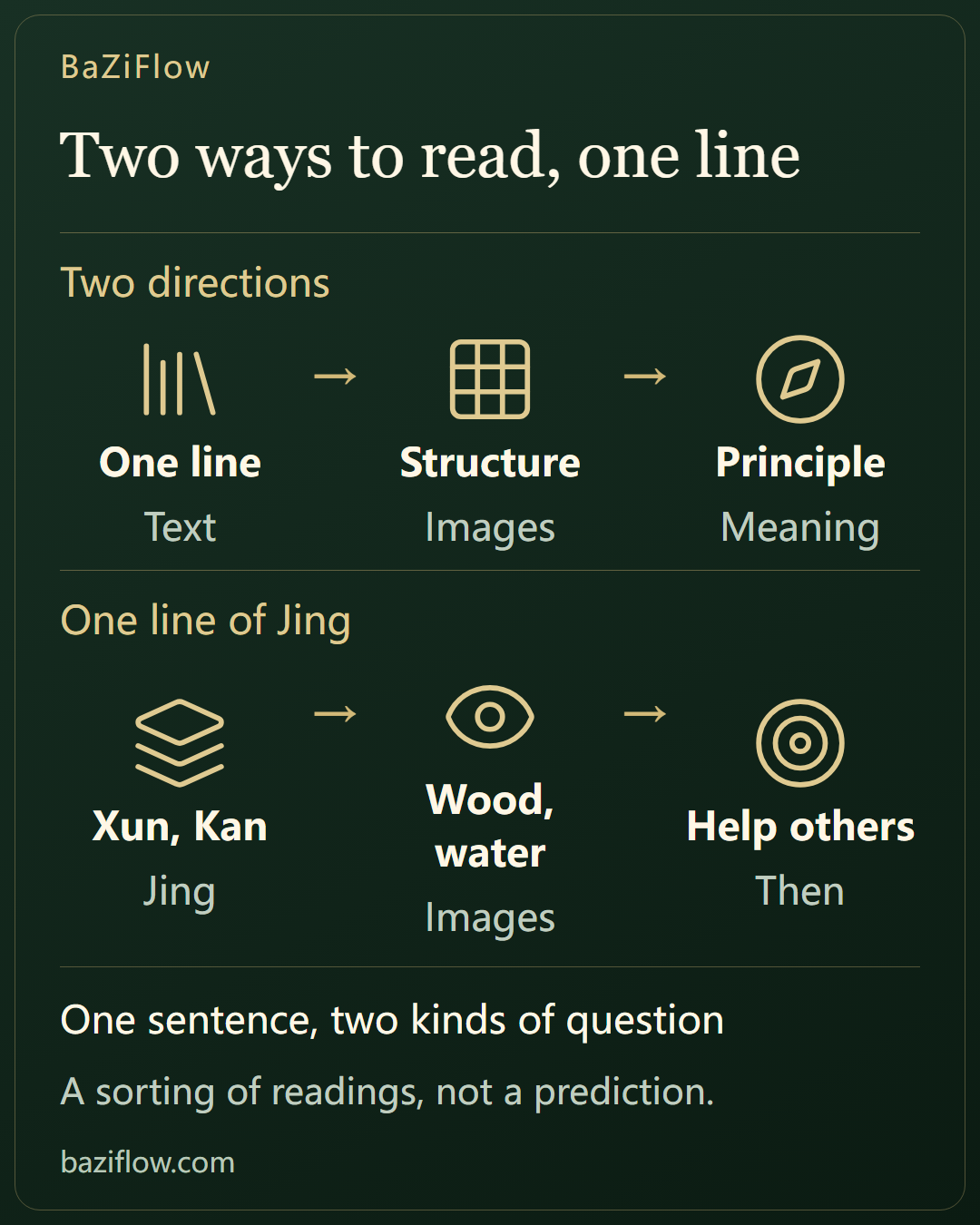
Readers of the Zhou Yi ask about structure or about principle. A Commentary on the Images sentence on Jing, two passages by Kong Yingda and Wang Bi's "Ming Xiang" show the two directions crossing, not competing.
The short version10 min read
A line of the Zhou Yi can be asked two kinds of question: how the lines and trigrams are arranged (images and numbers), and what principle the words state (meaning). Both often land on one sentence.
- Images and numbers look at lines, trigrams, imagery and counts; meaning looks at what the words say and how to conduct oneself. They are two directions of reading, not two books.
- "Two schools, six lines of descent" comes from the Qing-dynasty Siku Quanshu Zongmu: a later catalogue sorting earlier commentators, not wording from the Zhou Yi.
- On Jing, Kong Yingda first splits the hexagram into two trigrams and cites the Shuo Gua, then explains nourishing the people: one commentator, two kinds of question.
Read first
One sentence, two kinds of question
A line of the Zhou Yi (周易) invites two kinds of question. One asks about structure: which hexagram is it, which trigrams make it, how many yang and yin lines, what image is used. The other asks about principle: what is the sentence saying, why does it say so, and what does it mean for conduct.
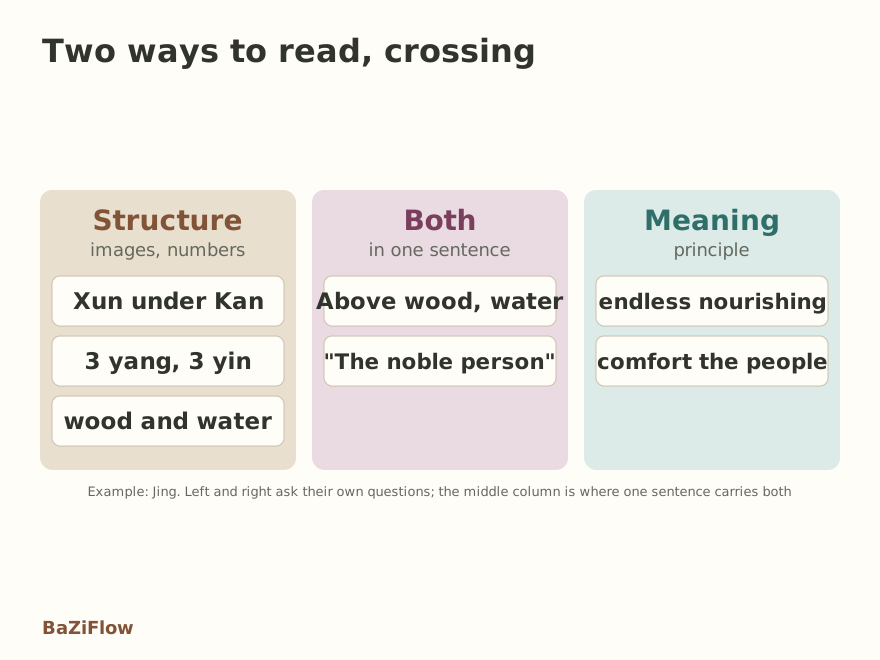
Reading sketch with Jing as the example: left and right each ask their own question, and the middle column is where one sentence carries both.
The first kind is usually called "images and numbers" (象数), the second "meaning and principle" (义理). The figure takes Jing (井) as its example: the left column asks about structure, the right column about principle, and the middle column is where they meet. The Commentary on the Images (象传) reads "Above the wood there is water: Jing. The noble person accordingly comforts the people and urges them to help one another." The first half gives the image and the second half what to do, so one sentence carries both layers.
What each direction asks
Asks about structure
Images are the figure and its imagery: Jing is Xun (巽) below and Kan (坎) above, with water over wood. Numbers are counts, and only the simplest kind is taken here: Jing has three yang lines and three yin lines, and its line names carry Nine and Six.
Asks about principle
What the words say, their reasoning and the conduct they suggest: Jing nourishes without end, and the noble person comforts the people and urges mutual help.
How Nine and Six build a line name is in Line positions: Initial to Top. Both terms appear in the Qing catalogue Siku Quanshu Zongmu, our next stop.
How the Siku catalogue describes the two paths
The Siku Quanshu Zongmu (四库全书总目) is a catalogue of books compiled in the Qing dynasty. Its short preface to the section on the Changes puts earlier commentators in order and uses the phrase "two schools, six lines of descent". That is later people sorting earlier ones, not wording from the Zhou Yi. A passage of the preface:
The Han scholars spoke of images and numbers, and they were not far from antiquity. With the first change came Jing (京) and Jiao (焦), who drifted into omens; with the second came Chen and Shao, who set themselves to exhaust creation and transformation. The Changes were by then of no use to the people. Wang Bi set images and numbers aside entirely and explained with Laozi and Zhuangzi. With one change came Hu Yuan and Master Cheng, who first brought out Confucian principle; with a second change, Li Guang and Yang Wanli, who also drew on the evidence of history, and the Changes day by day opened more arguments. These two schools and six lines of descent have already attacked one another.
Enlarge diagram · scroll sideways to read
The passage names six strands in order, each with its own phrase (see figure). The preface then states its editors' choice: "now, comparing the various schools, we take those who found their teaching on images as the main line". The standard has images in it, and it has teaching. The catalogue entries also name two images-and-numbers practices: the "nuclear body" (互体) in Zheng Xuan's notes on the Changes, and the "line-hour diagram" (爻辰) that the Qing scholar Hui Dong drew from them. How they are worked out is left aside.
The preface also sums up that "in all sixty-four hexagrams the Great Image has the words 'the noble person accordingly'". Checked against the text, the summary and the original do not match exactly:
Check: how the Great Images begin
"The noble person accordingly"
"Heaven moves with strength; the noble person accordingly strives without rest."
"The ruler accordingly"
"Heaven and earth interact: Tai. The ruler accordingly shapes the way of heaven and earth..."
Bi (比) and Fu (复) begin "the former kings accordingly", as shown below. A summary is convenient, but a citation has to go back to the original. The general preface to the classics section, speaking of classical studies as a whole, has this line:
Dissolve the walls between schools and take what each does best, and private feeling is cleared away and common principle emerges; when common principle emerges, the meaning of the classics becomes clear.
Taking that sentence as it stands, the editors' attitude is to take the best of each, not to choose a side.
Jing: two layers in one sentence
Take Jing (井) first. Its lower trigram is Xun (巽) and its upper trigram is Kan (坎). The sentence on the whole hexagram in the Commentary on the Images, usually called the Great Image (大象), is:
Above the wood there is water: Jing. The noble person accordingly comforts the people and urges them to help one another.
Enlarge diagram · scroll sideways to read
The Commentary on the Images is one of the Ten Wings; what each part looks at is in Reading the Ten Wings. Structure can be checked item by item: three yang lines, three yin lines. The image can be checked against chapter 11 of the Shuo Gua (说卦), which has "Xun is wood" and "Kan is water"; water above and wood below also fits the position in "above the wood there is water". Where these entries come from is covered in The eight trigrams: structure and images.
The subcommentary on this one hexagram holds both kinds of reading:
Kong Yingda on Jing: one commentator, two readings
Naming from two trigrams
"Here Kan is water above and Xun is wood below, and Xun is also entering; wood enters water and again draws water up, which is the image of Jing."
From the nature of a well to what to do
"What Jing means is drawing and nourishing without end; the noble person, with the kindness of comforting, attends to the people's hidden troubles and urges and helps them to complete their work, and that is nourishing without end."
Both come from Kong Yingda's Tang-dynasty subcommentary on Jing in the Zhou Yi Zhengyi. The first splits Jing into two trigrams and draws on three Shuo Gua entries: Kan is water and Xun is wood (chapter 11), and Xun is entering (chapter 7). The second no longer discusses how the lines are arranged and turns to what the image means for people. The Commentary on the Judgments pairs them in one sentence: "Xun with water, and water above: Jing; Jing nourishes without end." A trigram name and an image word come first, the nature of a well second.
Wang Bi's "Ming Xiang": how words, images and meaning connect
Wang Bi of the Wei wrote an essay, "Ming Xiang" (明象, "Making the Images Clear"), in his Zhou Yi Lüeli (周易略例). It leans toward meaning and principle, and it discusses how words, images and meaning relate.
Enlarge diagram · scroll sideways to read
The image is what brings meaning out; words are what make the image clear. To exhaust meaning nothing is better than the image, and to exhaust the image nothing is better than words. Words are born of the image, so one can follow the words to see the image; the image is born of meaning, so one can follow the image to see the meaning. ... Words are what make the image clear: having got the image, forget the words. The image is what holds the meaning: having got the meaning, forget the image. It is like the snare, which is for the hare: having got the hare, forget the snare; or the fish trap, which is for the fish: having got the fish, forget the trap.
The snare and the trap are tools for catching hare and fish, and they stand for words and images: once the aim is reached, the tool need not be gripped. This set of lines is often summed up as "getting the meaning and forgetting the image". He also says how an image should follow the meaning:
So a category may be taken as its image, and a matching meaning as its token. If the meaning lies in strength, why must it be a horse? If the category lies in yielding, why must it be an ox?
"Qian is a horse" and "Kun is an ox" are entries of Shuo Gua chapter 8. His point is that the image follows the meaning, so Qian need not be fixed to the horse.
Reading across: asking the same sentence twice
Turn this into an exercise: take one sentence of the Commentary on the Images, ask about structure, then principle, then what the other direction adds. Two more hexagrams to try:
Enlarge diagram · scroll sideways to read
- Images-and-numbers check: Shuo Gua chapter 11 has "Kun is earth", "Kan is water" and "Zhen is thunder", matching the upper and lower positions in "above the earth, water" and "thunder within the earth".
- Reading for meaning: what follows "accordingly" is what the former kings did in light of it. For Fu, the note in the Zhou Yi Zhengyi reads the day the text names (至日) as the two solstices, hence the cell above.
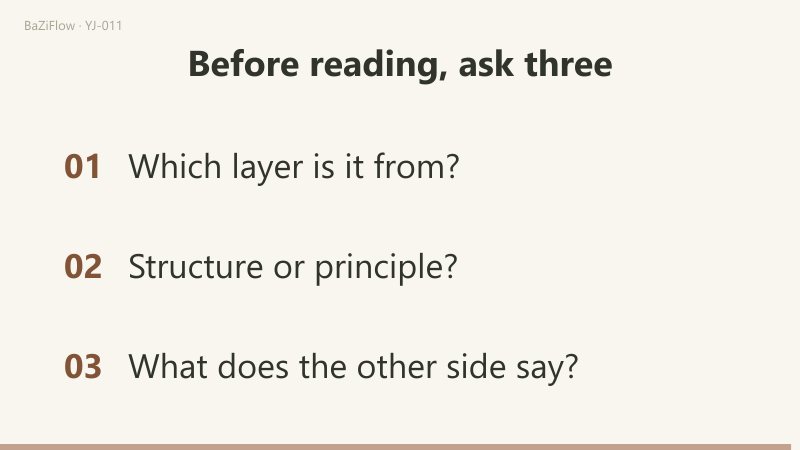
Which layer is the sentence from?
The core text, a Commentary on the Judgments or the Images, or a later note? Mark the layer first, then quote.
Structure, or principle?
The trigrams, imagery and counts, or what the hexagram means and what to do? One sentence may be both.
What does the other side say?
Having checked the structure, ask what reading it supports; having read the principle, look back for its basis in the structure.
Questions readers ask next
Images and numbers, meaning and principle: are they rival schools that I must pick between?
No. The catalogue does describe earlier commentators as "two schools, six lines of descent", yet where it speaks of classical studies as a whole it writes of taking the strengths of each side. A single line can be asked about structure first and principle second.
Does "getting the meaning and forgetting the image" mean the images can be dropped?
No. Wang Bi also writes "establish images to exhaust the meaning" in the same essay. What he criticises is fixing Qian to the horse and stacking method upon method; he is describing how words, images and meaning relate, not abolishing images.
Is what follows "the noble person accordingly..." in a Commentary on the Images a prediction?
It is not. The part after the word for "accordingly" says what a noble person may do in light of the hexagram's image, such as comforting the people and urging mutual help in Jing. It belongs to conduct, not to an outcome announced for some matter.
Was this article helpful?
Sources & references
Continue reading
Yijing, Meihua and Liu Yao: Shared Hexagrams, Different Methods ↗
Eight Trigrams: Three-Line Structure and Basic Images, Read Through the Shuo Gua ↗