

Look up birth-year transformations
Content version · · Sources & references
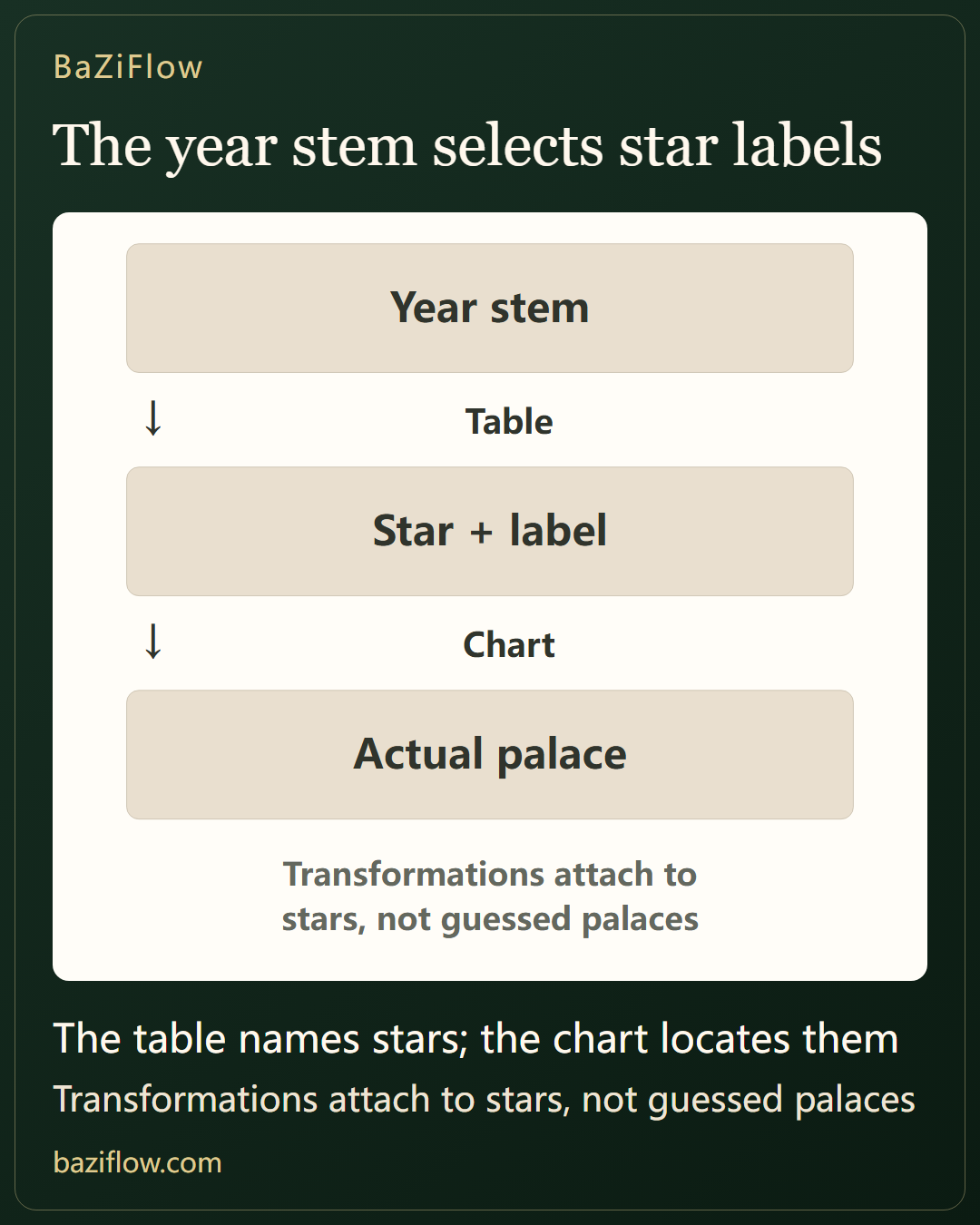
Learn what a birth-year stem selects in a Four Transformations table, why the selected stars still need chart positions, and how to record a real difference between two published tables.
The short version6 min read
The birth-year stem selects a table row; the row selects stars and labels; the individual chart supplies their locations. Yang Wood offers a complete four-item exercise. A Yang Water–Ke discrepancy shows why the source table and the origin of the stem must remain attached.
- Birth-year transformations use the year stem to select star-label pairs, then require the actual chart to locate those stars.
- Yang Wood selects Lian Zhen–Lu, Po Jun–Quan, Wu Qu–Ke and Tai Yang–Ji; sharing that row does not mean sharing the entire chart.
- For Yang Water–Ke, the cited classical transcription names Tian Fu and iztro names Zuo Fu; preserve two sources rather than merging them.
Read first
The fourteen major stars: learn the roster and its structure ↗
What the birth-year stem actually selects
For natal, birth-year transformations, first establish the year stem under the calendar convention being used. That stem selects a row of the chosen table. The row maps four transformation labels to stars: Lu, Quan, Ke and Ji. These labels attach to stars; they are not four additional members of the major-star roster.
There are therefore two tasks. The table tells you which star receives which label. The individual chart tells you where that star is located. Confusing those tasks leads to claims such as “Lu must be in the Wealth palace,” which the lookup alone does not establish.
People sharing the same year stem can share a row without sharing all their placements. Other birth information and charting rules contribute to the arrangement. A common mapping is a limited common input, not evidence for a common biography.
Transformations attach to stars, not guessed palaces
Follow the Yang Wood row without inventing a chart
Both references used here give the following Yang Wood mapping. No birth date or complete palace arrangement has been supplied for this exercise.
| Transformation label | Star selected by Yang Wood | Still to be obtained from the chart |
|---|---|---|
| Lu | Lian Zhen | Its actual palace |
| Quan | Po Jun | Its actual palace |
| Ke | Wu Qu | Its actual palace |
| Ji | Tai Yang | Its actual palace |
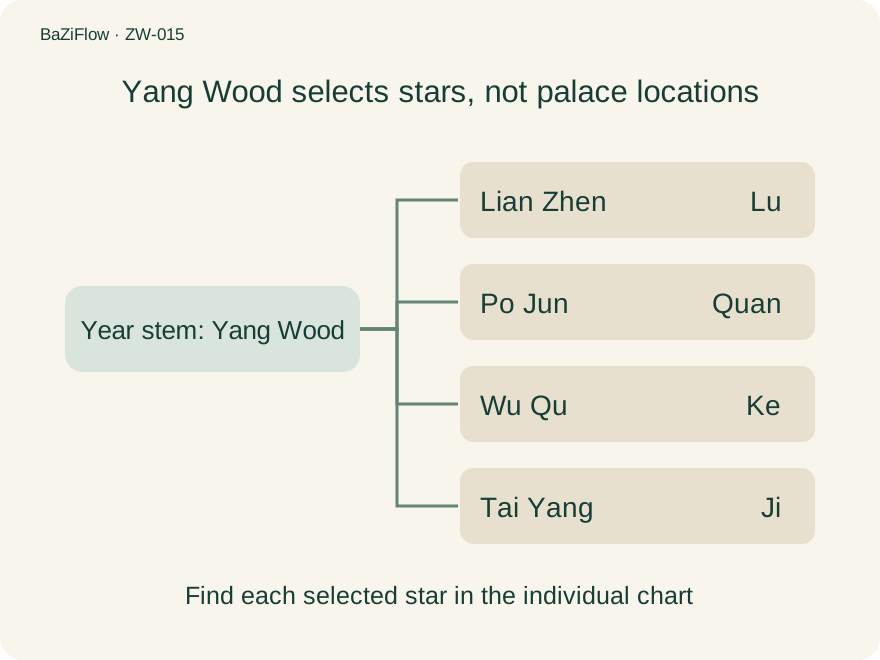
Original BaZiFlow lookup diagram. The cited classical transcription and iztro documentation agree on this Yang Wood row; other rows require separate comparison.
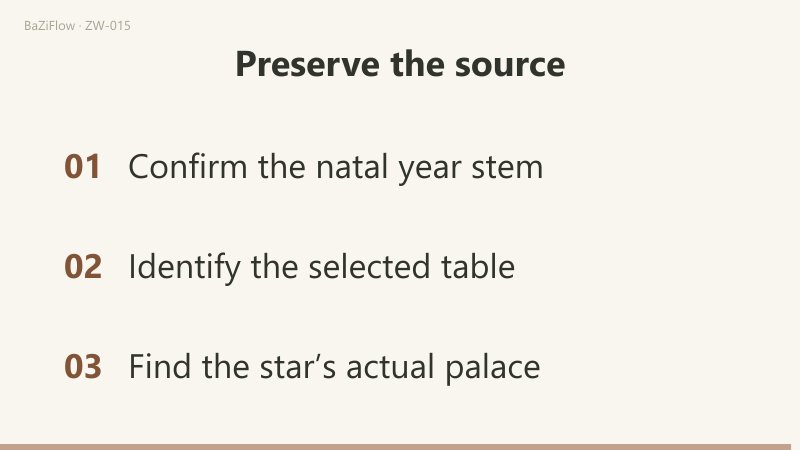
To complete a record for a real chart, find each named star and retain its actual location. Until then, leave the palace field unspecified. You cannot infer it from the transformation label's everyday associations.
Agreement on this row also does not eliminate the Yang Water discrepancy discussed next. Checking one example is a good first exercise; it is not verification of an entire table. If an application allows customised mappings, a documentation example of how to configure one must likewise be distinguished from the configuration actually in use. This article does not establish BaZiFlow's current application defaults.
Two sources can agree on a rule and disagree on an entry
A useful way to learn the Four Transformations is to compare references before interpreting a chart. The volume-two transcription of Ziwei Doushu Quanshu on Wikisource gives one set of instructions by birth-year stem. The modern iztro documentation also publishes a ten-stem table. Their Yang Wood row agrees, but a specific Yang Water entry does not.
In the Wikisource transcription, the third item of the Yang Water sequence identifies Tian Fu for Ke. In the iztro table read for this article, the Yang Water row lists Zuo Fu in the Ke column. This is a difference between two identified texts, not a claim about every edition of a classic or every practitioner. It shows why “using the traditional table” is not always a sufficiently precise record.
Do not resolve that discrepancy by marking both stars. That would create a new table rather than preserve either source. For a chart already produced under a named configuration, check it against that configuration. For a comparison of methods, retain two labelled results. The method choice belongs in the record.
Classical text
- Yang Water → Ke
- Tian Fu
iztro table
- Yang Water → Ke
- Zuo Fu
Read the label without turning it into an event
Translations such as prosperity, authority, distinction or obstruction may help introduce traditional associations, but they easily sound more concrete than the chart notation warrants. Lu is not a recorded windfall. Quan is not a confirmed promotion. Ke is not an admission letter. Ji is not a report that a disaster will occur.
The Ji label can be especially unsettling to a new reader. It supplies neither a probability of harm nor a date. Before considering any interpretation, determine the star, its palace and the source of the annotation. A threatening prediction based solely on the label has moved well beyond the lookup evidence.
Traditional authors and modern practitioners organise these symbols in different interpretive ways. You can study those ways while keeping their status clear. Successfully reproducing a table assignment demonstrates consistency with a selected rule. It does not independently validate a claim about someone's future.
Traditional label
- A table assignment
- Location still needed
Real event
- Not established here
- No probability or date
Make the source travel with the annotation
An incomplete but honest record might read: “Selected table: this reference; natal year stem: Yang Wood; Wu Qu receives Ke; Wu Qu's palace has not yet been checked.” When the full chart is available, add the location rather than replacing the whole note with a generic favourable statement.
If another layer also displays Ke on Wu Qu, make a separate entry for its origin. A palace-stem calculation and a birth-year calculation can use the same table machinery while starting from different stems. An annual annotation also needs its year and layer. See palace-stem versus birth-year transformations and natal, decade and annual layers for those distinctions.
Try reversing the process as a final exercise. Someone gives you only the phrase “Tai Yang with Ji.” Can you conclude that the person's natal year stem is Yang Wood? Not from that phrase alone: the table and the annotation's originating layer have not been identified. Restoring that missing context is more valuable than attaching another paragraph of interpretation to an ambiguous label.
Reverse the lookup in two stages. First constrain the question to the Yang Wood row in these two tables: which star receives Ke? Wu Qu. Which label attaches to Tai Yang? Ji. This reversal is well specified because the row has already been selected. Now remove the source and show only Tai Yang–Ji in a screenshot. Recognising the Yang Wood row does not establish a natal Yang Wood stem: a palace stem of Yang Wood can select the same pair.
The omitted words identify the stem’s role. A note such as “natal Yang Wood; this table; Wu Qu–Ke; location unchecked” preserves both the known mapping and the remaining task. Once Wu Qu is located, update that field without pretending that the year-stem mapping had supplied the palace all along.
Natal stem
- Origin still needed
- Tai Yang + Ji
Palace stem
- Origin still needed
- Tai Yang + Ji
Cycle stem
- Origin still needed
- Tai Yang + Ji
The same Yang Wood row can be selected at different origins.
Questions readers ask next
Does knowing Yang Wood as the year stem locate Lu in a palace?
No. The Yang Wood row selects Lian Zhen with Lu. Its position and palace topic must then be found in the individual chart. The word Lu does not place a star and cannot by itself fill in the Wealth palace.
Why do the two cited tables disagree on Yang Water–Ke?
The specified volume-two transcription gives Tian Fu as the third Yang Water item, while the cited iztro Ke column gives Zuo Fu. Record the textual difference without generalising to every edition or marking both stars in one result.
Does Tai Yang with Ji prove a natal Yang Wood year stem?
Only after the table and stem origin are identified could a relevant inference be tested. The Yang Wood mapping includes Tai Yang–Ji, but a display may show a palace-stem or cycle annotation. The star and label alone do not establish a birth-year source.
Was this article helpful?
Part of a learning path
Zi Wei: from palaces and stars to the Four Transformations · Step 5 of 5 available