

Secondary progression and solar arc
Content version · · Sources & references
Test what stays invariant when every natal point receives one solar arc, then contrast that operation with day-for-year positions. Check wraparound, mean arcs and angle methods before comparing software.
The short version6 min read
Secondary progression maps age to a symbolic date after birth and looks up each body separately. Solar arc adds one solar displacement to all natal points. The first permits different shifts; the second preserves internal angles, so their identically named bodies are not interchangeable.
- A day for a year is a symbolic date rule: secondary progression uses each body’s own ephemeris position, not one shared displacement.
- Solar arc adds the same shift to every point, preserving internal angles; comparison with a fixed natal point can still change.
- Declare true or mean arc, symbolic date and angle algorithm. About one degree a year is not a complete calculation setting.
Read first
A whole-chart reading needs an evidence trail ↗
One sky, different natal targets: how transits are compared ↗
Secondary progression does a different job
The usual secondary convention maps one day after birth to one year of life. At an illustrative age of 24 whole years, inspect the positions 24 days after birth. Each body gets its own position at that symbolic date. It is not required to travel the same distance as the Sun.
The Moon, Mercury and Saturn have different motions during that interval. A body's relevant ephemeris passage may also contain a station or retrograde movement. Accordingly, progressed-to-progressed aspects can change, unlike the internal differences in a uniform solar-arc rotation.
The day-for-year mapping is symbolic. The positions are drawn from an ephemeris at a different date; they are not the current positions at age 24. Transits use the actual observation-time sky, as explained in transits and the natal chart.
Fractional ages need a date convention and corresponding fractions of a day. An integer-age teaching example is not a complete software specification. Record the calculated symbolic date instead of assuming two programs must have used exactly the same date merely because they display the same age.
Secondary P
Solar arc SA
Age and angle use different units; 24 years need not give 24°
Where the common arc comes from
In the true-solar-arc method illustrated here, first calculate the secondary progressed Sun and establish how far it has moved forward from its natal longitude. TimePassages describes applying that solar displacement to the other natal planets. The resulting positions are directed positions, not the actual simultaneous sky at the target age.
Suppose the natal Sun is at 350° and the progressed Sun has moved forward through zero to 14°. The arc is 24°: ten degrees to the boundary, then fourteen more. A raw subtraction gives −336°, which is not the intended forward displacement in this short illustrative interval.
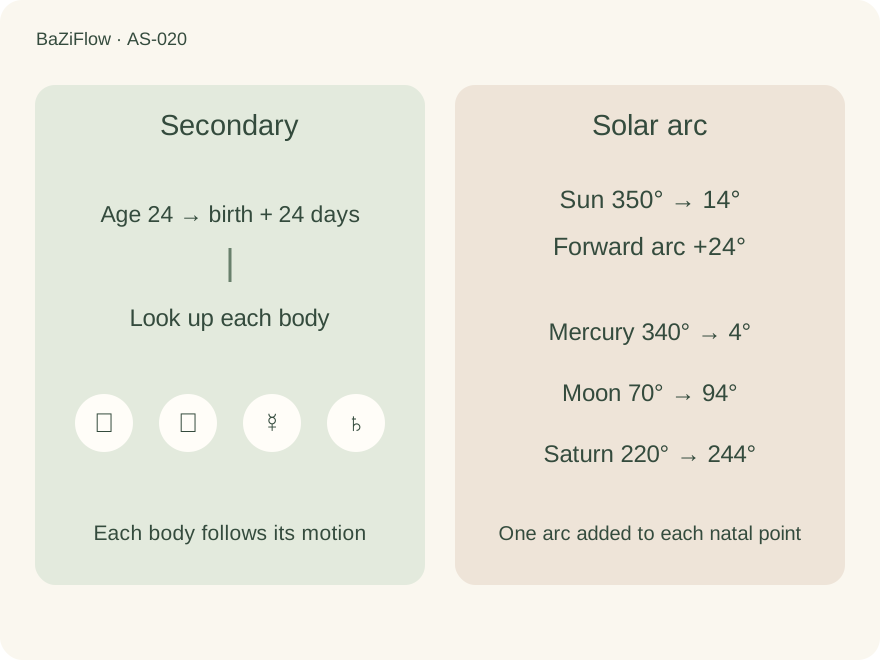
Original method comparison using constructed inputs, not a calculated chart for an actual person.
The 24° arc was chosen for arithmetic clarity. It is not proof that age 24 must produce an arc of exactly 24°. A real calculation needs the relevant solar positions and the stated timing convention. The diagram uses assumed positions without a birth date; it is a calculation exercise rather than an ephemeris extract.
Wraparound applies to every directed position. Mercury 340° plus 24° gives 364°, displayed as 4°. Failing to reduce that value would create an apparent mismatch at the zodiac boundary while leaving the underlying rotation concept unchanged.
Start with an invariant: a shared rotation preserves internal aspects
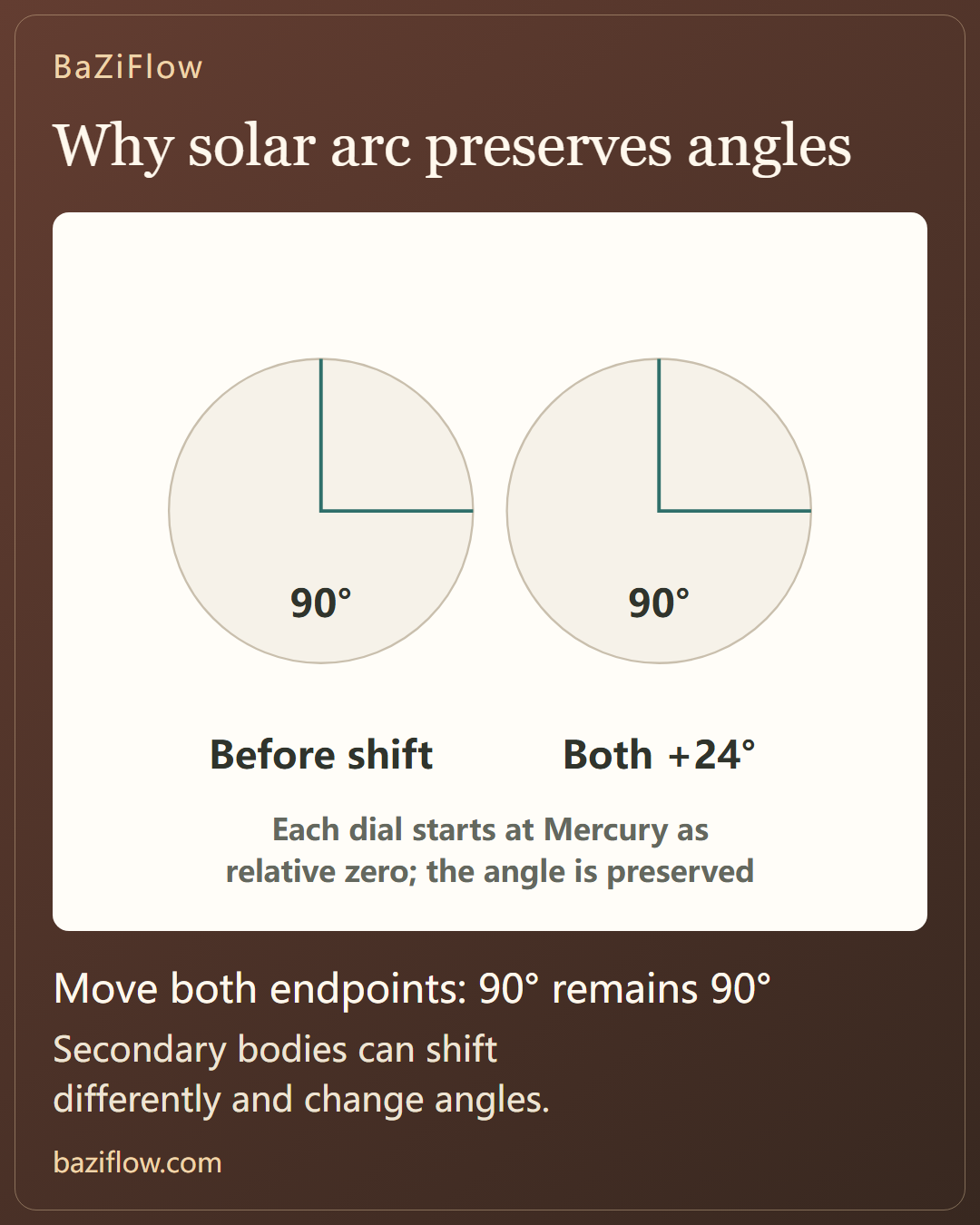
Take natal Mercury at 340°, the Moon at 70° and Saturn at 220°. Add the same 24° to every longitude, reducing values modulo 360°. The new positions are Mercury 4°, Moon 94° and Saturn 244°. Mercury–Moon remains a 90° separation; Moon–Saturn remains 150°.
That is a consequence of the operation, not a claim about astrology's effectiveness. When all points receive the same displacement, their differences remain unchanged. A solar-arc chart can therefore reproduce its natal internal aspect pattern without supplying a newly formed piece of evidence each year.
Compare a directed point with a fixed natal point and the result can change. Directed Mercury at 4° to natal Moon at 70° is 66°, whereas directed Mercury at 4° to directed Moon at 94° is 90°. The labels on both ends matter. Do not switch between directed-to-natal and directed-to-directed tables while treating their lines as the same relationship.
Before shift
N340° → N70°
Both +24°
SA4° → SA94°
Each dial starts at Mercury as relative zero; the angle is preserved
“About a degree a year” is not a sufficient settings record
A true solar arc and an arc based on a constant mean rate are different choices. Astrodienst's solar-arc documentation describes the Naibod mean rate of 0.98564733° per year. It should be identified as that method, rather than silently equated with either the true arc or a flat 1° rule.
For 24 years, the stated mean rate yields 23.65553592°. It differs from our constructed 24° arc by 0.34446408°. Rounding both to a rough whole-degree description hides a difference that can matter when comparing a close contact to a narrow allowance.
| Field | Why it belongs in the comparison |
|---|---|
| Target age and symbolic date | Establish which time mapping was used |
| Arc value and its derivation | Distinguish true, mean and other stated choices |
| Natal positions and zodiac | Preserve the actual starting coordinates |
| Angle and house method | Explain differences beyond planetary longitudes |
| Aspect endpoints | Separate progressed, directed and natal layers |
The presence of a mean-arc option does not show that an ephemeris is wrong. Nor does selecting the result that sounds more convincing resolve a numerical disagreement. First identify the operations that generated the numbers.
Illustrative true arc 24° · 24
23.5° ↔ 24.1°
- Mean arc · 23.65553592
- Assumed true arc · 24
24×0.98564733°=23.65553592°; difference 0.34446408°
Angles need their own method check
TimePassages separately explains that its progressed Ascendant is derived from a progressed Midheaven and that other products may use a different method. Thus matching progressed planetary longitudes does not guarantee matching Ascendants or house cusps. Keep that calculation choice visible.
This is not a license to explain every discrepancy away as a school difference. Verify the birth data, time handling, symbolic date, zodiac and precision first. If two outputs still disagree under genuinely identical inputs and methods, investigate the calculation rather than broadening the interpretation until both seem acceptable.
Uncertain birth time also remains uncertain when angles are progressed. Detailed numerical output cannot repair an unreliable starting angle. A reading should state the limitation at the relevant point instead of presenting an exact-looking date as a guaranteed life event.
Align birth inputs
Check time, place, time-zone handling and zodiac before comparing results.
Align timing rules
Keep the actual symbolic date and true or mean arc value, not only the integer age.
Inspect the angle algorithm
If planets match but angles differ, compare how the Midheaven and Ascendant were progressed.
Label both endpoints before interpreting
Use N for natal, P for secondary progressed and SA for solar arc if compact labels help. Keep T for transits separate. A claim about P Moon to N Sun is not interchangeable with SA Moon to N Sun. The whole-chart reading workflow can organize the background; the timing layer then needs its own stated rule. Clear differences in method should produce clear differences in the record, not two interchangeable paragraphs about change.
SA Mercury → N Moon
70° − 4° = 66°
SA Mercury → SA Moon
94° − 4° = 90°
Moving one side differs from moving both; zero is SA Mercury
Questions readers ask next
Does secondary progression move every body one degree per year?
No. It maps the age to a date after birth and looks up each body there. The Sun, Moon, Mercury and Saturn have their own motions, which may include stations or retrograde passages in the relevant interval.
Why does solar arc preserve the natal internal aspects?
Each longitude receives the same increment, which cancels when two positions are subtracted. This does not preserve every directed-to-natal aspect: that comparison moves only one endpoint.
Must one program be wrong if progressed Ascendants differ?
First compare birth data, time handling, symbolic date, zodiac and the angle algorithm. Different algorithms may differ legitimately; identical inputs and methods that still disagree require investigation.
Was this article helpful?
Sources & references
Continue reading
Solar returns: solve the time, then choose the chart location ↗
Saturn return: test the position before telling the life story ↗