

Kun (坤): from frost to fighting dragons
Content version · · Sources & references
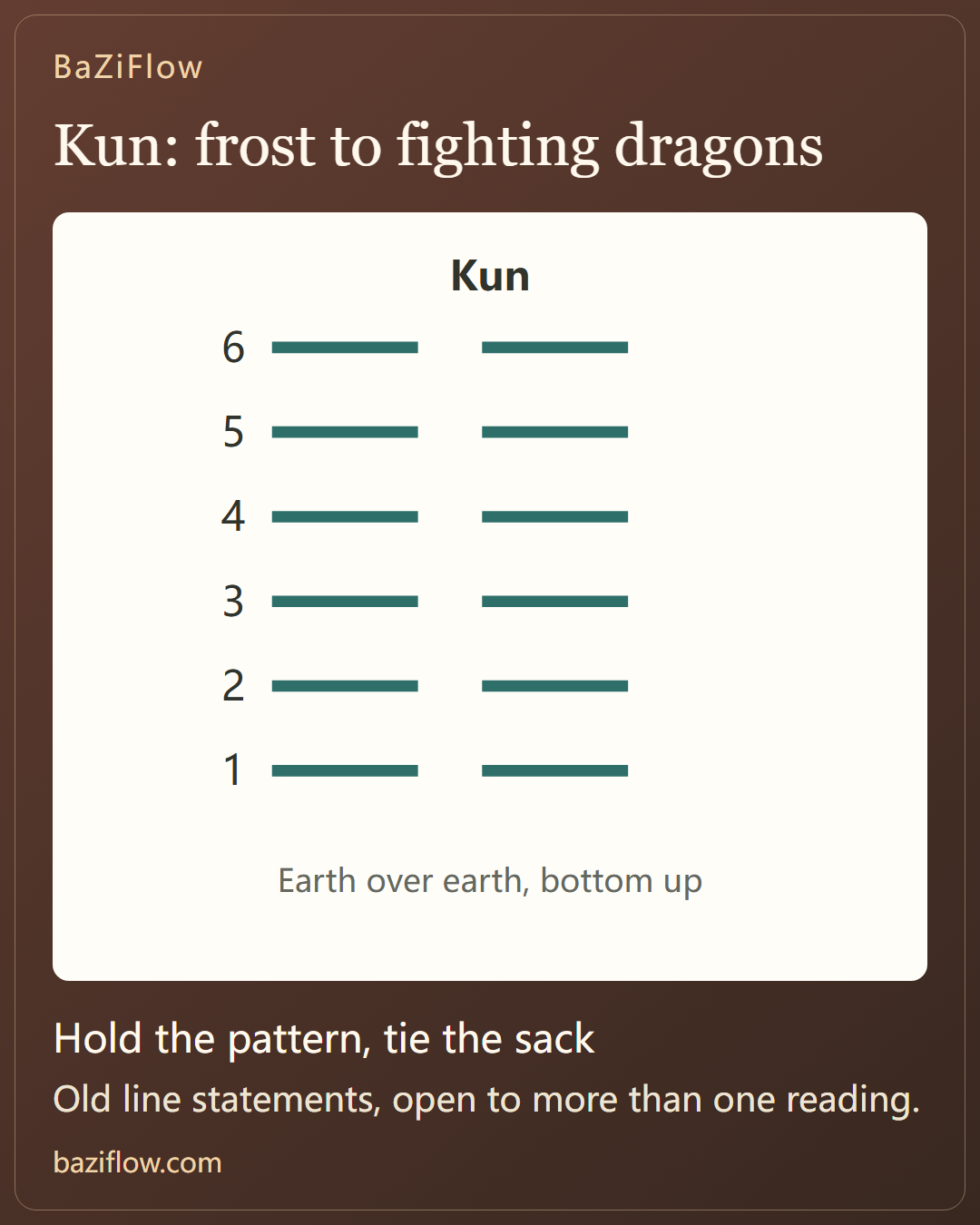
Kun is the second of the 64 hexagrams: six broken yin lines, with Kun (earth) as both trigrams. Read the mare and compass points of the judgment, the Great Image on carrying, and six lines from frost to blood.
The short version8 min read
Kun has one kind of line, the broken yin line, six of them. Its text keeps returning to two verbs, carrying and holding, and runs from the first frost underfoot to dragons fighting in open country.
- Kun stacks Kun (earth) on Kun (earth), so all six lines are yin. The Shuo Gua says "Kun is compliant", and the Great Image ends on carrying things with thick virtue.
- The animal in the judgment is a mare, which the Commentary on the Judgments files under "the earth's kind". The compass points read "southwest gain friends, northeast lose friends", and the passage closes on settled steadfastness: good fortune.
- The six lines are frost, straight-square-great, holding the pattern, a tied sack, a yellow garment and fighting dragons. "Using six" closes on being steadfast for good, and the Wenyan adds a passage to each of the six lines.
Read first
The Sixty-Four Hexagrams: How Upper and Lower Trigrams Form One Figure ↗
Judgment and Line Statements: Whole Hexagram or Single Line? ↗
Six broken lines: earth on earth
Kun (坤) is the second hexagram: six broken yin lines, named from the bottom first six, six in the second place, six in the third, six in the fourth, six in the fifth and top six. Both trigrams are Kun, so it reads as Kun above Kun: earth on earth. For this trigram the Shuo Gua offers the word "compliant" and then a long list of images, among them earth, mother, cloth, cooking pot, evenness, a cow with her calf, a big carriage, pattern, the multitude and a handle. It adds one more sentence: "on the ground it is black".
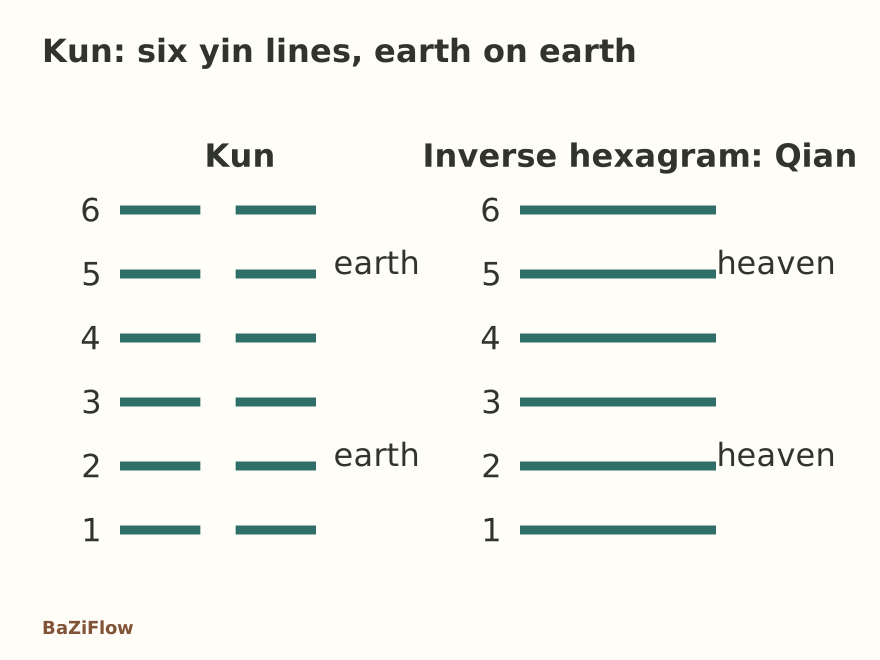
Kun and its inverse hexagram Qian: the inverse changes every line to the opposite polarity.
A few of these images find an echo in the hexagram's own text.
Enlarge diagram · scroll sideways to read
The first three rows are echoes. "Compliant" returns in the Commentary on the Judgments (彖传) as "follows heaven", and the big carriage, which carries people and goods, matches the Commentary on the Judgments, "Kun is thick and carries things". Pattern appears in the Small Image (小象) of line 5, which says "the pattern is within". The last row does not match: the Shuo Gua gives the cow to Kun, but the judgment says mare. The next section starts there.
The judgment: a mare, losing the way, southwest and northeast
Kun's judgment runs to three sentences, much longer than Qian (乾)'s. Here they are one at a time.
The three sentences of the judgment
A mare's steadfastness
"Primal and free-flowing. It is fitting to be as steadfast as a mare." The opening matches Qian's, then turns to the mare.
Lose the way, find a master
"When the noble person has somewhere to go, they first lose the way and later find a master."
Gain and lose friends
"It is fitting: in the southwest gain friends, in the northeast lose friends." Then it closes: "settling in steadfastness: good fortune."
A "mare" is a female horse. The Commentary on the Judgments explains: "the mare is of the earth's kind; she travels the earth without limit; gentle compliance is fitting and steadfast." The Shuo Gua hands the horse to Qian, but here the Commentary on the Judgments files the mare under the earth's kind, so this is a horse that goes along with the ground.
The second sentence, "first lose the way, later find a master", is restated in the Judgments: "first they go astray and lose the way; later, by following, they find what is constant." The third sentence is one gain and one loss, and the Commentary on the Judgments comments on each. The two comments are clearest side by side.
Enlarge diagram · scroll sideways to read
Gaining friends is read as moving together with one's own kind. Losing friends is read as ending in celebration. Gain and loss are not matched to good and bad in any simple way, and the whole passage lands on "the good fortune of settled steadfastness, answering to the earth's limitlessness".
Two verbs: carrying and holding
Two verbs keep turning up in Kun's Commentary on the Judgments and Great Image (大象). One is to carry: the Commentary on the Judgments says "Kun is thick and carries things", the Great Image says the noble person "carries things with thick virtue", and the Shuo Gua has the big carriage. The other is to hold: the Commentary on the Judgments says "holding broadly, shining greatly", line 3 says "holding its patterns", and the Wenyan says "it holds the ten thousand things and turns them to light".
Enlarge diagram · scroll sideways to read
The Great Images follow a fixed pattern (the background is in how the Ten Wings are read): first the natural image, then what the noble person (in some hexagrams an ancient king or a ruler) does. Kun's image is the lay of the earth and the action is carrying things with thick virtue. The Commentary on the Judgments' "thick and carries things" speaks of the earth; the Great Image hands the same two ideas, thickness and carrying, to the noble person.
The three "holds" all point inward, with different objects: the Commentary on the Judgments holds what is vast, line 3 holds a single line's own patterns, and the Wenyan holds all things and makes them shine.
From frost to blood: six yin lines, holding and showing
Every one of the six line statements names something concrete: frost, squareness, a pattern, a sack, a garment, blood. A Small Image remark follows each.
Enlarge diagram · scroll sideways to read
The first line sits at the lowest place: a foot on frost, and solid ice is coming. The Small Image says the yin has just begun to congeal, and "following its course, it reaches solid ice". This line is about how something that starts small grows step by step.
The three adjectives of line 2, "straight, square, great", are followed by "without practice, nothing fails to benefit". The Small Image says "the movement of the second six is straight and square", and "the earth's way shines".
Line 3 reads "holding its patterns, it can stay steadfast", then "if it serves the king's affairs, it has no achievement of its own, yet it has a finish". The Small Image says "it brings them out at the right time".
Line 4, "a sack tied shut", closes the mouth of a bag: "no blame, no praise". The Small Image says "carefulness prevents harm".
Line 5, "a yellow lower garment, primal good fortune", puts yellow in the lowest article of clothing. The Small Image places the good fortune in "the pattern is within".
Only at the top line does open conflict appear: "dragons fight in the wilds; their blood is dark and yellow". The Small Image says "its way has run out". Before that come the alertness of frost, the restraint of holding a pattern and tying a sack, and the inner beauty of the yellow garment; the fight comes last.
The Wenyan, "using six" and Qian
Kun's Wenyan adds a passage to each of the six lines. One key sentence from each lines up with the six rows above.
What the Wenyan adds to each line
Gradual
"It is never the work of a single morning or evening; the cause came on by degrees."
Respect and rightness
"The noble person makes the inside straight with respect and the outside square with rightness."
No achievement, yet a finish
"The way of the earth has no achievement of its own, and in its place carries things to a finish."
Care
"When heaven and earth close, the worthy hide": the tied sack speaks of care.
Yellow within, order throughout
"The beauty is within, and spreads to the four limbs."
Dark and yellow
"Dark and yellow are heaven and earth mixed. Heaven is dark and earth is yellow."
In the passage on line 3 the Wenyan sets "the way of the earth", "the way of a wife" and "the way of a minister" side by side, using the old ranking of roles as its analogy. What is worth taking from it today is the structure "no achievement, yet a finish": not claiming the credit, but seeing the work through. The passage on line 6 explains why the line says "dragons": when yin presses so far that it doubts it has any yang left, it must fight, and so it is called a dragon; it has not yet left its own kind, and so it is called blood.
Kun adds one last sentence, "using six: fitting to be steadfast for good", and the Small Image says "using six, steadfast for good: it ends in greatness". Qian ends with a flight of dragons that has no head; Kun's "using six" takes only a few words and lands on staying steadfast for good.
Enlarge diagram · scroll sideways to read
Flip Kun over and nothing changes, so its reverse is itself, and so is its nuclear hexagram. Only the inverse differs: swap every yin line for a yang line and Qian appears. The Xu Gua has no sentence that introduces Kun on its own. The first sentence after the pair is "what fills the space between heaven and earth is only the ten thousand things", and the next hexagram begins there.
Questions readers ask next
Is Kun teaching softness and obedience?
The word in the text is "compliant" in the sense of following: the Commentary on the Judgments says Kun "follows heaven", and in the same breath "carries things thickly" and "holds broadly and shines greatly". The six lines include the caution of a tied sack and also dragons fighting in the wilds, so none of them asks only for giving way.
Does "mare" contradict the Shuo Gua's "Kun is the ox"?
When the Shuo Gua hands out animals, the horse goes to Qian and the ox to Kun, yet Kun's judgment names a mare. The Commentary on the Judgments explains it as "the mare is of the earth's kind; she travels the earth without limit". Both statements are in the sources, so the practical way to read them is side by side.
Is "southwest gain friends, northeast lose friends" about making friends?
Literally it is gaining and losing companions. The Commentary on the Judgments reads the first as "then moving together with one's kind" and the second as "in the end there is cause to celebrate", and closes on the good fortune of settled steadfastness. The text never says who the friends are, so the reading stays within the wording and the Commentary on the Judgments.
Was this article helpful?
Sources & references
Continue reading
Qian (乾): six yang lines, read from the hidden dragon to the overreaching one ↗
Zhun: one sentence, "riding a horse, circling", with three different endings ↗
The Sixty-Four Hexagrams: How Upper and Lower Trigrams Form One Figure ↗
Judgment and Line Statements: Whole Hexagram or Single Line? ↗