

Fire: no body, body and use, Yang and Yin Fire
Content version · · Sources & references
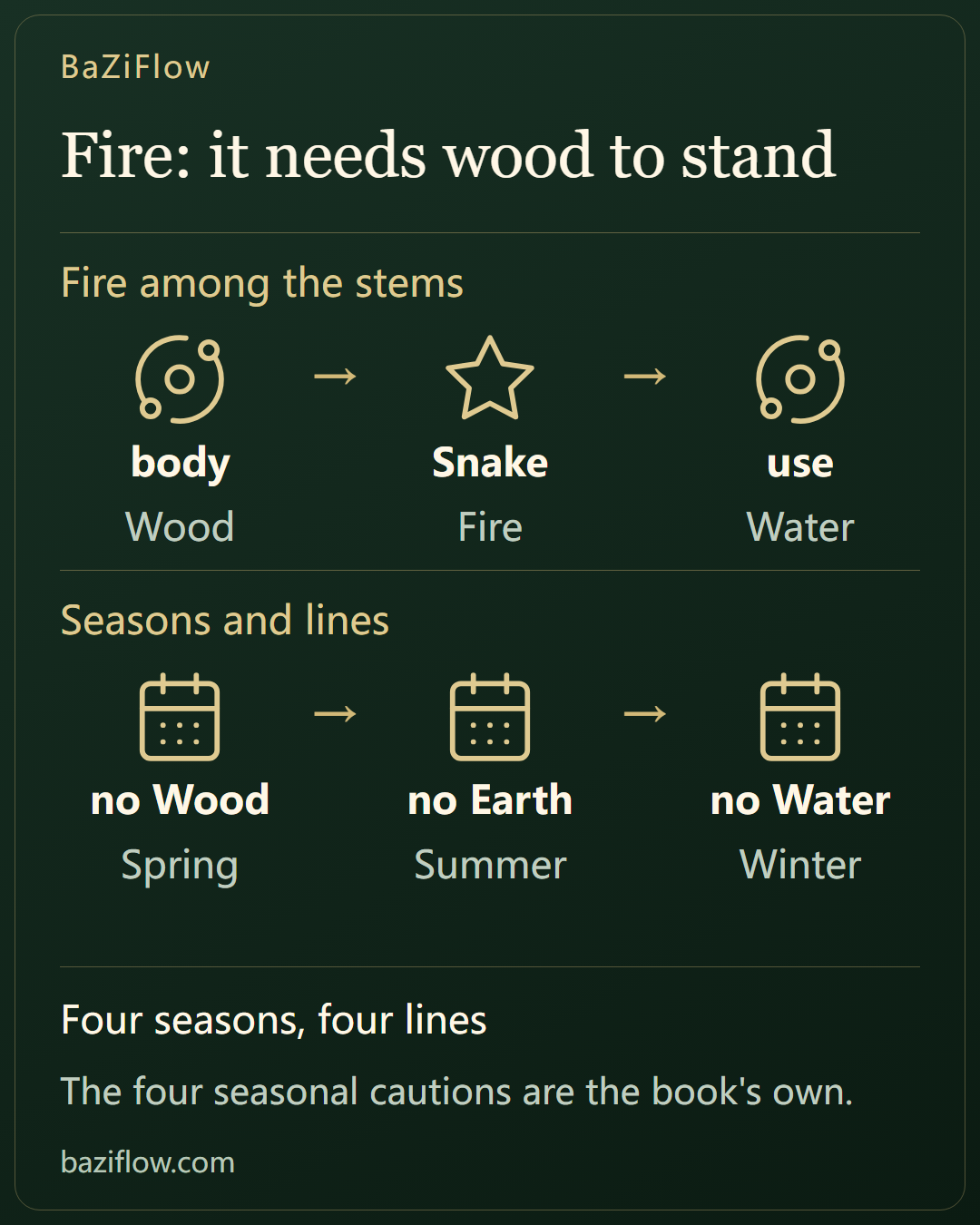
What the Sanming Tonghui says of Fire: "no body of its own", Wood as body and Water as use, one disliked element per season that matches Fire's four lines, Yang against Yin Fire, and the branches that hide Fire.
The short version9 min read
Fire is the element that throws light and heat up and out. The book says it has no form of its own, that Wood is its body and Water its use, and it splits Fire into the sun and the lamp.
- Fire takes the stems Yang Fire and Yin Fire and the branches Snake and Horse; in this site's table it generates Earth and controls Metal, and is generated by Wood and controlled by Water.
- The book says Fire "has no body of its own, its body is Wood", and also that Water is its use: Wood is the body, Water is the condition that makes Fire serviceable.
- In the book each season dislikes one element: spring Wood, summer Earth, autumn Metal, winter Water. In order they are Fire's four lines: generated by, generating, controlling and controlled by.
Read first
Five Elements cycles: learn the relationships, not just the order ↗
Does Fire have a form of its own?
A small question to start: does Fire have a "body" of its own? The Sanming Tonghui (三命通会) by Wan Minying, written in the Ming era, gives a surprising answer: no.
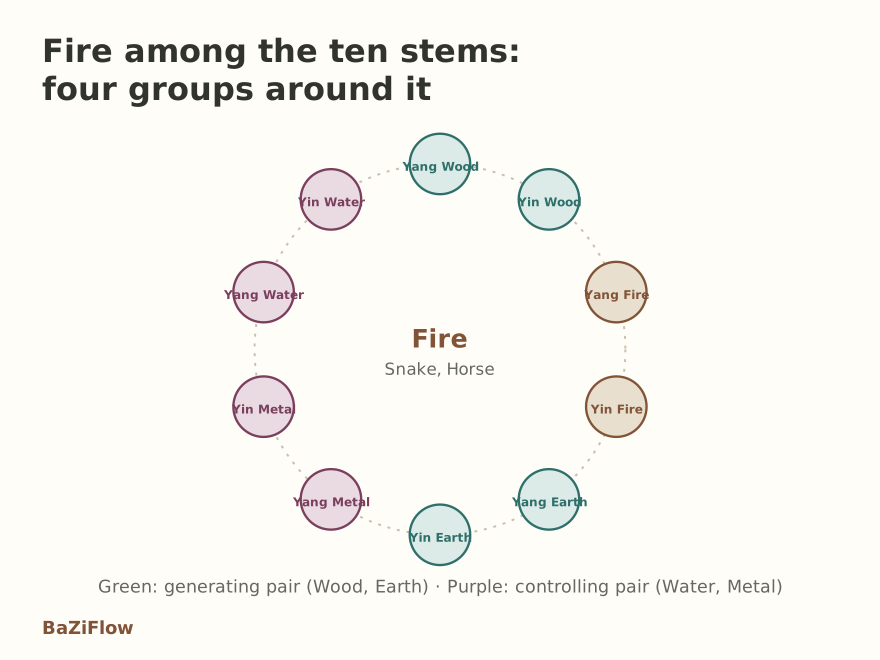
Relation sketch: the ten stems run around a ring and the colors group them by element-level generating and controlling, not by a bond between any two particular stems.
The picture sets the ten stems on a ring with the two Fire stems at the upper right. Green marks the two groups that stand in a generating relation to Fire: the Wood stems that generate it and the Earth stems it generates. Purple marks the two in a controlling relation: the Water stems that control Fire and the Metal stems that Fire controls. Fire takes the Snake (巳) and Horse (午) branches.
Fire rules the south and answers to summer. The word fire means to transform and to blaze: yang above, yin below, blazing up and transforming the ten thousand things. Boring wood makes fire, so Wood is what generates it; yet Fire has no body of its own, its body is Wood. It goes out to meet things and, when spent, goes back in. That is its natural qi.
"Transform" (化) says that Fire makes things change, and "blaze" (燬) that it burns fiercely; "yang above, yin below" pictures the flame. The most interesting part is the second half. Fire has "no body of its own": no fixed form, and its body is Wood. It "goes out to meet things and, when spent, goes back in". Fire reads less like a thing and more like a phenomenon that cannot be separated from Wood. The book also puts it in the south and in summer, with the number two (seven once it is complete) and the color red, a traditional filing system that gives the word "Fire" its address.
Wood is the body, Water is the use
The chapter "On the Five Elements" goes on to separate the "body" of Fire from its "use":
Fire takes Wood as its body: without Wood the flame does not last. Fire takes Water as its use: without Water it is too fierce. So too much Fire is hollow, and too fierce a Fire harms things.
"Body" is what Fire stands on: with no Wood the flame cannot burn long. "Use" is what makes Fire useful: with no Water to restrain it, Fire turns so fierce that it harms other things. The same Water is both the element that controls Fire and what the book calls Fire's "use"; restraint here is the condition that makes Fire serviceable. "Hollow" roughly means floaty and unsteady: Fire that is merely large cannot hold. The book also gives Fire an overall momentum: "Fire is the great yang, its nature is to flame upward".
Enlarge diagram · scroll sideways to read
The line "Wood generates Fire" was read from Wood's side in the article on Wood; here the same line is read from Fire's side.
Each season avoids one element, and the four match Fire's four lines
When the Sanming Tonghui turns to Fire in each season, it names one element to avoid:
Enlarge diagram · scroll sideways to read
Put the four "avoids" back on Fire's four lines and they neither repeat nor leave a gap. Spring avoids Wood: too much Wood on the line that generates Fire. Summer avoids Earth: too much Earth on the line where Fire generates. Autumn avoids Metal: Metal so strong that Fire cannot overcome it, on the line where Fire controls. Winter avoids Water: Water too strong on the line that controls Fire. Each season takes one line. The book also says what Fire wants in each season: in spring brightness without blaze, in autumn hiding without shine, in winter being born without being killed. There is no matching sentence for summer.
Yang Fire is the sun, Yin Fire is the lamp
In the passage on the life and death of the ten stems, the book splits Fire in two. Yang Fire (丙) is "in the sky the sun and lightning, on the earth the furnace and the forge", called yang or hard fire, which "likes dead wood to give birth to its flame"; the dead wood is Yang Wood cut as timber. Yin Fire (丁) is "in the sky the ranked stars, on the earth the lamp", called yin or living fire, and it depends on Yin Wood: the book compares it to vegetable or sesame oil in a lamp, and the oil is the grease of Yin Wood.
Enlarge diagram · scroll sideways to read
The lower rows are the interesting ones. Yang Fire has Growth at the Tiger and Death at the Rooster, and the book quotes a classic saying that "Fire does not face west"; Yin Fire has Growth at the Rooster and Death at the Tiger, and the book quotes "when Fire is bright it goes out". Yang Fire's Establishment is the Snake and its Peak the Horse, and Yin Fire is exactly the reverse: the two Fire branches change places between the two stems. To walk through the whole table of twelve stages, read the twelve stages and the void branches.
Strong Fire, weak Fire, and too much Metal
The book quotes Xu Dasheng, who writes the strength and weakness of Fire as conditional sentences, and adds a line for the case of too much Metal:
Enlarge diagram · scroll sideways to read
Set this beside "Water as its use" and the role of Water changes with the strength of Fire: when Fire is in measure, Water is the "use" that makes it serviceable; when Fire is too weak, the same Water means, in the book's words, being put out. So whether a line works comes down to how much sits at either end. For Fire that is too strong, the remedy the book names is Earth, which drains its flame.
From Snake and Horse to the furnace store: five branches with Fire
This site's table assigns Fire the Snake (巳) and Horse (午) branches. The book says of the Snake that it is "early summer, its fire grows brighter, the limit of six yang lines", and of the Horse that "blazing fire is just rising". In the hidden-stem table used here, the Tiger and the Snake carry Yang Fire, while the Horse, the Goat and the Dog carry Yin Fire.
Enlarge diagram · scroll sideways to read
Note the Dog. The book calls it "the storehouse of the great furnace", where blunt iron and stubborn metal are forged. Yet in this site's twelve-stage table the Dog is Storage for Yang Fire. The hidden-stem table asks "which stems are stored in the Dog"; the twelve-stage table asks "what stage is Yang Fire in when it lands on the Dog". Each answers its own question and neither replaces the other. For what each layer answers, read how hidden stems unfold.
Check yourself
Two small questions
What does the book say Fire avoids in summer, and which of its lines is that?
Summer avoids Earth, which dims the fire. Earth is the element Fire generates, so this is the line "Fire generates Earth": with too much Earth, Fire is covered over.
The Dog hides which stem of Fire, and what stage is the Dog for Yang Fire?
The Dog hides Yang Earth, Yin Metal and Yin Fire, so Yin Fire is the Fire; and in the twelve-stage table the Dog is Storage for Yang Fire. One looks up hidden stems and the other a stage.
The element after Fire is Earth; how seasons change the strength of an element is in month command and element strength.
Questions readers ask next
Water controls Fire, so why does the book call Water the "use" of Fire?
Control names a direction and is not wholly bad. The same passage says that without Water, Fire is too fierce and harms what it touches; Water is the restraint that makes Fire serviceable. Yet for a weak Fire the book says meeting Water means being put out, so it matters how much stands at each end.
Why does Yin Fire rely on Yin Wood rather than Yang Wood?
The book calls Yin Fire living, soft fire that rejoices in Yin Wood to be born, "yin producing yin", and compares it to a lamp burning rapeseed or sesame oil: the oil is the grease of Yin Wood. Yang Fire is the reverse: it "rejoices in dead wood to raise its flame", and that dead wood is Yang Wood cut as timber. Both are Wood generating Fire, but the book gives the two Fires two different Woods.
Is Fire in summer always too strong in the book's eyes?
The book says summer Fire "holds power and wields authority", since it is in season, but adds at once that meeting the restraint of Water spares it the fault of burning itself out. The season sets the background; whether Fire is actually too strong depends on how much Water, Wood and Earth stand around it.
Was this article helpful?
Sources & references
Continue reading
Wood (木): From "Touching Off" to Yang and Yin Wood, Tiger and Rabbit ↗
Earth (土): The Center That Holds Four Branches, with Yang Earth and Yin Earth ↗
Missing element in BaZi: does it need a remedy? Four questions after a zero ↗